The most interesting facts about Antigua and Barbuda, from pink-sand beaches to a mountain renamed in honor of President Obama.

Fast facts
Official name: Antigua and Barbuda
Population: 101,922
Area: 443 sq km
Capital city: Saint John’s
Major languages: English, Antiguan creole
Major religions: Christianity
Time zone: UTC-4 (Atlantic Time Zone)
Interesting facts about Antigua and Barbuda
1. Antigua and Barbuda is an island nation located in the West Indies of the Caribbean, consisting of two main islands – Antigua and Barbuda – as well as the small uninhabited island of Redonda and several even smaller islands.
2. Antigua is home to approximately 97% of the population. Nearly all of Barbuda’s population live in the settlement of Codrington.

3. In 1493, Christopher Columbus became the first European to visit Antigua, naming it after the Church of Santa Maria de la Antigua in Seville, Spain.
4. Antigua and Barbuda became independent in 1981 after centuries of British rule, who first colonised Antigua in 1632.
5. The flag of Antigua and Barbuda has red triangles at the ends with a central triangular area of white, blue and black stripes, and a sun. The blue, white and gold colors together represent the country’s natural beauty. The V-shape stands for “Victory at last!”
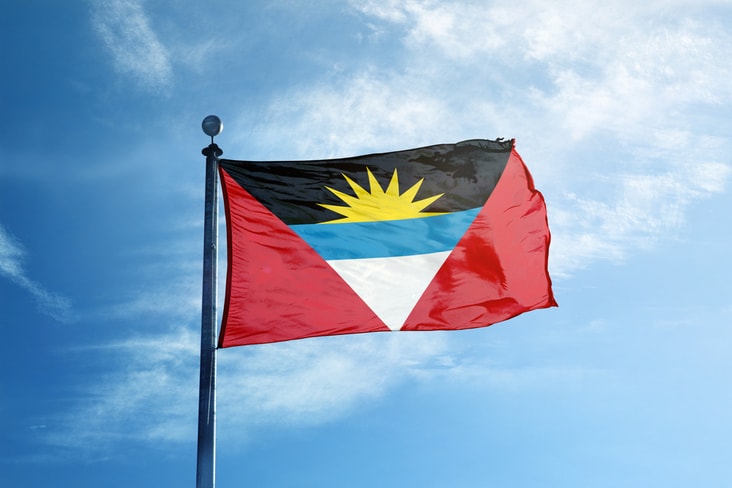
See how Antigua and Barbuda’s flag compares to other Caribbean flags.
6. In 2009, Antigua renamed its highest mountain, Boggy Peak, to Mt Obama. The 402m (1,319ft) peak was renamed in honor of US President Obama on August 4th, his birthday. Despite the change, it is still referred to by its original name.
7. Legendary West Indian cricketer Sir Viv Richards is from Antigua and Barbuda. Richards is widely considered one of the world’s greatest batsmen and even has a stadium named after him in Antigua.
8. The Antigua Carnival begins in late July and culminates on the first Monday or Tuesday in August. The free-spirited event celebrates the abolition of slavery on 1st August 1834 and features parades, music, dancing and colorful costumes.

9. Codrington Lagoon National Park in Barbuda has one of the world’s largest colonies of frigate birds – and the largest in the western hemisphere – with over 2,500 birds roosting there.
10. In 2017, Barbuda was struck by Hurricane Irma with winds of up to 185mph (666kmph) winds damaging an estimated 90% of properties on the island.
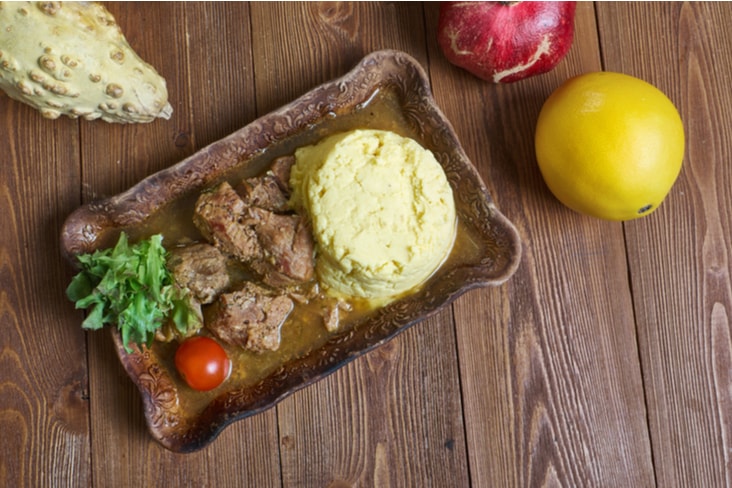
11. Antigua’s national dish is fungee and pepperpot, a hearty stew of meat and vegetables often served with fungi (fungee), which are cornmeal patties or dumplings.
12. Antigua faces water scarcity due to the absence of rivers and limited springs, leading to periodic droughts despite an average annual rainfall of approximately 1,000 mm (40 inches).
13. Antigua and Barbuda is one of the Caribbean’s most prosperous countries, relying heavily on its tourism industry and offshore financial services.
14. With a Human Development Index (HDI) of 0.851 in 2025, Antigua and Barbuda ranks 53rd out of 193 countries worldwide, making it the most developed independent nation in the Caribbean.
15. Antigua and Barbuda has one UNESCO World Heritage Site, the Antigua Naval Dockyard and Related Archaeological Sites. The site, built by enslaved Africans in the 18th century, consists of a group of Georgian-style naval defensive buildings and structures.

16. Slavery, established to run the sugar plantations on Antigua, has played a major role in the country’s history with thousands of slaves transported from Africa to work on tobacco and then sugarcane plantations before the practice was abolished in 1834.
17. Unique among the West Indies, Antigua emancipated all its slaves at the first opportunity in 1834. The island’s entire plantation workforce of 32,000 was freed at midnight on August 1st, 1834 – the earliest date mandated by Britain’s act of emancipation.
18. Antigua and Barbuda is home to the world’s rarest snake. The critically endangered Antiguan racer snake can only be found only on Bird Island off the coast of Antigua.
19. Barbuda is Spanish for “bearded” which likely refers to either the beards of the indigenous people or to the island’s bearded fig trees.
20. The uninhabited island of Redonda in Antigua and Barbuda had become stripped of its flora and fauna by invasive rats and feral goats. But, in 2016, conservation work began rounding up the goats and poisoning the rats. The island has now rebounded and is rich in vegetation and teeming with birdlife.

21. Barbuda is famous for its pink-hued sandy beaches, caused by the presence of a microscopic organism that has a reddish-pink shell in the sand.
22. Antigua and Barbuda supposedly has 365 beaches – one for every day of the year.
23. Previously known as Coco Point Beach, there is a beach called Princess Diana Beach in Antigua and Barbuda. The exclusive beach was renamed in honor of what would have been her 50th birthday in 2011.

24. At just 443 sq km (171 sq mi), Antigua and Barbuda is one of the world’s smallest countries by area.
Explore more from Caribbean
We strive to verify all facts using authoritative and primary sources where possible. However, if you find an error or have any questions, please contact us.

Caitriona Maria is an education writer and owner of The Facts Institute. With seven years of teaching experience and a background in educational content, she specialises in creating clear reference resources about countries, geography and global topics.