The most interesting facts about Turkmenistan, from a president nicknamed “The Turkmenator” to an old fire pit burning for more than 50 years.
Fast facts
Official name: Turkmenistan
Capital city: Ashgabat
Population: 7,241,000
Area: 491,210 sq km
Major languages: Turkmen, Russian, Uzbek
Time zone: UTC+5 (Turkmenistan Time)
Interesting facts about Turkmenistan
1. Turkmenistan is a landlocked country in Central Asia. Landlocked countries are completely surrounded by land and do not have access to the open sea.
2. The historic Silk Road, the ancient trading route that connected China with Europe and the Middle East, runs through Turkmenistan.
3. The UNESCO-listed State Historical and Cultural Park “Ancient Merv” in Turkmenistan is the oldest and best-preserved of the oasis-cities along the Silk Route in Central Asia. The ancient city spans 4,000 years of human history.

4. Despite being landlocked, Turkmenistan is bounded to the west by the Caspian Sea – the world’s largest inland body of water. At 386,400 sq km, it is larger than the area of Japan.
5. Turkmenistan is famous for its traditional carpets. Turkmen carpets are known for their “dense texture ornamented with characteristic colored patterns pertaining to one of the five main Turkmen tribes”. There is even an annual celebration of Carpet Day.
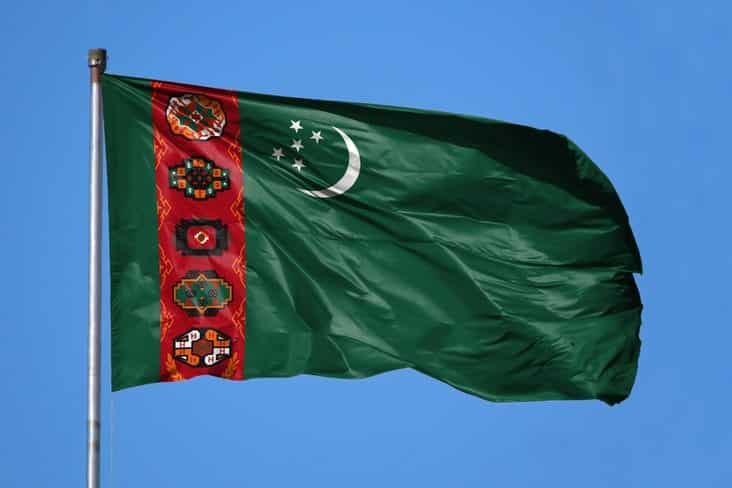
6. The flag of Turkmenistan features a green background and a white crescent, both traditional symbols associated with Islam. The five stars represent the country’s five administrative regions: Ahal, Balkan, Daşoguz, Lebap, and Mary. Along the hoist side is a vertical red stripe displaying five traditional carpet motifs that represent major Turkmen tribes and the country’s famous carpet-weaving heritage.
See how Turkmenistan’s flag compares to other Asian flags.
7. From 1881, Turkmenistan was ruled by Russia. In 1921 it became part of the USSR initially as the Turkestan Autonomous Soviet Socialist Republic (ASSR) before becoming a fully-fledged constituent republic of the USSR in 1925.
8. In 1991, as the Soviet Union was collapsing, the Turkmen Republic declared independence and adopted the name Turkmenistan.
9. Turkmenistan means “place of the Turkmen (people)”. The suffix “-stan” means “place of” or “country”.
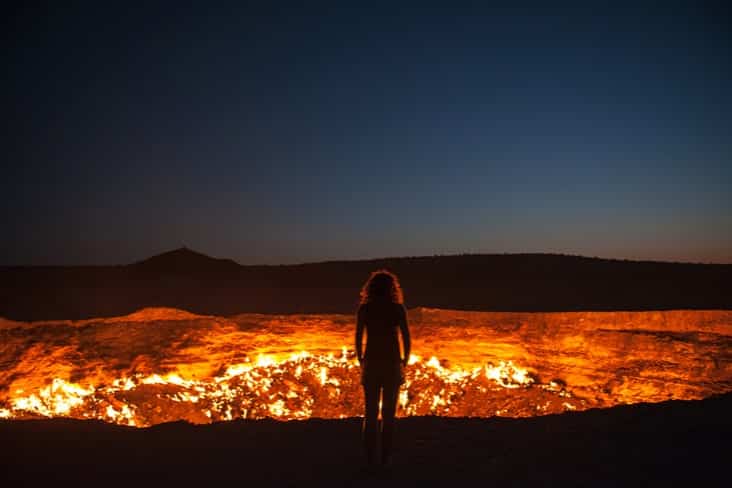
10. Known as the “Door to Hell“, Darvaza is a fire pit in Turkmenistan that has been burning for over 50 years. Following a mining accident in 1971, the gas crater opened up and began venting gas, killing local wildlife. Scientists believed that lighting the gas would cause it to burn out in a few weeks, but it continues to burn to this day.

11. In 2014, adventurer George Kourounis became the first person to enter the “Door to Hell” and reach the bottom of the pit.
12. In 1948, one of the world’s deadliest earthquakes struck Turkmenistan. Between 68 000 and 120 000 people died when a 7.3 magnitude earthquake rocked Ashgabat and the surrounding region.
13. Around 70% of Turkmenistan is made up of the Karakum Desert.
14. Consequently, Turkmenistan ranks among Asia’s least densely populated countries, with around 16 people per square kilometer.
15. Turkmenistan has a number of unusual world records which include the highest density of white marble-clad buildings, the largest aquatics sports park, the largest indoor Ferris Wheel, the largest architectural star and the most fountain pools in a public place.

16. There is a national holiday in Turkmenistan for melons. Celebrated on the second Sunday in August, the day honors the country’s muskmelon, a close relative of the watermelon.
17. Turkmenistan has been described by Human Rights Watch as one of the “world’s most repressive and closed countries, where the president and his associates have total control over all aspects of public life.”
18. Turkmenistan has the seventh-worst freedom of press record in the world.
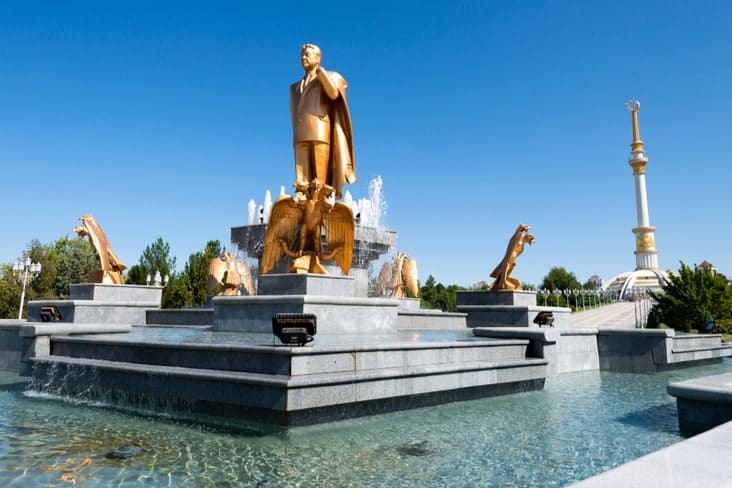
19. Saparmurat Niyazov led Turkmenistan from 1985 and then became the country’s first president in 1991 until his death in 2006. Niyazov assumed the name ‘Turkmenbashi’ (‘father of the Turkmen’), had thousands of statues built in his honor, and even renamed the months of January after himself and April after his mother.
20. Niyazov also implemented a number of bizarre laws including banning opera, ballet, listening to car radios as well as outlawing young men growing beards and long hair.
21. Niyazov even wrote a book called Ruhnama (The Book of the Soul). The book was a spiritual and moral guide, and it had to be displayed alongside the Islamic holy book of the Quran in schools.

22. Kurbanguly Berdymukhamedov has ruled Turkmenistan since 2007 in a similar fashion and is also known for his bizarre PR stunts and strongman image. These stunts include an exercise video, a firing range visit and ordering banks to fund a pet project. He’s been nicknamed “The Turkmenator”.
23. Turkmenistan has the world’s fifth-largest proven natural gas reserves, with 80 billion cubic meters of natural gas produced in 2022.
24. Turkmenistan has the lowest smoking rate in Asia, with just 4.8% of people aged 15 and over smoking daily.
25. Turkmenistan holds the status of permanent neutrality, which “reflects the country’s strong commitment to international peace and security”. It celebrates the status every year on the national holiday, Day of Neutrality.
Explore more from Asia
We strive to verify all facts using authoritative and primary sources where possible. However, if you find an error or have any questions, please contact us.

Caitriona Maria is an education writer and owner of The Facts Institute. With seven years of teaching experience and a background in educational content, she specialises in creating clear reference resources about countries, geography and global topics.