The most interesting facts about Uzbekistan, from one of the planet’s worst environmental disasters to the crossroad of the world’s cultures.

Fast facts
Official name: Republic of Uzbekistan
Capital city: Tashkent
Population: 36,520,593
Area: 447,400 sq km
Major languages: Uzbek, Russian, Tajik
Time zone: UTC+5 (Uzbekistan Standard Time)
Interesting facts about Uzbekistan
1. Uzbekistan is a double-landlocked country in Asia. A double-landlocked country is surrounded solely by landlocked nations, necessitating the crossing of at least two national borders to reach a coastline. Uzbekistan is also one of just two doubly landlocked countries, Liechtenstein being the second.
2. The country was at the heart of the historic Silk Road, the ancient trading route or “superhighway” that connected China with Europe and the Middle East.
3. The historic city and UNESCO World Heritage Site of Samarkand is known as a crossroad and melting pot of the world’s cultures, with a history of over 2,500 years going back to 1500 BC. It is most famous site is the Registan Mosque: a central square flanked by ornately tiled, mosaic-clad madrassas (historic Islamic schools).

4. Uzbekistan’s Silk Road sites include four of the country’s five UNESCO World Heritage Sites: Samarkand, Shakhrisyabz, Bukhara and Itchan Kala. The fifth is the Tien-Shan mountains.
5. During the 7th and 8th centuries, Arabs conquered Uzbekistan and converted its population to Islam.
6. Uzbekistan is a combination of the Turkic words “uz” (self) and “bek” (master) and the Persian suffix “-stan” (country). This essentially translates as the “Land of the Free”.
7. Uzbekistan’s flag is striped blue, white and green with red narrow margins between the stripes. The white stripe symbolizes peace in Uzbek culture, reflected in the Uzbek expression “ok yul!”, meaning “go in peace.”
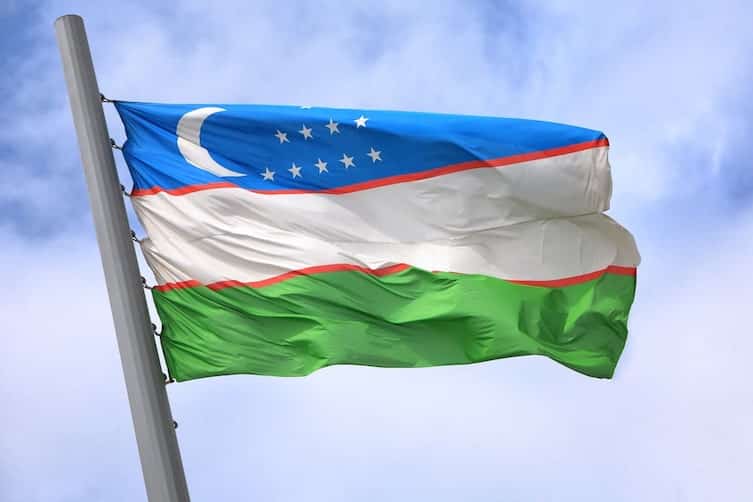
See how Uzbekistan’s flag compares to other Asian flags.
8. In 1966, a 7.5 magnitude earthquake flattened the capital city of Tashkent, leaving hundreds of thousands of people homeless.
9. Every year, around one million students, doctors and government employees are forced to work in Uzbekistan’s cotton fields to pick cotton for the government. This practice persisted until 2021 when forced labor and systemic child labor were finally ended.
10. Cotton in Uzbekistan is known as “white gold”. Cotton accounts for around 8.26% of the country’s exports.
11. The Aral Sea, located on the border of Uzbekistan, Kazakhstan and Turkmenistan, was once the world’s fourth-largest lake. Since the construction of a Soviet irrigation project in the 1960s, the lake has almost disappeared. It has been described as ‘one of the planet’s worst environmental disasters’.

12. Uzbekistan is home to one of the world’s largest open-pit gold mines. The Muruntau Gold Mine in the Qizilqum Desert is the world’s largest open-pit gold mine and it has the second-highest level of annual production at 66 tonnes. The pit is around 3.35km by 2.5km and at least 560m deep.
13. Uzbekistan has the world’s 10th largest mine reserves of gold and is the world’s 12th largest gold producer. Gold accounted for around 30.7% of the country’s exports in 2022.
14. The air in Tashkent is among the most polluted on Earth. Ambient PM₂.₅ concentrations peak during the winter months, and the city’s annual average is more than six times higher than the WHO’s recommended limit of 5 µg/m³.
15. In Uzbekistan, at the end of a shared meal, it is common etiquette to run your hands over your face in the amin gesture to signify thanks.
16. There is a formal etiquette for pouring tea in Uzbekistan. First, it is customary to rinse out your piala (a small tea bowl) with a drop of hot tea, then return a bowlful to the pot twice before the tea is finally considered fit to drink.

17. At the 2016 Rio Olympics, Uzbekistan topped the boxing medal table, winning three gold, two silver, and two bronze medals.
18. Uzbekistan is the most populated country in Central Asia.
19. The national dish of Uzbekistan is plov, a Central Asian pilaf consisting of rice, onions, and fried vegetables, topped with lamb or beef, and typically enjoyed as a lunchtime favorite.
Explore more from Asia
We strive to verify all facts using authoritative and primary sources where possible. However, if you find an error or have any questions, please contact us.

Caitriona Maria is an education writer and owner of The Facts Institute. With seven years of teaching experience and a background in educational content, she specialises in creating clear reference resources about countries, geography and global topics.