A brief overview of the meaning, history, and key facts about the national flag of Tanzania.
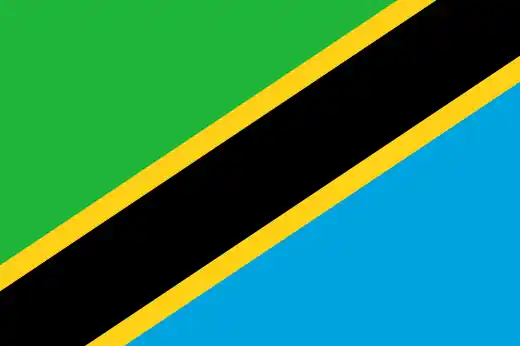
Flag of Tanzania
Adopted in 1964, the national flag of Tanzania consists of a diagonal black band edged in yellow running from the lower hoist corner to the upper fly corner, dividing the flag into a green upper triangle and a blue lower triangle. Green represents the land and agricultural resources of the country, black represents the people of Tanzania, blue represents the surrounding sea and inland waters, and yellow represents the nation’s mineral wealth.
Printable Tanzania Flag (PNG Download)
Interesting facts about Tanzania’s flag
1. The current flag was introduced after Tanganyika and Zanzibar united in April 1964 to form the United Republic of Tanzania.
2. The design combines elements from the flags of the two former states: green and black from Tanganyika and blue from Zanzibar.
3. Tanzania’s flag is one of the relatively few national flags that uses a diagonal band, rather than horizontal or vertical stripes.
Explore more about Tanzania:
Evolution of Tanzania’s flag
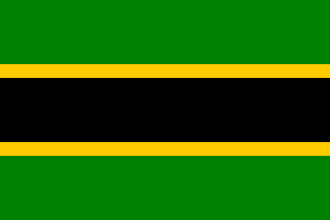
Flag of Tanganyika (1961–1964)
Before the formation of Tanzania, Tanganyika used a flag featuring a green field with a black horizontal band edged in yellow across the center.
Mysid, CC BY-SA 3.0, via Wikimedia Commons
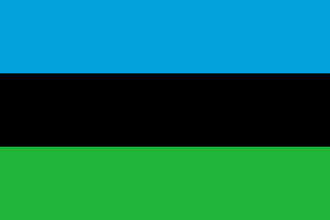
Flag of Zanzibar (1964)
After the Zanzibar Revolution in 1964, the People’s Republic of Zanzibar adopted a flag with three horizontal bands of blue, black, and green.
History of Tanzania’s flag
Tanganyika before independence
Tanganyika was occupied by British forces after Germany’s defeat in the First World War. The territory was later administered by Britain as a League of Nations mandate and, after the Second World War, as a United Nations trust territory.
In 1961 Tanganyika gained independence and adopted a national flag based on the colors of the Tanganyika African National Union (TANU), the political party that led the independence movement.
Zanzibar and the 1964 revolution
Zanzibar had previously been a British protectorate under the rule of a sultan.
In January 1964 the Zanzibar Revolution overthrew the monarchy, and the newly formed People’s Republic of Zanzibar adopted a flag consisting of blue, black, and green horizontal bands.
Formation of Tanzania
In April 1964 Tanganyika and Zanzibar united to form the United Republic of Tanzania.
A new national flag was designed by combining elements of the two previous flags. The green and black colors from Tanganyika were retained, while the blue from Zanzibar was incorporated.

Caitriona Maria is an education writer and owner of The Facts Institute. With seven years of teaching experience and a background in educational content, she specialises in creating clear reference resources about countries, geography and global topics.