The most interesting facts about Laos, from a tragic history, one of the world’s last communist states and a collection of over 2,100 stone jars.

Fast facts
Official name: Lao People’s Democratic Republic
Capital city: Vientiane
Population: 7,953,556
Area: 236,800 sq km
Major languages: Lao, French, English
Time zone: UTC+7 (Indochina Time)
Interesting facts about Laos
1. Laos is a landlocked country in Southeast Asia. A landlocked country is surrounded by land and does not have access to the open sea.
2. The Mekong River runs through Laos. At 4,350km, it is the longest river in Southeast Asia, the 7th longest in Asia, and the 12th longest in the world.

3. Despite being landlocked, Laos is home to an area where the Mekong River spreads to a 14km-wide network of streams creating an archipelago of islands called Si Phan Don, which translates as Four Thousand Islands.
4. Irrawaddy dolphins (known for their bulging forehead and short beak) used to be widely found in the Mekong River in Laos. Tragically, in 2016, the WWF announced that only three dolphins were left in Laos. The final irrawaddy dolphin died in 2022.
5. In 1893, Laos became a French protectorate. It was briefly occupied by Japan in 1945, then the French resumed control in 1946.
6. In 1954, Laos gained independence from France, although it immediately slipped into a civil war between the monarchy and communist forces.
7. The Laos flag consists of three horizontal stripes of red, blue, and red. The white circle on the Laos flag is often described as a full moon, which Lao sources associate with national unity and harmony. The circular shape is interpreted as a symbol bringing the nation together as one.

See how Laos’ flag compares to other Asian flags.
8. During the Vietnam War from 1964 to 1973, the US carried out unprovoked bombing raids on the neutral country of Laos in an attempt to destroy North Vietnamese sanctuaries and disrupt the supply lines known as the Ho Chi Minh trail. The raid killed 200,000 civilians – one-tenth of the population of Laos.
9. Laos is the most heavily bombed nation in history. It’s estimated that more bombs were dropped on Laos during the Vietnam War than were dropped during the whole of the Second World War. There were 2 million tons of bombs dropped on Laos.
10. Laos is still dealing with millions of unexploded bombs from these attacks. A third of the bombs dropped failed to explode on impact and have since killed or injured 20,000 people – an average of 500 victims a year.
11. Craters from the American airstrikes are often used as fishponds or for irrigating crops in rice fields in Laos.
12. Likewise, there are examples of excavated bomb casings being used in basic structures. The casings are also a form of valuable scrap metal.
13. During the American bombardment of Laos, a system of over 480 caves located sheltered up to 23,000 people. The caves had previously been used by communist forces as shelter.

14. Today, Laos remains one of the world’s few communist states. The only others are China, Cuba, Vietnam and nominally North Korea (although technically its government doesn’t refer to itself as communist).
15. Laos has one of the lowest population densities in Asia, at about 21 people per square kilometer, compared to a continental average of 152.
16. Recently, the country has begun to open up and in 2016, President Barack Obama became the first sitting US president to visit Laos.
17. Roughly 21.2% of all deaths in Laos are linked to air pollution, driven by a mix of household fuel use, agricultural burning, and rapid urban development.
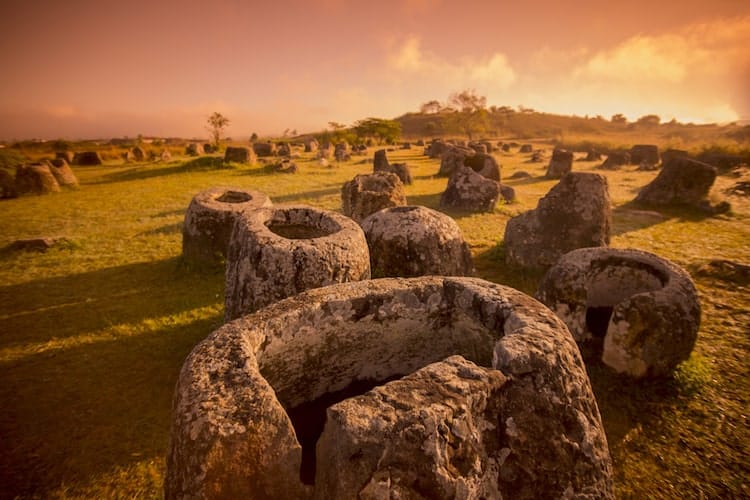
18. The UNESCO World Heritage Site of the Plain of Jars is comprised of over 2,100 tubular-shaped stone jars that were used for funerals during the Iron Age from 500 BC to 500 AD.
19. Buddhism was introduced to Laos in the 13th or early 14th centuries. Around 64.7% of the population is Buddhist.
20. Every Buddhist male in Laos is expected to become a monk for at least a short period in his life. Ideally, this would be just after he finishes school but before he starts a career or marries. During this time they are known as a náirn or novices.
21. Laos has a nationwide curfew where nearly all bars, restaurants and nightclubs are expected to close by midnight. This is more strictly enforced in the UNESCO World Heritage Site town of Luang Prabang.
22. People in Laos greet each other by putting their hands together in a prayer-like manner known as the nop.
23. Laos was once known as Lan Xang which translates as “The Land of a Million Elephants.” Unfortunately, today there are thought to be just 800 elephants remaining, of which half are kept in captivity.
Explore more from Asia
We strive to verify all facts using authoritative and primary sources where possible. However, if you find an error or have any questions, please contact us.

Caitriona Maria is an education writer and owner of The Facts Institute. With seven years of teaching experience and a background in educational content, she specialises in creating clear reference resources about countries, geography and global topics.