A brief overview of the meaning, history, and key facts about the national flag of Slovenia.

Flag of Slovenia
The national flag of Slovenia is a horizontal tricolor of white, blue, and red, with the national coat of arms positioned in the upper left corner. The three equal horizontal bands are arranged with white on top, blue in the middle, and red on the bottom. The coat of arms sits in the upper canton, straddling the white and blue stripes.
Printable Slovenia Flag (PNG Download)
Interesting facts about Slovenia’s flag
1. The Slovenian tricolor was first raised in 1848 in Ljubljana by a group of nationally minded students led by the poet and activist Lovro Toman, in response to a German flag that had been raised on Ljubljana Castle.
2. Slovenia’s flag colors come from the medieval coat of arms of the Duchy of Carniola, a historical region that covered much of what is now modern-day Slovenia.
3. The coat of arms is precisely positioned by law, where its center must sit exactly at the point where the white and blue stripes meet, one-quarter of the flag’s length from the left edge.
4. The coat of arms features a shield depicting Mount Triglav, Slovenia’s highest peak, in white against a blue background. Below the mountain are two wavy blue lines representing the Adriatic Sea and local rivers. Above it are three six-pointed golden stars arranged in an inverted triangle, taken from the coat of arms of the Counts of Celje, a prominent Slovenian noble family of the late 14th and early 15th centuries.
5. On the day Slovenia declared independence in June 1991, there were not enough new flags available, so many plain tricolors without the coat of arms were hoisted alongside the official flag.
Explore more about Slovenia:
Evolution of Slovenia’s flag
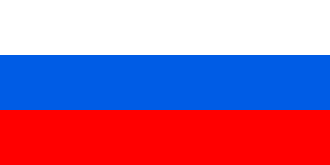
Slovenian tricolor (1848)
A plain horizontal tricolor of white, blue, and red. This simple design was used to represent the Slovenian nation during the 19th and 20th centuries.
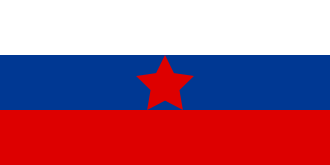
Flag of the Slovene Partisans (1941–1945)
The same white-blue-red tricolor with a red five-pointed star added to the center of the blue stripe. This version was used by the Partisan Resistance Movement during World War II.
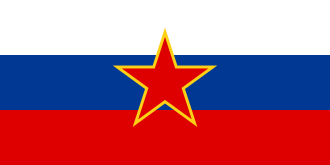
Flag of the Socialist Republic of Slovenia (1945–1991)
The tricolor was retained, but the red star was enlarged and given a yellow border. This version served as the official flag of Slovenia as a constituent republic of socialist Yugoslavia.
History of Slovenia’s flag
19th century origins
The Slovenian tricolor was first raised publicly on 7 April 1848 in Ljubljana during the revolutionary Spring of Nations.
The Austrian government recognized it as the official flag of the Carniola region, making it an exception to the empire’s usual policy of only permitting bicolor flags for its provinces.
Over the following decades, the tricolor grew beyond its regional origins and became a unifying national symbol for all Slovenians.
Yugoslavia and World Wars
When Slovenia became part of the Kingdom of Serbs, Croats and Slovenes after World War I, the tricolor remained an important symbol of Slovenian identity, even as the kingdom adopted its own flag, though it was banned or at best rarely tolerated.
During World War II, both the anti-fascist partisans and the Home Guard used variations of the flag.
After the war, a red star was placed at the center of the tricolor to reflect Slovenia’s status as a socialist republic within Yugoslavia.
Independence
Slovenia declared independence from Yugoslavia on 26 June 1991.
The red star was removed and replaced with artist Marko Pogačnik’s newly designed coat of arms featuring Mount Triglav, the two wavy lines, and the three stars of the Counts of Celje.
The flag was formally enshrined in law on 20 October 1994.
Explore more: European flags.

Caitriona Maria is an education writer and owner of The Facts Institute. With seven years of teaching experience and a background in educational content, she specialises in creating clear reference resources about countries, geography and global topics.