A brief overview of the meaning, history, and key facts about the national flag of Dominica.

Flag of Dominica
Adopted in 1978, the national flag of Dominica features a dark green field with a triple-colored cross of yellow, black, and white. At the center is a red circular emblem displaying the Sisserou parrot standing on a twig and surrounded by ten green stars. The green background symbolizes the island’s lush forests and natural environment. The cross represents the Trinity and reflects Dominica’s belief in God. The central parrot, Dominica’s national bird, symbolizes the nation’s aspirations and is also featured on the country’s coat of arms.
Printable Dominica Flag (PNG Download)
Interesting facts about Dominica’s flag
1. The national flag of Dominica was designed by Alwin Bully, a Dominican artist, playwright, and cultural leader.
2. The ten green stars surrounding the parrot represent the ten parishes of Dominica, symbolizing equality among the people.
3. The red circular emblem at the center represents Dominica’s commitment to social justice.
4. The Sisserou parrot, also known as the Amazona imperialis, featured on the flag of Dominica, is found only on the island. It is the country’s national bird and is critically endangered, with estimates suggesting that only about 50 mature individuals remained in the wild in 2019.
5. While the triple-colored cross represents the Trinity of God, each stripe also has its own meaning:
- Yellow represents sunshine, the island’s agricultural products such as citrus and bananas, and the Carib and Arawak peoples, the island’s first inhabitants.
- White symbolizes the purity of the island’s rivers and waterfalls and the aspirations of its people.
- Black represents the rich volcanic soil of Dominica as well as the African heritage of its people.
Explore more about Dominica:
Evolution of Dominica’s flag
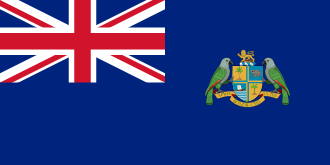
Colonial flag of Dominica
Before independence, Dominica was a British colony and used British colonial flags, including the Blue Ensign with a colonial badge.
Vectored by FOX 52, CC BY-SA 4.0, via Wikimedia Commons
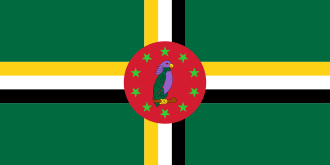
Flag of Dominica (1978–1981)
Dominica adopted its first national flag on 3 November 1978. It featured the Sisserou parrot surrounded by ten stars on a red disk placed on a triple-colored cross.
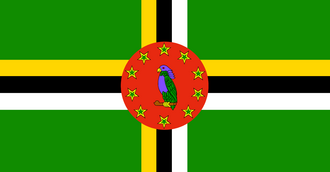
Variant of the flag of Dominica
Some illustrations of the flag use a brighter color based on the original description of “lime green stars.”
Michael Rose Schaengel89, CC BY-SA 3.0, via Wikimedia Commons
History of Dominica’s flag
Colonial period
Before independence, Dominica was part of the British Empire and used British colonial flags such as the Blue Ensign with a colonial badge. These flags represented the island’s status as a British colony.
Independence and adoption of the national flag
Dominica became independent on 3 November 1978. As the country prepared for independence, a competition was held to design a national flag.
The winning design was created by Alwin Bully, a Dominican playwright and artist. The design incorporated national symbols such as the Sisserou parrot, the island’s endemic national bird.
Later modifications
Although the general design has remained the same since independence, several small modifications were made to the flag after its adoption.
In 1981, the order of the black and white bands in the cross was changed and a yellow outline was added to the stars. In 1988, the coloring and posture of the Sisserou parrot were adjusted to better match the real bird.
The most recent change occurred in 1990, when the yellow borders around the stars were removed, creating the version of the flag that is used today.

Caitriona Maria is an education writer and owner of The Facts Institute. With seven years of teaching experience and a background in educational content, she specialises in creating clear reference resources about countries, geography and global topics.