A brief overview of the meaning, history, and key facts about the national flag of Egypt.
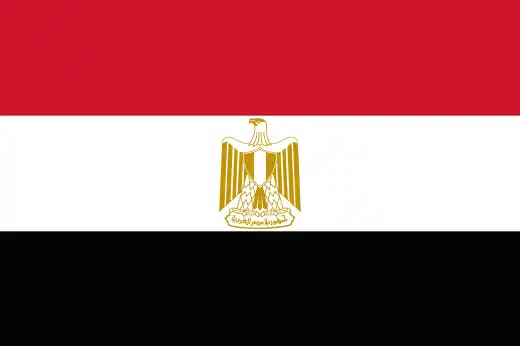
Flag of Egypt
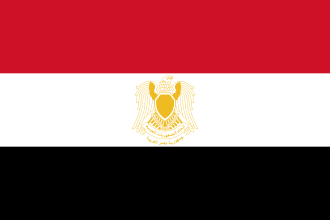
Adopted in 1984, the national flag of Egypt consists of three horizontal bands of red, white, and black with a golden eagle in the center. The red stripe expresses power and hope and also symbolizes the blood of martyrs. The white stripe represents the bright future ahead of the country, while the black stripe recalls the days during which Egyptians fought against oppression and injustice.
Printable Egypt Flag (PNG Download)
Interesting facts about Egypt’s flag
1. The Egyptian tricolor design first appeared after the 1952 Egyptian Revolution, which ended the monarchy and established a republic.
2. The current Egyptian flag was adopted in October 1984, when the golden eagle replaced the previous hawk emblem used during the Federation of Arab Republics period.
3. The eagle in the center is the Eagle of Saladin, a historic symbol connected to the medieval ruler Saladin who governed Egypt and Syria.
4. The Egyptian flag is part of the Arab Liberation flag color scheme of red, white, and black, which later influenced the flags of several other Arab countries.
Explore more about Egypt:
Evolution of Egypt’s flag

Early modern Egyptian flags
During the nineteenth and early twentieth centuries, designs typically featured a red background with white crescents and stars, reflecting Egypt’s political status within the Ottoman system.
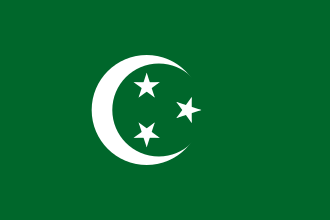
Flag of the Kingdom of Egypt (1923–1952)
After Egypt gained independence from Great Britain in 1922, the new national flag featured a green field with a white crescent and three stars in the center.
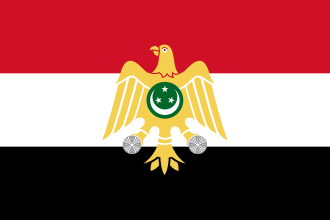
Egyptian Revolution Flag (1952–1958)
Following the 1952 Revolution, Egypt introduced a tricolor flag of red, white, and black horizontal stripes. The design included the Eagle of Saladin in the center.
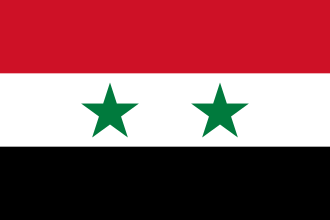
Flag of the United Arab Republic (1958–1971)
When Egypt and Syria united, a new flag was introduced. It retained the red, white, and black tricolor but replaced the eagle with two green stars, representing Egypt and Syria.
Federation of Arab Republics Flag (1972–1984)
In 1972 Egypt joined Syria and Libya in the Federation of Arab Republics. The two stars were replaced by the golden Hawk of Qureish.
History of Egypt’s flag
Early modern Egyptian flags
The development of modern Egyptian flags began during the rule of the Muhammad Ali dynasty, when Egypt was formally part of the Ottoman Empire.
Flags used during this period featured red backgrounds with crescents and stars influenced by Ottoman symbolism.
British protectorate period
In 1914, Egypt was declared a British protectorate during the First World War.
Sultan Hussein Kamel ruled the country, and the flag already in use at the time continued to serve as Egypt’s national flag until the proclamation of the Kingdom of Egypt in 1923.
Kingdom of Egypt flag (1923–1952)
In 1923 a royal decree introduced a new national flag following Egypt’s independence from Britain in 1922.
The design featured a green field with a white crescent and three stars. The stars represented the territories of Egypt, Nubia, and Sudan.
The 1952 Revolution
The Egyptian Revolution of 1952 led by the Free Officers Movement overthrew King Farouk and established a republic.
A new tricolor flag of red, white, and black was introduced to symbolize the revolutionary period and Egypt’s struggle against foreign domination.
Arab nationalist period
In 1958, Egypt united with Syria to form the United Arab Republic, adopting a modified version of the tricolor with two green stars representing the two countries.
Although Syria withdrew from the union in 1961, Egypt continued using the name United Arab Republic until 1971.
Modern Egyptian flag
In 1972 Egypt joined the Federation of Arab Republics with Syria and Libya, introducing a new emblem, the Hawk of Qureish, on the national flag.
In 1984, the hawk was replaced by the Eagle of Saladin, creating the design used by Egypt today.

Caitriona Maria is an education writer and owner of The Facts Institute. With seven years of teaching experience and a background in educational content, she specialises in creating clear reference resources about countries, geography and global topics.