A brief overview of the meaning, history, and key facts about the national flag of South Korea.

Flag of South Korea
The national flag of South Korea, known as the Taegeukgi, consists of a white background with a red and blue Taegeuk symbol in the center and four black trigrams in the corners. The white background reflects the traditional Korean association with purity and peace. The trigrams represent elements of nature: heaven, earth, water, and fire. The design reflects traditional East Asian philosophy and symbolizes balance and harmony in the universe.
Printable South Korea Flag (PNG Download)
Interesting facts about South Korea’s flag
1. The national flag of South Korea is called the Taegeukgi, named after the Taegeuk symbol displayed at the center of the flag.
2. The Taegeuk symbol represents the balance of yin (blue) and yang (red), expressing the idea that opposing forces in the universe exist in harmony.
3. The trigrams on the flag are made of three lines. Solid lines represent yang, while broken lines represent yin, reflecting traditional East Asian philosophy about balance in nature.
4. The Taegeukgi design was first used in 1882, and it was officially proclaimed as the national flag of Korea by royal decree in 1883.
5. After the establishment of the Republic of Korea in 1948, the government standardized the design of the flag in 1949.
Explore more about South Korea:
Evolution of South Korea’s flag
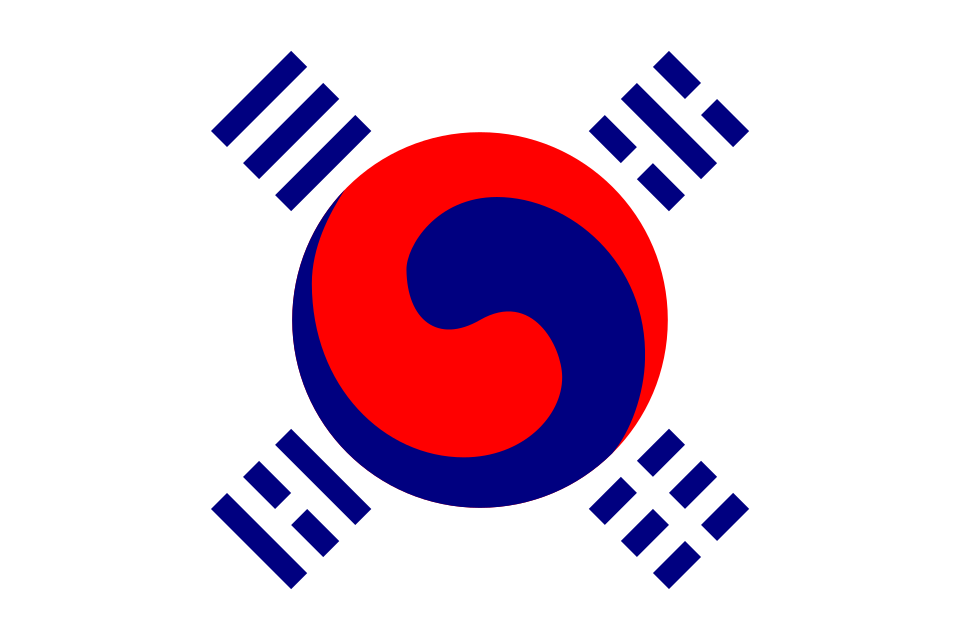
Early Taegeukgi designs (1882–1910)
The first version of the flag featured a red and blue taegeuk symbol in the center with four trigrams on a white background.
Lumia1234, CC BY-SA 4.0, via Wikimedia Commons.
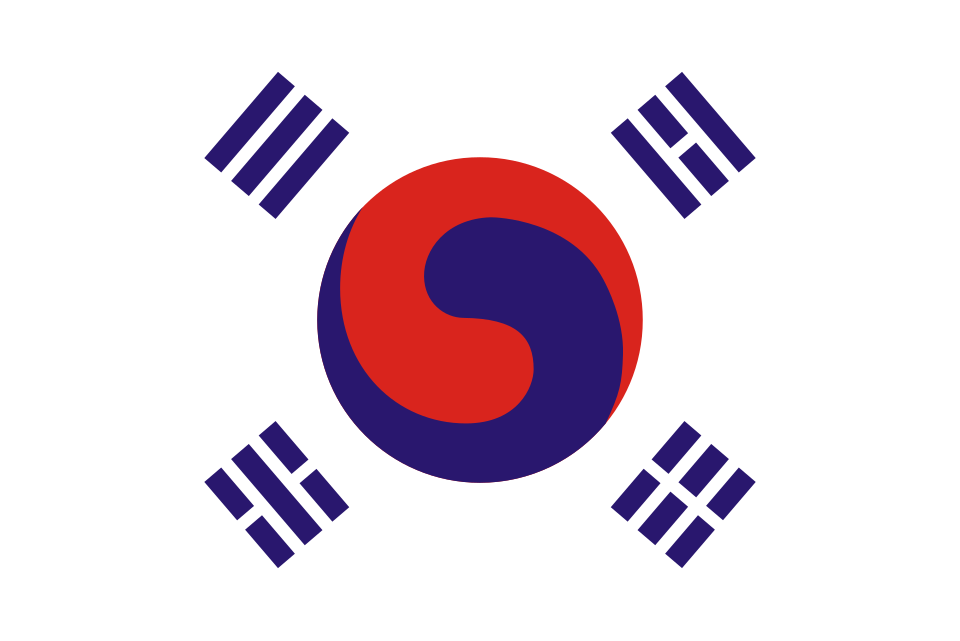
Korean Empire (1897–1910)
Variations of the flag existed during this period because no exact standard for the flag’s construction had yet been defined.
History of South Korea’s flag
Origins of the Taegeukgi
The Taegeukgi was created in the late 19th century when Korea began increasing diplomatic contact with foreign countries and needed a national flag to represent the state internationally.
The first version of the Taegeukgi appeared in 1882 during the Joseon dynasty. The design featured a red and blue taegeuk symbol in the center with four black trigrams on a white background.
King Gojong officially proclaimed the flag as the national flag of Korea in 1883.
Korean Empire
The Taegeukgi continued to be used after Korea became the Korean Empire in 1897.
The empire remained until the Japanese annexation of Korea in 1910.
Japanese colonial period
During Japanese rule, the Taegeukgi was banned as an official national symbol.
However, it continued to be used by Korean independence activists and by the Korean Provisional Government in exile.
After Korea regained independence following World War II, the Taegeukgi was adopted as the national flag of the Republic of Korea (South Korea) in 1948. North Korea adopted a different national flag in the same year.
Modern standardization
Although the basic design remained consistent, the exact specifications of the Taegeukgi were not fully standardized until the mid-20th century.
In 1949, the South Korean government introduced official rules defining how the flag should be constructed, including the placement of the taegeuk and trigrams.

Caitriona Maria is an education writer and owner of The Facts Institute. With seven years of teaching experience and a background in educational content, she specialises in creating clear reference resources about countries, geography and global topics.