The Arab identity is a cultural and historical one, rather than being limited to one single continent or political region. Arab countries are also commonly linked by the Arabic language and membership in the Arab League, an intergovernmental organization created to represent and coordinate cooperation between Arab states.
Traditional Arab genealogies often divided Arabs into northern and southern groups, associated with the ancestors Adnan and Qahtan. Today, however, Arab identity is usually understood more broadly through language, culture, history and shared identity.
There are 22 Arab countries today. These countries are spread across North Africa, Western Asia, the Arabian Peninsula, the Levant, the Horn of Africa and nearby island regions.
Arab countries in alphabetical order
Here is the alphabetical list of Arab country names and their capital cities.
| Country | Capital City | Country Code |
|---|---|---|
| Algeria | Algiers | DZ |
| Bahrain | Manama | BH |
| Comoros | Moroni | KM |
| Djibouti | Djibouti | DJ |
| Egypt | Cairo | EG |
| Iraq | Baghdad | IQ |
| Jordan | Amman | JO |
| Kuwait | Kuwait City | KW |
| Lebanon | Beirut | LB |
| Libya | Tripoli | LY |
| Mauritania | Nouakchott | MR |
| Morocco | Rabat | MA |
| Oman | Muscat | OM |
| Palestine | Ramallah (administrative capital) | PS |
| Qatar | Doha | QA |
| Saudi Arabia | Riyadh | SA |
| Somalia | Mogadishu | SO |
| Sudan | Khartoum | SD |
| Syria | Damascus | SY |
| Tunisia | Tunis | TN |
| United Arab Emirates | Abu Dhabi | AE |
| Yemen | Sana'a | YE |
View their country flags here.
How many Arab countries are there?
The following 22 countries are members of the Arab League and are commonly considered Arab countries:
Algeria, Bahrain, Comoros, Djibouti, Egypt, Iraq, Jordan, Kuwait, Lebanon, Libya, Mauritania, Morocco, Oman, Palestine, Qatar, Saudi Arabia, Somalia, Sudan, Syria, Tunisia, the United Arab Emirates and Yemen.
Where are the Arab countries located?
Arab countries are mainly located in two broad regions: Africa and Asia.
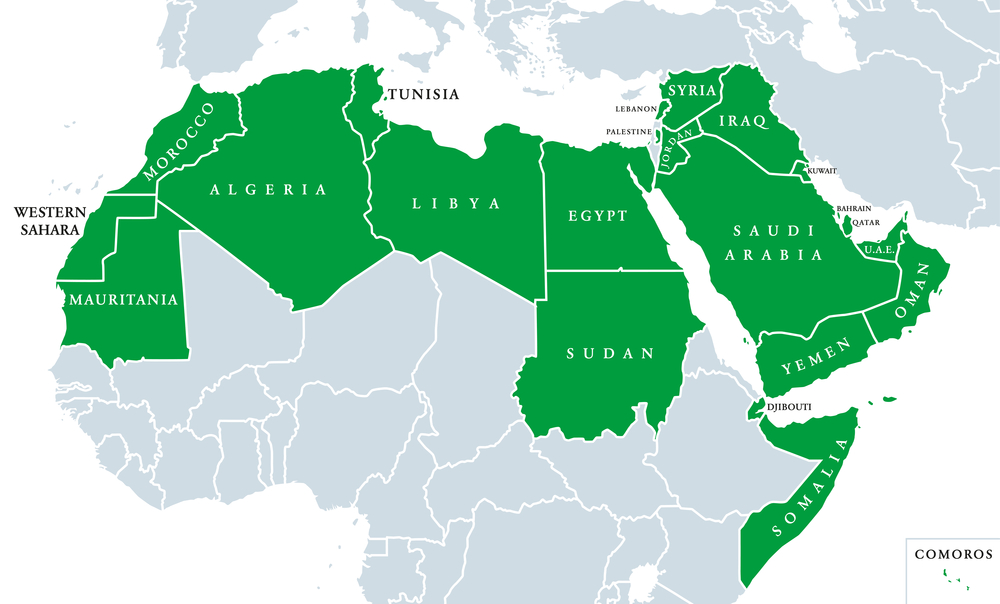
In Africa, Arab countries are found mostly in North Africa, along with parts of the Horn of Africa and nearby island areas.
African Arab countries include:
In Asia, Arab countries are mainly found in Western Asia, including the Arabian Peninsula and the Levant.
Asian Arab countries include:
- Bahrain
- Iraq
- Jordan
- Kuwait
- Lebanon
- Oman
- Palestine
- Qatar
- Saudi Arabia
- Syria
- United Arab Emirates
- Yemen
Arab countries vs Middle Eastern countries
Arab countries and Middle Eastern countries overlap, but they are not the same.
Many Middle Eastern countries are Arab countries, including Bahrain, Iraq, Jordan, Kuwait, Lebanon, Oman, Palestine, Qatar, Saudi Arabia, Syria, the United Arab Emirates and Yemen.
However, some Middle Eastern countries, such as Iran and Israel, are not Arab countries. At the same time, several Arab countries, including Algeria, Libya, Morocco and Tunisia, are located in North Africa rather than the Middle East.
The Arab League
The Arab League, officially known as the League of Arab States (LAS), was founded in Cairo in 1945.
Its purpose is to promote cooperation between Arab countries, support shared interests and coordinate policies between member states.
The original members included Egypt, Iraq, Jordan, Lebanon, Saudi Arabia, Syria and Yemen. Over time, more countries joined, bringing the total to 22 full member states. These are the same 22 countries listed above as Arab countries.
Syria was suspended from the Arab League in 2011 and readmitted in 2023.
Observer states
Some countries have observer status with the Arab League, but they are not full members and are not usually counted among the 22 Arab countries.
Current observer states are commonly listed as Brazil, India, Venezuela, Chad, Eritrea, Armenia and Greece.
Are Arab countries the same as Muslim countries?
No. Arab countries and Muslim countries are not the same thing.
Most Arab countries have Muslim-majority populations, but “Arab” refers mainly to language, culture and shared history rather than religion.
There are also many non-Arab Muslim-majority countries, such as Turkey, Iran, Pakistan, Indonesia and Malaysia.
At the same time, Arab countries are home to religious minorities, including Christian communities and other groups.
Are Arabs a race?
No. Arab identity is not a race.
Arab people can come from many different backgrounds and may have different appearances, skin tones, ethnic roots and religious traditions. The term “Arab” is usually connected to shared language, culture, history and identity rather than race or genetics.
Arab flags
Many Arab flags use the pan-Arab colors of red, white, black and green. Some Arab flags include distinctive national symbols, such as Lebanon’s cedar tree, Saudi Arabia’s Shahada and sword and Egypt’s Eagle of Saladin.
You can learn more in our guide to Arab flags.

Caitriona Maria is an education writer and owner of The Facts Institute. With seven years of teaching experience and a background in educational content, she specialises in creating clear reference resources about countries, geography and global topics.