The most interesting facts about Dominica, from a frog known as the “mountain chicken” to the world’s second-largest boiling lake.

Fast facts
Official name: Commonwealth of Dominica
Capital city: Roseau
Population: 74,661
Area: 751 sq km
Major languages: English, French patois
Major religions: Christianity
Currency: East Caribbean Dollar (XCD)
Time zone: UTC-4 (Atlantic Time Zone)
Fun facts about Dominica
1. Dominica is an island nation located in the eastern Caribbean Sea of North America.
2. The Caribs, who settled in Dominica during the 14th century, called the island Waitikubuli, which means ‘Tall is her Body.’
3. Dominica was named by explorer Christopher Columbus after the day of the week he sighted the island in 1493: Sunday – or Domingo in Latin.

4. Dominica was the last Caribbean island to be colonized by Europeans. This was largely down to the fierce resistance of the native Kalinago people.
5. Today, Dominica is home to the largest indigenous population in the East Caribbean. Around 3,000 Kalinago (once referred to as “Caribs” by colonists) still live in Dominica.
6. Dominica’s mountainous terrain helped provide sanctuary for the Kalinago people during attacks from the early colonists.

7. During the 1600s, Britain and France repeatedly attempted to gain control but eventually agreed to abandon Dominica in 1660.
8. However, in 1763, Britain gained possession of Dominica following the end of the Seven Years’ War.
9. Dominica’s national symbol is the Sisserou parrot, a rare bird indigenous to the island.
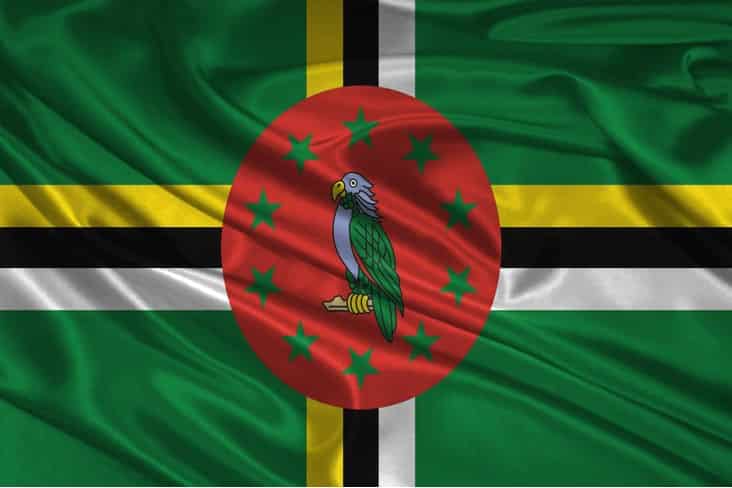
10. Dominica’s flag has a green background representing the island’s forests. In the center is a ring of 10 stars reflecting the parishes of the island. The yellow, white, and black cross represents the Trinity of God, and in the center is a Sisserou parrot.
See how Dominica’s flag compares to other Caribbean flags.
11. In 1838, Dominica became the first and only British colony in the Caribbean to have a black-controlled legislature. However, this was suspended in 1865, and then in 1896, Britain re-established Dominica as a crown colony government.
12. It’s possible to see and even swim with the world’s largest toothed predator, the sperm whale in Dominica.

13. In 1979, Dominica was struck by Hurricane David with winds of 150mph. About 80% of the population were displaced or lost their homes.
14. In 2017, category 5 Hurricane Maria caused severe damage across Dominica. Ninety-five percent of buildings were damaged or destroyed, 99% of the island lost power, and more than 50,000 people were displaced.
15. Dominica is home to nine active volcanoes, although there hasn’t been a major eruption since 1997 and before that in 1880.

16. Dominica is one of just 21 countries that do not have an army.
17. As such, Dominica has the world’s highest concentration of active volcanoes.
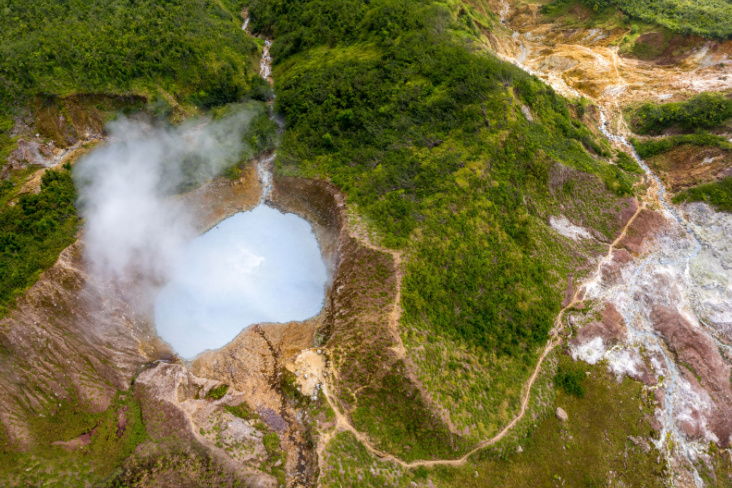
18. The world’s second-largest boiling lake is in Dominica. Discovered in 1875, it is actually a flooded crack in the earth that allows hot gases to vent from the molten lava below.
19. Much of the movie Pirates of the Caribbean: Dead Man’s Chest, starring Johnny Depp, Orlando Bloom and Keira Knightley, was filmed in Dominica.
20. Dominica is home to an endangered species of frog known as the “mountain chicken”. Found only on the islands of Dominica and nearby Montserrat, the frog was a delicacy among islanders as it tasted like chicken. However, the species is now protected after a fungus wiped out nearly 80% of the island’s population in the early 2000s.
21. Two-thirds of Dominica is covered in rainforest.
22. In Dominica, there’s a river for every day of the year – 365 in total.
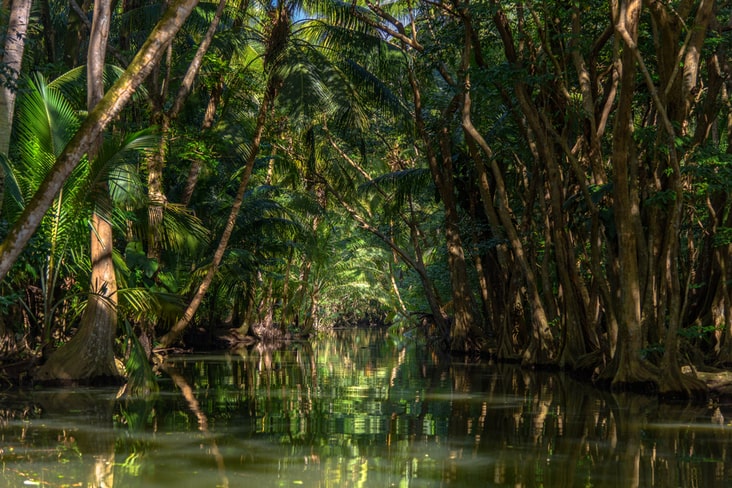
23. In fact, Dominica is known as the “Nature Island” due to its vast array of geographic features such as rivers, waterfalls, mountains, forests and volcanoes.
24. For decades, the Dominican economy was dependent on banana exports. Recently, it has pivoted towards tourism as the government attempts to promote Dominica as an “ecotourism” destination.
25. Dominica is home to the Caribbean’s first long-distance hiking trail. The Waitukubuli National Trail (WNT) is 183km (115 miles) and is divided into 14 segments.
Explore more from North America
We strive to verify all facts using authoritative and primary sources where possible. However, if you find an error or have any questions, please contact us.

Caitriona Maria is an education writer and owner of The Facts Institute. With seven years of teaching experience and a background in educational content, she specialises in creating clear reference resources about countries, geography and global topics.