The European Union is a political and economic union of member states that cooperate on legislation, trade, economic policy, and regional development.
Unlike Europe, which is a geographic continent, EU membership is defined by treaties and political agreements, not location alone.
As a result, EU countries are not the same as European countries, and the two lists should not be confused.
What is the European Union?
The European Union is a unique partnership between several member states, representing approximately 450 million people, or around 5.5% of the world’s population.
EU member states participate in shared decision-making through EU institutions, where national ministers help shape laws and policies that apply across the union.
Many EU countries also share a common currency, the euro, though not all members have adopted it.

How many countries are in the European Union?
There are 27 countries in the European Union.
These countries are:
- Austria
- Belgium
- Bulgaria
- Croatia
- Cyprus
- Czechia (Czech Republic)
- Denmark
- Estonia
- Finland
- France
- Germany
- Greece
- Hungary
- Ireland
- Italy
- Latvia
- Lithuania
- Luxembourg
- Malta
- Netherlands
- Poland
- Portugal
- Romania
- Slovakia
- Slovenia
- Spain
- Sweden
Countries in the European Union (alphabetical list)
The following is a complete alphabetical list of current EU member states, along with their capitals, ISO country codes, and additional geographic details.
🗺️ Looking for a map of all EU countries with their borders? You’ll find it further down the page, or jump straight to the map.
| Country | Country Capital | Country Abbreviation | Region | Continent |
|---|---|---|---|---|
| Austria | Vienna | AT | Central Europe | Europe |
| Belgium | Brussels | BE | Western Europe | Europe |
| Bulgaria | Sofia | BG | Southeastern Europe | Europe |
| Croatia | Zagreb | HR | Southeastern Europe | Europe |
| Cyprus | Nicosia | CY | Western Asia | Asia |
| Czechia (Czech Republic) | Prague | CZ | Central Europe | Europe |
| Denmark | Copenhagen | DK | Northern Europe | Europe |
| Estonia | Tallinn | EE | Eastern Europe | Europe |
| Finland | Helsinki | FI | Northern Europe | Europe |
| France | Paris | FR | Western Europe | Europe |
| Germany | Berlin | DE | Central Europe | Europe |
| Greece | Athens | GR | Southern Europe | Europe |
| Hungary | Budapest | HU | Central Europe | Europe |
| Ireland | Dublin | IE | Northwestern Europe | Europe |
| Italy | Rome | IT | Southern Europe | Europe |
| Latvia | Riga | LV | Eastern Europe | Europe |
| Lithuania | Vilnius | LT | Eastern Europe | Europe |
| Luxembourg | Luxembourg | LU | Western Europe | Europe |
| Malta | Valletta | MT | Southern Europe | Europe |
| Netherlands, The | Amsterdam | NL | Northwestern Europe | Europe |
| Poland | Warsaw | PL | Central Europe | Europe |
| Portugal | Lisbon | PT | Southwestern Europe | Europe |
| Romania | Bucharest | RO | Southeastern Europe | Europe |
| Slovakia | Bratislava | SK | Central Europe | Europe |
| Slovenia | Ljubljana | SI | Central Europe | Europe |
| Spain | Madrid | ES | Southwestern Europe | Europe |
| Sweden | Stockholm | SE | Northern Europe | Europe |
Download: List of the European countries.
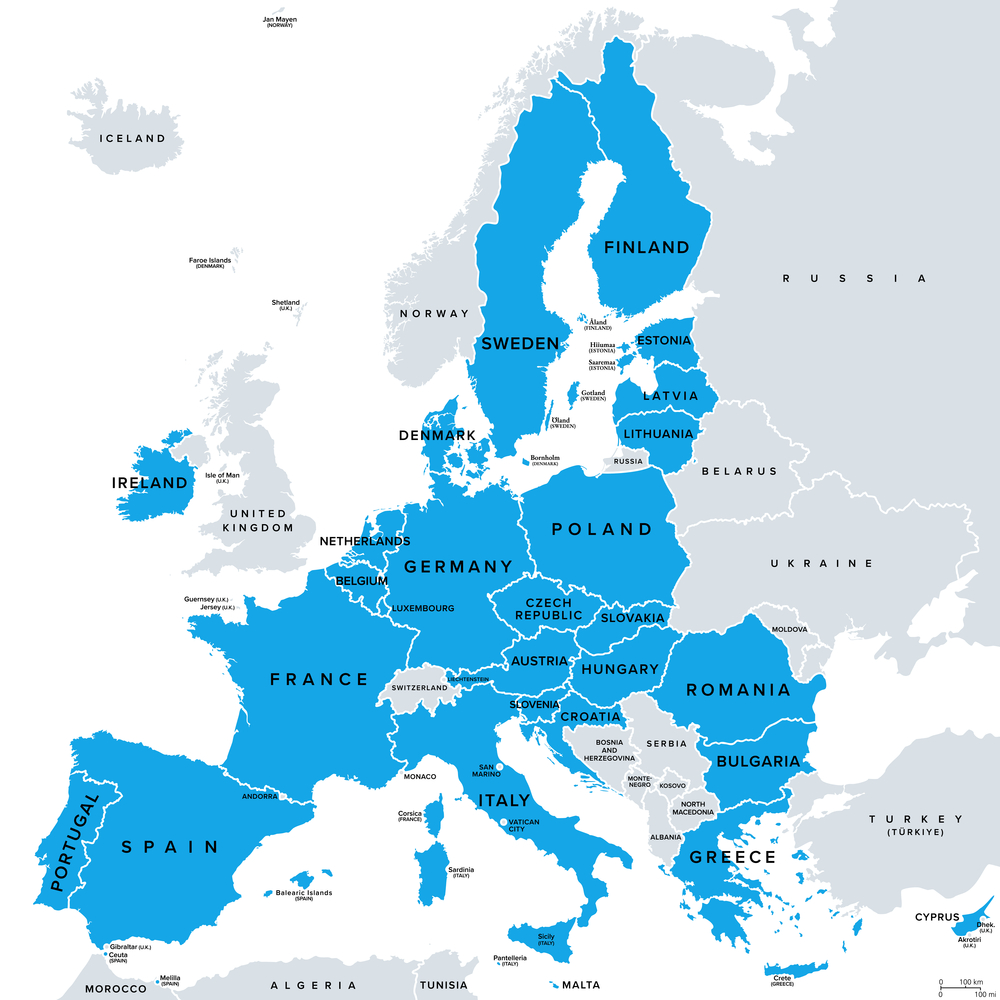
EU map
EU member states are primarily located in Europe, though the union also includes territories outside mainland Europe.
Our printable European maps show the exact locations of each country.
EU countries vs European countries
Not all European countries are members of the EU.
Several well-known European states, including Norway, Switzerland, the United Kingdom, and Ukraine, are located in Europe but are not part of the European Union.
Conversely, Cyprus, while geographically located in Western Asia, is a full EU member state due to political and historical factors.
Are microstates part of the EU?
European microstates such as Vatican City (Holy See), Monaco, San Marino, and Andorra are not members of the European Union.
Although some have special agreements with the EU and may use the euro, they are not EU member states and are excluded from EU country lists and statistics.

Caitriona Maria is an education writer and owner of The Facts Institute. With seven years of teaching experience and a background in educational content, she specialises in creating clear reference resources about countries, geography and global topics.