A brief overview of the meaning, history, and key facts about the national flag of Greece.
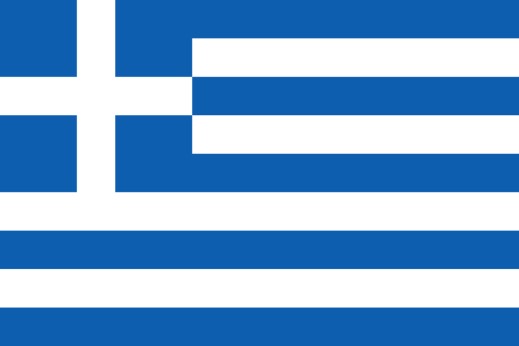
Flag of Greece
The national flag of Greece consists of nine alternating blue and white horizontal stripes with a white cross on a blue canton in the upper hoist corner. The white cross is widely associated with Greek Orthodox Christianity.
Printable Greece Flag (PNG Download)
Interesting facts about Greece’s flag
1. The Greek flag is often referred to as “Galanolefki” (“the blue-and-white”).
2. No official explanation was ever given for the choice of the flag’s colors or the nine stripes, despite many popular theories.
3. A popular tradition claims the nine stripes represent the nine syllables of the Greek independence motto “Eleftheria i Thanatos” (“Freedom or Death”), although this has never been officially confirmed.
4. During different periods of Greek history, crowns were added to and removed from the flag depending on whether Greece was a monarchy or a republic.
5. Greek Flag Day is celebrated on 27 October, the eve of Ohi Day, one of the Greek national holidays.
Evolution of Greece’s flag
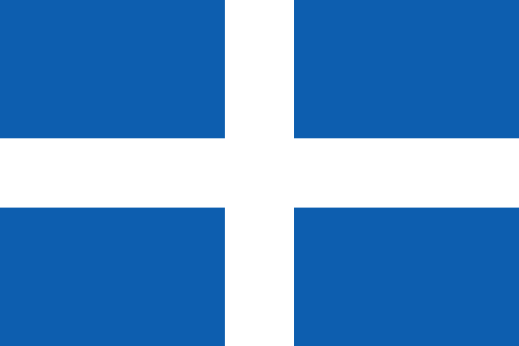
Flag of Greece (1822–1863, 1924–1935, 1975–1978)
A white cross on a blue field. This served as Greece’s principal land flag and national flag during several periods of republican rule.
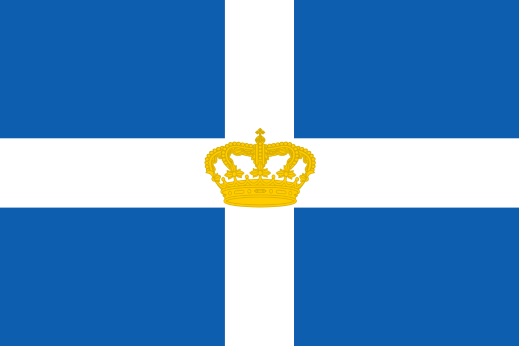
Flag of Greece (1863–1924, 1935–1941, 1944–1969)
The same white cross on a blue field, but with a royal crown added during periods of monarchy.
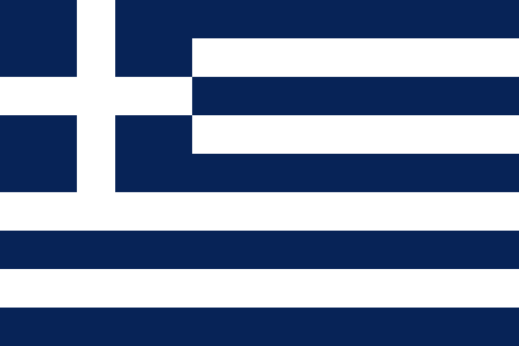
Flag of Greece (1969–1975)
The striped blue-and-white flag with a white cross in the canton became the official national flag during the military junta period.
History of Greece’s flag
Origins during the Greek War of Independence
The origins of the modern Greek flag date to the Greek War of Independence against Ottoman rule, which began in 1821.
During the revolution, different military units used a variety of flags featuring crosses, saints, phoenixes, anchors, and other symbols. The cross appeared prominently on many of these flags as a symbol of Orthodox Christianity.
Establishment of a national flag
In 1822, the First National Assembly of Epidaurus decided that Greece would adopt national flags in blue and white.
Shortly afterward, the Provisional Government established three official designs: a white cross on a blue field as the land flag, a striped blue-and-white flag with a white cross in the canton as the sea flag (the flag in use today), and a blue flag with a white canton containing a blue cross as the civil naval ensign.
Monarchy and constitutional changes
Throughout the nineteenth and twentieth centuries, the flag underwent several modifications reflecting political changes within Greece.
Crowns were added during periods of monarchy, removed during republican periods, restored when the monarchy returned, and removed again under later governments.
Adoption of the modern flag
In 1969, the striped “sea flag” became Greece’s official national flag for the first time.
After the restoration of democracy, Greece briefly returned to the plain cross flag, the “land flag”, in 1975.
In 1978, Law 851 officially established the striped blue-and-white “sea flag” as the sole national flag of Greece, a status it retains today.

Caitriona Maria is an education writer and owner of The Facts Institute. With seven years of teaching experience and a background in educational content, she specialises in creating clear reference resources about countries, geography and global topics.