A brief overview of the meaning, history, and key facts about the national flag of Liberia.

Flag of Liberia
The national flag of Liberia consists of eleven horizontal red and white stripes with a blue square canton in the upper left corner containing a single white five-pointed star. The eleven stripes represent the eleven signatories of Liberia’s Declaration of Independence, while the white star symbolizes Liberia as the first independent republic in Africa. The blue field is often interpreted as representing the African continent.
Printable Liberia Flag (PNG Download)
Interesting facts about Liberia’s flag
1. Liberia’s flag is commonly known as the “Lone Star.” The name refers to the single white star in the blue canton.
2. The flag was designed and sewn by a committee of seven women, led by Susannah Elizabeth Lewis.
3. The Liberian flag design closely resembles the flag of the United States, reflecting Liberia’s historical connection to freed African Americans who helped establish the republic in the nineteenth century.
4. In the commonly accepted interpretation of the colors, red represents valor, white symbolizes purity, and blue stands for fidelity.
5. Liberia celebrates Flag Day on 24 August, commemorating the adoption of the national flag in 1847.
Explore more about Liberia:
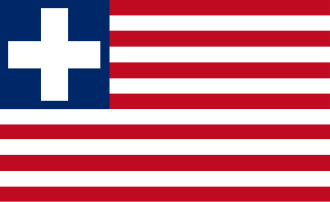
Colonial flag of Liberia (1827–1847)
The territory used a flag similar to that of the United States. However, instead of a field of stars, the canton contained a white cross.
History of Liberia’s flag
Colonial period
Liberia was established in the early nineteenth century as a settlement for freed African Americans supported by the American Colonization Society.
During this period, the colony used a flag similar to that of the United States. The design featured red and white stripes with a blue canton, but instead of multiple stars it displayed a white cross.
Creation of the national flag
In preparation for independence, Liberia’s leaders decided to create a new national flag. Governor Joseph Jenkins Roberts asked Susannah Elizabeth Lewis to lead a committee responsible for designing and sewing the flag.
The committee consisted of seven women, most of whom had been born in the United States and were connected to prominent families in Liberia.
Their design replaced the colonial cross with a single white star, symbolizing the new republic.
Adoption of the flag
The new national flag was officially adopted on 24 August 1847, shortly after Liberia declared independence.
A public ceremony was held in Monrovia, where the flag was unfurled for the first time. Susannah Lewis delivered a patriotic speech during the event, and the ceremony included speeches and musical performances.
Later developments
In 1915, the Liberian government established 24 August as National Flag Day, commemorating the adoption of the flag.
In the 1970s a national commission reviewed Liberia’s state symbols, including the flag, to determine whether changes were needed. The commission ultimately recommended keeping the existing design.
Today the flag remains one of Liberia’s most recognizable national symbols.

Caitriona Maria is an education writer and owner of The Facts Institute. With seven years of teaching experience and a background in educational content, she specialises in creating clear reference resources about countries, geography and global topics.