From a village where men are banned to the cradle of humanity, these are the most interesting facts about Kenya.

Fast facts
Official name: Republic of Kenya
Population: 57.5 million
Area: 580,367 sq km
Capital city: Nairobi
Major languages: Kiswahili (Swahili), English
Major religions: Christianity, Islam
Time zone: UTC+3 (East Africa Time)
Interesting facts about Kenya
1. Kenya is a country located in East Africa bordering five countries: Ethiopia, Somalia, South Sudan, Tanzania and Uganda.
2. Kenya has been described as the “cradle of humanity” and “birthplace of humankind” as evidence of some of the earliest human tools have been found in Kenya from around 3.3 million BC. It is believed that Kenya is where humankind’s descendants moved out to populate the world.
3. The remains of at least seven hominid species have been found in Kenya including the earliest known Homo fossil with an age of 2.3 million years.

4. Kenya is named after Mount Kenya (the country’s highest peak). The meaning of the name is unclear but may derive from the Kikuyu, Embu, and Kamba words “kirinyaga,” “kirenyaa,” and “kiinyaa” – all of which mean “God’s resting place”.
5. Kenya was colonized by Britain first as part of the British East African Protectorate in 1895 and then as a crown colony administered by a British governor from 1920 onwards.
6. The Kenyan flag is made up of horizontal stripes of black, red and green separated by thinner white stripes. In the center is a shield and two crossed spears. The flag’s black, red, and green colors are also associated with pan-African symbolism, which became widely used by independence movements across Africa during the twentieth century.

See how Kenyan’s flag compares to other African flags.
7. Kenya achieved independence from the UK in 1963 following a drawn-out guerrilla war with the British colonizers.
8. The name of the capital city, Nairobi, stems from the Maasai phrase meaning “cool waters” and refers to a cold water stream that flowed through the area during the 19th century.
9. Nairobi was once nicknamed ‘Nairobbery’ by expats living there due to its crime rate and poor safety levels.

10. Just outside the city is Nairobi National Park, home to plentiful wildlife that can be viewed against a backdrop of city skyscrapers and planes coming into land. It’s one of the world’s only national parks in a capital city and also home to the world’s densest concentration of black rhinos (over 50).
11. At 5,199m (17,057ft) Mount Kenya is the second-highest mountain in Africa, after Kilimanjaro in Tanzania.
12. Mount Kenya is a member of the Seven Second Summits, the second-highest mountains on each continent. These mountains are considered harder to climb than the seven summits (the highest peaks on every continent) as there is less mountaineering infrastructure in place and have higher fatality rates and lower success rates.

13. The first African woman to win the Nobel Peace Prize was from Kenya. Wangari Maathai won the 2004 Nobel Peace Prize for “her contribution to sustainable development, democracy and peace.”
14. Kenya has seven UNESCO World Heritage Sites. In Africa, only South Africa (10), Ethiopia (9), Morocco (9) and Tunisia (8) have more.
15. Kenya produces some of the world’s best long-distance runners, particularly marathon runners. Kenyan Eliud Kipchoge has collected more gold medals and records than any other marathon runner in history.

16. Kenya is located along the East African Rift (also known as Great Rift Valley or simply Rift Valley), where two tectonic plates are moving apart, essentially breaking the African continent in two. The rift has been developing for 25-30 million years and caused extensive volcanic activity and huge lakes to form in the area.
17. Kenya is one of the best places in the world to see wildlife, including the celebrated Big Five game animals of lions, leopards, rhino, elephants and buffalo in the country.
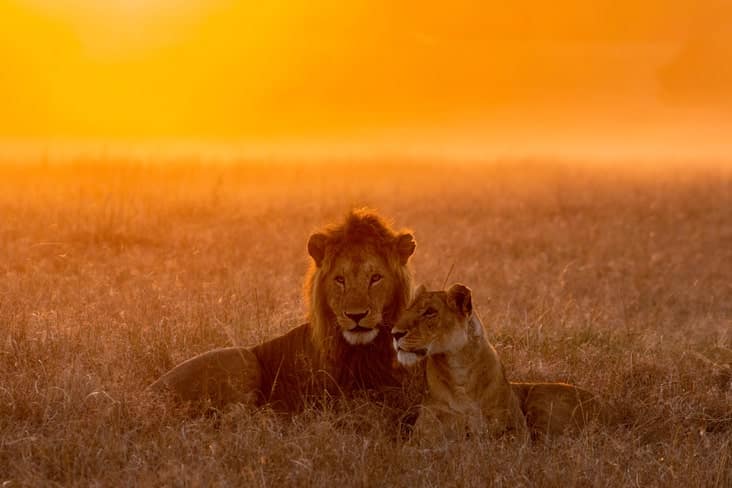
18. The world-renowned Maasai Mara National Reserve is famed for its abundant wildlife and the annual migration of half a million animals such as wildebeest, gazelles and zebras, and their predators, from Tanzania.
19. Kenya is home to more than 40 tribes with over 60 tribal languages spoken.
20. Ugali is a staple meal in Kenya, with most meals centered around the thick, doughlike mass made from maize and/or cassava flour.

21. Polygamy is legal in Kenya which means men can take more wives without consulting existing spouses. The controversial marriage law was passed in 2014.
22. There is a village in Kenya where men are banned. Only women are allowed to live in Umoja, a village founded in 1990 by 15 women who had suffered sexual abuse and violence. Men are not allowed to live there, although they may enter as visitors and must abide by the community’s rules.
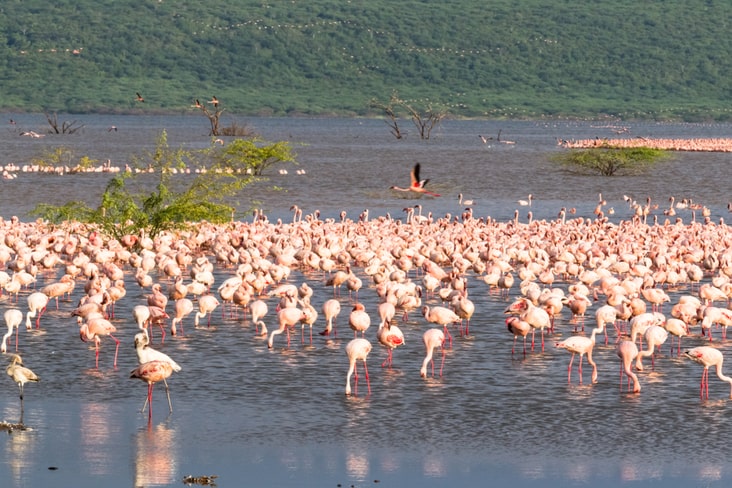
23. Lake Baringo in Kenya registered the world record count of bird species observed in 24 hours. More than 340 different species were spotted at this freshwater lake in the Rift Valley. In total, 470 species of birds can be found there.
24. A small section of Africa’s largest lake is located in Kenya. Lake Victoria, also called Victoria Nyanza, has an area of 69,484 sq km (26,828 sq mi) and a coastline of 3,220 km (2,000 mi). It is also the world’s second-largest freshwater lake after Lake Superior in North America.
25. As of 2022, Kenya’s largest exports were tea ($1.139B), cut flowers ($665M), titanium ore ($290M) and coffee ($341M).
26. Lake Turkana in northern Kenya is the world’s largest permanent desert and alkaline lake. It is sometimes called the “Jade Sea” because of its greenish-blue color.
Explore more: Test your knowledge with our Africa map quiz.
We strive to verify all facts using authoritative and primary sources where possible. However, if you find an error or have any questions, please contact us.

Caitriona Maria is an education writer and owner of The Facts Institute. With seven years of teaching experience and a background in educational content, she specialises in creating clear reference resources about countries, geography and global topics.