A brief overview of the meaning, history, and key facts about the national flag of Mexico.

Flag of Mexico
Officially adopted in 1968, Mexico’s flag features three stripes of green, white and red with Mexico’s coat of arms in the center. Green originally represented independence, white represented the Roman Catholic religion and red represented union.
Printable Mexico Flag (PNG Download)
Interesting facts about Mexico’s flag
1. Mexico’s coat of arms, shown at the center of the flag, depicts an eagle holding a snake while perched on a cactus growing from a rock surrounded by water.
2. The coat of arms represents the founding legend of Tenochtitlán, now known as Mexico City. According to an Aztec prophecy, their gods instructed them to build a new city where they witnessed this sign.
3. The three colors of the Mexican flag were adopted following the War of Independence against Spain.
4. The colors of Mexico’s flag originally symbolized the “three guarantees” of independence, religion, and union. Over time, their meanings have been reinterpreted, and modern interpretations often associate them with hope, unity, and the sacrifices made for the nation.
5. A small detail many people miss is the tricolor ribbon in green, white, and red beneath the coat of arms, which ties together the oak and laurel branches as a symbol of national patriotism.
6. The first known Mexican flag in 1810 depicted the Virgin of Guadalupe, a revered Roman Catholic title of the Virgin Mary.
7. Día de la Bandera (Flag Day) is celebrated annually in Mexico on February 24th. On this day, schools hold special ceremonies and students pledge allegiance to the flag.
Explore more about Mexico:
Variants of the Mexican flag
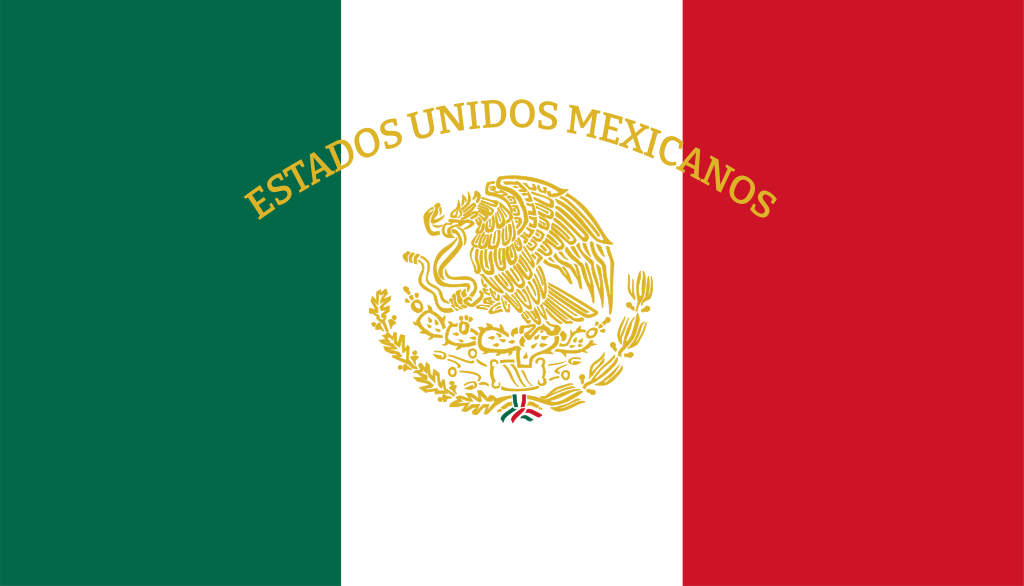
State flag
A variant of Mexico’s flag, with a gold coat of arms and the tricolor ribbon in green, white and red.
In addition to the national flag, Mexico uses official variants that mainly differ in the coloring of the coat of arms.
One commonly seen version features a gold coat of arms, while the tricolor ribbon remains green, white, and red.
This variant is used by government institutions and officials in formal settings.
History of Mexico’s flag
Mexico’s flag has evolved through several historical periods before reaching its modern form. Early independence movements in the early 1800s used symbolic banners, including religious images and early eagle designs linked to the founding legend of Tenochtitlán.
In 1821, the Flag of the Three Guarantees introduced the green, white, and red colors that remain today. These colors were originally connected to the ideals of independence, religion, and unity during the country’s transition to independence.
Throughout the 19th century, the flag’s design changed as different governments altered the style of the eagle and coat of arms. The modern version of the eagle devouring a snake was officially standardized in 1968 and remains the national flag of Mexico today.

Caitriona Maria is an education writer and owner of The Facts Institute. With seven years of teaching experience and a background in educational content, she specialises in creating clear reference resources about countries, geography and global topics.