A brief overview of the meaning, history, and key facts about the national flag of Italy.

Flag of Italy
Officially adopted in 1797, Italy’s flag features three stripes of green, white and red. The green is often associated with the country’s plains and hills, white represents the snow-capped Alps, and red symbolizes the blood shed in the wars of Italian independence.
Printable Italy Flag (PNG Download)
Interesting facts about Italy’s flag
1. The national flag of Italy is known as the Tricolor, or il Tricolore.
2. Italy’s tricolor flag is inspired by the French one, which is a blue-white-red design, first introduced during the French Revolution. For the Italians, green symbolized hope and nature.
3. One theory suggests the green, white, and red were inspired by the uniforms of Milan’s civic militia in the late 18th century.
4. The Italian flag once included a royal symbol representing the House of Savoy. It was removed in 1946 following the end of the monarchy and the establishment of an Italian Republic.
5. Festa del Tricolore (Flag Day) is celebrated annually in Italy on January 7th.
Explore more about Italy:
Variants of the Italian flag
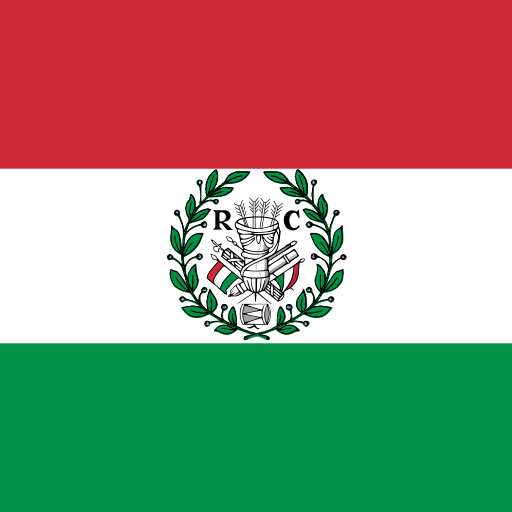
Cispadane Republic Flag (1796-1797)
The first to adopt the green-white-red design was the Cispadane Republic, an Italian sovereign state in Northern Italy.
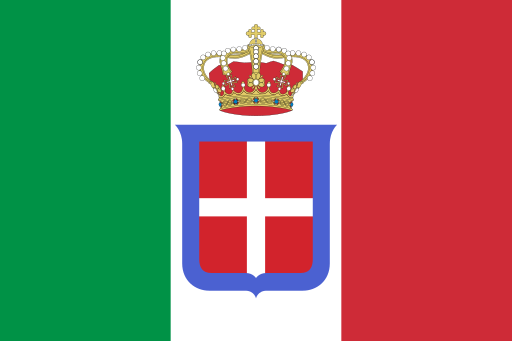
State Flag of Kingdom of Italy (1861-1946)
The green-white-red design features a shield at its center and crown on top, representing the ruling House of Savoy.
History of Italy’s flag
The green, white, and red tricolor first appeared in Italy in the late 18th century, during a period of political change inspired by the French Revolution. Italian revolutionaries adopted the three-color design as a symbol of national renewal and self-determination.
The first official use of the Italian tricolor as a flag took place on January 7, 1797, when the Cispadane Republic adopted a green, white, and red flag. This version originally featured horizontal stripes. Soon after, the vertical arrangement was adopted by the Cisalpine Republic, establishing the format that remains in use today.
During the 19th century, the tricolor became a powerful symbol of Italian nationalism and unification. In 1848, King Charles Albert of Sardinia ordered his troops to carry the green-white-red flag during the wars against Austria. When Italy was unified in 1861, the tricolor became the national flag, with the coat of arms of the House of Savoy placed in the center to represent the monarchy.
Following World War II, a national referendum was held in 1946 to decide between retaining the monarchy or establishing a republic. After the monarchy was abolished, the Savoy emblem was removed from the flag. After quite a few versions over the years, the simple green, white, and red tricolor became the official flag of the Italian Republic.

Caitriona Maria is an education writer and owner of The Facts Institute. With seven years of teaching experience and a background in educational content, she specialises in creating clear reference resources about countries, geography and global topics.