A brief overview of the meaning, history, and key facts about the national flag of China.

Flag of China
Officially adopted in 1949, China’s flag has a red background with a large yellow star and four smaller stars at the upper left corner. Red represents the Chinese Communist Revolution, while the stars represent the Chinese people, united under the main star of the Chinese Communist Party (CCP).
Printable China Flag (PNG Download)
Interesting facts about China’s flag
1. The four smaller stars were originally said to represent four social groups: the working class, peasants, the petty bourgeoisie, and the national bourgeoisie, united under the leadership of the Communist Party.
2. In Chinese tradition, yellow has long symbolized imperial power, central authority, and national heritage. The yellow stars are often described as golden rays shining over the vast red land.
3. Although red represents revolution in the modern flag, it has also long been an important color in Chinese culture and was historically associated with the Han Chinese, the dominant ethnic group in China.
4. Before 1949, the national flag of the Republic of China (1912–1928) featured five horizontal stripes representing five major ethnic groups in China.
5. Over time, the symbolism of the stars has been reinterpreted, with the large star sometimes described as representing China itself and the smaller stars representing national unity among its many ethnic groups.
6. In China, students regularly participate in flag-raising ceremonies at school. During these events, the national anthem is played or sung, and students stand facing the flag as it is raised according to strict protocol.
Explore more about China:
Variants of the Chinese flag
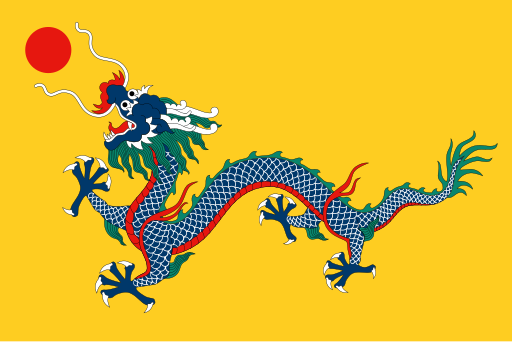
Flag of the Qing dynasty (1889–1912)
The first national flag in China, usually referred to as the “Yellow Dragon Flag.”

Five-Colored Flag (1912-1928)
The five horizontal stripes of red, yellow, blue, white and black represented five major ethnic groups of China.
History of China’s flag
Before the modern flag was adopted, China used several different national designs during periods of political change.
The first widely recognized national flag was the Yellow Dragon Flag, introduced by the Qing dynasty in 1862. In 1889, a rectangular version was officially adopted as China’s national flag and remained in use until the fall of the monarchy in 1912. It featured a blue dragon on a yellow field, reflecting imperial symbolism and the authority of the ruling dynasty.
After the Qing dynasty collapsed, the newly established Republic of China adopted a different design in 1912. Known as the Five-Colored Flag, it featured five horizontal stripes — red, yellow, blue, white, and black — representing five major ethnic groups within the country. This flag remained in use until 1928.
In 1928, the Republic of China adopted the Blue Sky, White Sun, and Red Earth flag, which continued to be used by the Nationalist government. After the Chinese Civil War ended in 1949, the Nationalist government relocated to Taiwan. This is the flag of Taiwan today.
On the mainland, a new design was selected for the newly founded People’s Republic of China. In July 1949, a public call was issued for flag proposals, and thousands of designs were submitted. The winning design, created by Zeng Liansong, featured a large yellow star surrounded by four smaller stars on a red background.
The flag was officially adopted on September 27, 1949, and first raised publicly in Tiananmen Square on October 1, 1949, during the founding ceremony of the People’s Republic of China. It has remained the national flag ever since.

Caitriona Maria is an education writer and owner of The Facts Institute. With seven years of teaching experience and a background in educational content, she specialises in creating clear reference resources about countries, geography and global topics.