A brief overview of the meaning, history, and key facts about the national flag of Kazakhstan.
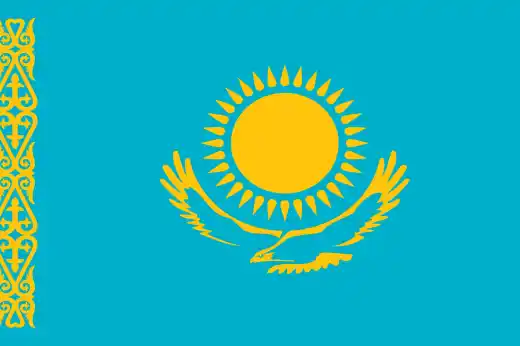
Flag of Kazakhstan
Adopted in 1992, the national flag of Kazakhstan features a sky-blue background with a golden sun above a soaring steppe eagle in the center and a vertical band of traditional Kazakh ornamental patterns along the hoist. The blue color represents the sky, peace, and unity of the nation, while the sun symbolizes life, energy, and abundance. The steppe eagle represents freedom, power, and the aspirations of the Kazakh people, and the ornamental pattern reflects the country’s cultural traditions.
Printable Kazakhstan Flag (PNG Download)
Interesting facts about Kazakhstan’s flag
1. The national flag of Kazakhstan was adopted in 1992 following the country’s independence.
2. The steppe eagle on Kazakhstan’s flag reflects the long tradition of Berkutchi, a form of eagle hunting practiced by Kazakh nomads for centuries.
3. The golden sun on the flag has 32 rays shaped like grains, symbolizing wealth and welfare.
4. Ancient Turkic peoples revered the sky, which makes the blue background a powerful symbol in Kazakh culture.
5. The ornamental band along the hoist is called koshkar-muiz, meaning “ram’s horns,” a traditional motif in Kazakh decorative art.
6. The blue and gold colors of Kazakhstan’s flag recall elements of the country’s Soviet-era flag, which featured a gold hammer and sickle and a turquoise stripe.
Explore more about Kazakhstan:
Evolution of Kazakhstan’s flag
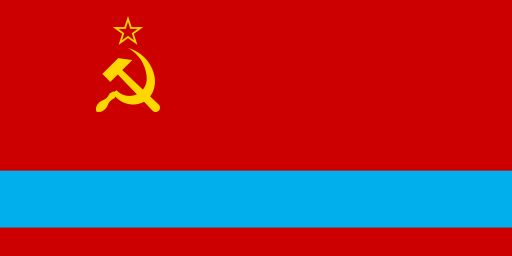
Flag of the Kazakh Soviet Socialist Republic (1953–1991)
The Soviet-era flag of Kazakhstan featured a red background with a hammer and sickle and star in the canton, along with a light blue horizontal stripe near the bottom. It represented Kazakhstan as a republic of the Soviet Union.
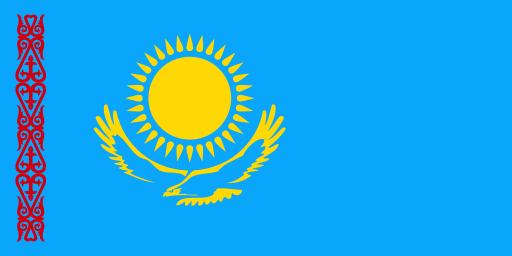
Proposed flag of Kazakhstan (1992)
The early version of the winning design featured the same sun, eagle, and blue background as the current flag, but the ornamental pattern along the hoist was originally colored red before being changed to gold.
History of Kazakhstan’s flag
Early nationalist movements
During the Central Asian Revolt of 1916, Kazakh rebels led by Amankeldy Imanov used a distinctive red flag featuring yellow text in Arabic script and blue symbols, including a crescent and weapons.
At the time, Kazakh was written using the Arabic alphabet, and the inscription on the flag referred to Imanov as a heroic warrior.
Alash Autonomy (1917–1920)
Following the upheavals of World War I and the Russian Revolution, Kazakh political leaders established the Alash Autonomy, an early attempt at national self-government.
Several flag designs were proposed during this period, including a tricolor flag with green, yellow, and red stripes and a crescent with a star. However, historians have found no clear evidence that these designs were officially used by the Alash government.
Other suggested symbols included a flag depicting a yellow yurt on a white background, associated with the Alash political movement.
Soviet period (1920–1991)
After the Bolsheviks consolidated control following the Russian Civil War, the territory of modern Kazakhstan became part of the Kazakh Autonomous Socialist Soviet Republic in 1920. The early Soviet flag featured yellow inscriptions representing the Kazakh Soviet Socialist Republic and the Russian Federation.
Kazakhstan later became the Kazakh Soviet Socialist Republic within the Soviet Union, and its flags changed several times. The final Soviet-era flag, adopted in 1953, consisted of a red field with a hammer and sickle and star in the canton, along with a light blue horizontal stripe.
This Soviet flag continued to be used even after Kazakhstan declared independence in December 1991.
Adoption of the current flag (1992)
Kazakhstan continued using its Soviet-era flag until 4 June 1992, when the current national flag was officially adopted.
Earlier that year, the government organized a national design competition, which received numerous proposals. The winning design was created by Shaken Niyazbekov.
In the original proposal, the ornamental pattern along the hoist was colored red, but it was later changed to gold in July 1992, creating the final design used today.

Caitriona Maria is an education writer and owner of The Facts Institute. With seven years of teaching experience and a background in educational content, she specialises in creating clear reference resources about countries, geography and global topics.