A brief overview of the meaning, history, and key facts about the national flag of Turkmenistan.

Flag of Turkmenistan
Adopted in 1992, the national flag of Turkmenistan features a green field with a vertical red stripe along the hoist containing five traditional carpet patterns representing the Ahal-Teke, Yomut, Saryk, Chowdur, and Ersari tribes. These patterns symbolize the friendship and unity of the Turkmen people. In the upper left corner of the green field are a white crescent moon and five stars. The flag is a symbol of the unity, independence, and neutrality of Turkmenistan.
Printable Turkmenistan Flag (PNG Download)
Interesting facts about Turkmenistan’s flag
1. The crescent moon and five stars on the Turkmenistan flag are widely interpreted as symbols of the nation’s bright future and its five administrative regions: Ahal, Balkan, Daşoguz, Lebap, and Mary.
2. At the bottom of the red stripe on the Turkmenistan flag are two crossed olive branches with ten leaves each, a traditional symbol of peace.
3. Turkmenistan is home to the Ashgabat Flagpole, which stands 133 meters (436 ft) tall. Completed in 2008, it briefly held the record as the tallest flagpole in the world until 2010.
4. On days of mourning, including commemorative days like 12 January and 6 October, the national flag of Turkmenistan is lowered as a sign of respect.
Explore more about Turkmenistan:
Evolution of Turkmenistan’s flag
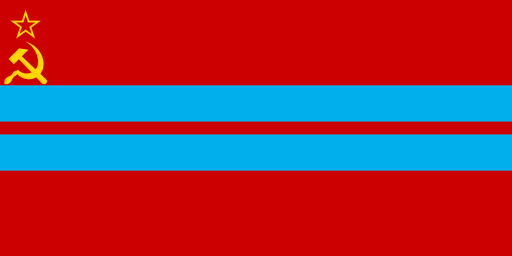
Flag of the Turkmen Soviet Socialist Republic
The Soviet-era flag of Turkmenistan featured a red background with a hammer and sickle and star in the canton, along with two horizontal blue stripes across the center. It represented Turkmenistan as a republic of the Soviet Union.
History of Turkmenistan’s flag
Turkmen Soviet Socialist Republic (1926–1991)
During the Soviet period, Turkmenistan used several different Soviet-style flags. The earliest flag of the Turkmen SSR, introduced in 1926, featured a red field with a hammer and sickle and a star.
Later designs included the initials of the republic written in different alphabets as the Turkmen writing system changed from Latin to Cyrillic.
In 1953, a redesigned flag was adopted featuring a red field with two horizontal blue stripes across the center and a hammer and sickle with a star in the canton.
In 1974, the design was slightly modified when the position of the hammer, sickle, and star was adjusted closer to the hoist.
This design remained in use until Turkmenistan gained independence in 1991.
Adoption of the national flag (1992)
After independence, Turkmenistan sought to create new national symbols. In February 1992, an exhibition in Ashgabat displayed proposed designs for a new flag and coat of arms.
Members of the Supreme Soviet selected the final design, and the new national flag was officially adopted on 19 February 1992. President Saparmurat Niyazov raised the flag for the first time on 21 March 1992, during the celebration of the Turkmen New Year.
Addition of the olive branches (1997)
In 1997, the design of the national flag was modified to include two crossed olive branches at the bottom of the red stripe.
The olive branches were added after the United Nations recognized Turkmenistan’s permanent neutrality in 1995. Their inclusion symbolizes peace and the country’s commitment to neutrality in international affairs.
Modification of proportions (2001)
In 2001, the proportions of the national flag were changed from 1:2 to 2:3, and the shade of green used in the design was slightly adjusted.
This version remains the official national flag of Turkmenistan today.

Caitriona Maria is an education writer and owner of The Facts Institute. With seven years of teaching experience and a background in educational content, she specialises in creating clear reference resources about countries, geography and global topics.