A brief overview of the meaning, history, and key facts about the national flag of Mongolia.

Flag of Mongolia
Adopted in 1992, the national flag of Mongolia features three vertical stripes of red, blue, and red. The blue stripe represents the eternal blue sky, a central concept in Mongolian culture. The red stripes symbolize progress and prosperity. On the left side of the flag appears the Soyombo, a traditional symbol that represents fire, the sun and moon, earth, water, and harmony.
Printable Mongolia Flag (PNG Download)
Interesting facts about Mongolia’s flag
1. The Soyombo symbol on the flag was created in the 17th century by Mongolian scholar Zanabazar and later became a powerful symbol of Mongolian independence and identity.
2. One of the elements within the Soyombo is a yin-yang symbol, often interpreted as two fish. Fish never close their eyes, symbolizing vigilance and awareness.
3. Tengerism is an ancient Central Asian spiritual tradition centered on the worship of Tengri, the eternal blue sky, which has influenced Mongolian beliefs and shamanistic practices for thousands of years.
4. During the period of the Mongolian People’s Republic, the flag included a red socialist star above the Soyombo. After the democratic revolution and the adoption of a new constitution in 1992, the star was removed.
5. Although the modern flag was adopted in 1992, the exact official color specifications were standardized by the government in 2011.
6. Mongolia celebrates National Flag Day on 10 July, established in 2008, with ceremonies and military parades honoring the national flag.
Explore more about Mongolia:
Evolution of Mongolia’s flag

Flag of the Bogd Khanate (1911–1919)
This flag featured a yellow field with the Soyombo symbol and Buddhist inscriptions. It was used by the Bogd Khanate of Mongolia, a Buddhist monarchy that ruled the country in the early 20th century.
Joins2003, CC BY-SA 4.0, via Wikimedia Commons
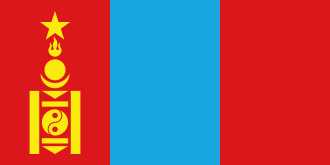
Flag of the Mongolian People’s Republic (1945–1992)
Adopted in 1945, this flag introduced the familiar red–blue–red vertical stripes with the Soyombo symbol. During the communist period, a red socialist star appeared above the Soyombo, representing Mongolia’s alignment with the Soviet Union.
History of Mongolia’s flag
Mongolia’s national flag has changed several times throughout the country’s modern history, reflecting major political and cultural transitions.
The first modern national flag of Mongolia appeared in 1911, when Mongolia declared independence following the collapse of the Qing dynasty. During the period led by the Bogd Khan, this early flag featured a yellow field with religious symbols and the Soyombo, along with red silk tails containing Buddhist inscriptions.
During the early 20th century, Mongolia experienced periods of political change. When Chinese forces occupied the country between 1920 and 1921, the five-striped flag of the Republic of China was briefly used.
After the Mongolian Revolution of 1921, independence was restored and Mongolia later became the Mongolian People’s Republic in 1924. A new flag introduced during this period was red with the state emblem, reflecting the country’s socialist government.
In 1945, Mongolia adopted a flag that more closely resembles the modern design. This flag featured red and blue vertical stripes with the Soyombo symbol, although it also included a communist star above the Soyombo.
Following Mongolia’s transition to democracy, the country adopted a new constitution in 1992 and removed the communist star from the flag. This created the current version of the Mongolian flag, which continues to be used today.
The official color standards of the flag were later standardized in 2011.

Caitriona Maria is an education writer and owner of The Facts Institute. With seven years of teaching experience and a background in educational content, she specialises in creating clear reference resources about countries, geography and global topics.