A brief overview of the meaning, history, and key facts about the national flag of Mozambique.

Flag of Mozambique
Adopted in 1983, the national flag of Mozambique features horizontal stripes of green, black, and yellow separated by thin white bands, with a red triangle at the hoist. The green represents the country’s land and natural resources, the black symbolizes the African continent, and the yellow represents Mozambique’s mineral wealth. The red triangle stands for the struggle for independence and the defense of sovereignty, while the white stripes represent the righteousness of the Mozambican people’s struggle for peace. In the center of the triangle is a yellow star bearing a book, a hoe, and an AK-47 rifle.
Printable Mozambique Flag (PNG Download)
Interesting facts about Mozambique’s flag
1. Mozambique’s flag prominently features an AK-47 rifle, making it the only national flag to display a modern assault rifle as part of its design.
2. The star in the flag represents international solidarity, while the book, hoe, and rifle symbolize education, agriculture and production, and the defense of the nation.
3. The flag’s design is inspired by the flag of FRELIMO (Mozambique Liberation Front), the liberation movement that led Mozambique to independence.
4. The inclusion of the AK-47 rifle on the flag has sparked debate since Mozambique’s democratization in 1990, with some calling for its removal as a symbol of reconciliation and peace.
5. Mozambique’s constitution does not specify how many points the star on the flag should have, though it is almost always depicted with five points.
Explore more about Mozambique:
Evolution of Mozambique’s flag
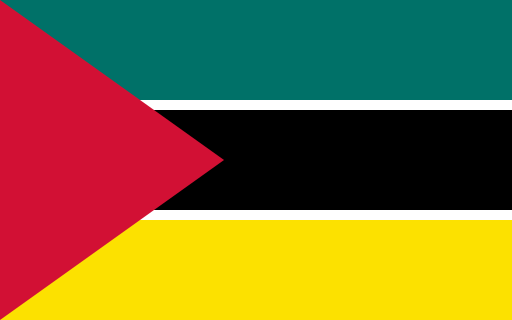
FRELIMO flag (1974–1975)
Used by FRELIMO during the struggle for independence, its colors later influenced the design of Mozambique’s national flag after independence.
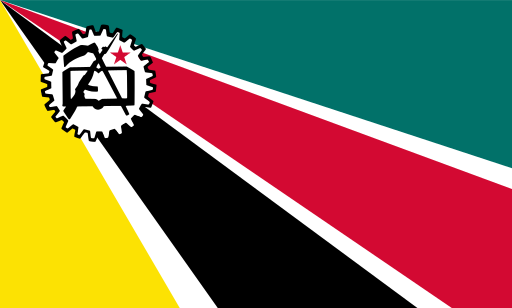
Flag of Mozambique (1975–1983)
After independence in 1975, Mozambique adopted this flag featuring diagonal stripes and an emblem with a cogwheel, book, hoe, and AK-47 rifle. The cogwheel represented industry, while the red star symbolized international socialism.
History of Mozambique’s flag
Colonial period
Before independence, Mozambique used the flag of Portugal, as the territory was a Portuguese colony.
During the struggle for independence, the Mozambique Liberation Front (FRELIMO) used a flag with colors similar to the modern national flag.
Mozambique gained independence from Portugal on 25 June 1975.
Flag of the People’s Republic of Mozambique (1975–1983)
After independence, a new national flag was introduced. This flag featured diagonal stripes of green, red, black, and yellow, separated by white lines.
Near the upper hoist was a cogwheel containing a red star, along with a hoe and AK-47 rifle crossed over an open book.
Adoption of the current flag (1983)
In April 1983, the government modified the design by adopting a version of the FRELIMO flag.
The emblem from the earlier flag was placed inside a yellow star within the red triangle, creating the modern layout.
Shortly afterward, the cogwheel was removed, resulting in the current design officially adopted on 1 May 1983.
Debates about changing the flag
Following constitutional reforms in 1990 that introduced multiparty democracy, there have been discussions about changing the national flag.
Some critics argue that the flag resembles the symbolism of the ruling FRELIMO party, while others object to the presence of the AK-47 rifle, believing it represents violence rather than peace.
In 2005, the Mozambican government held a national competition to design a new flag and emblem. A total of 169 proposals were submitted.
However, the Assembly of the Republic rejected all proposals, voting to keep the existing flag. Supporters of the current design argue that the symbols represent the country’s history and the struggle that led to independence.

Caitriona Maria is an education writer and owner of The Facts Institute. With seven years of teaching experience and a background in educational content, she specialises in creating clear reference resources about countries, geography and global topics.