A brief overview of the meaning, history, and key facts about the national flag of Portugal.

Flag of Portugal
The national flag of Portugal consists of a vertical green stripe at the hoist and a larger red field on the fly, with the Portuguese coat of arms placed over a yellow armillary sphere at the boundary between the two colors. The green color symbolizes hope and was associated with the Republican Revolution of 1910, while red represents courage, sacrifice, and the struggle for the nation. The armillary sphere recalls Portugal’s Age of Discovery, and the shield incorporates the traditional quinas and castles that have long appeared in Portuguese heraldry.
Printable Portugal Flag (PNG Download)
Interesting facts about Portugal’s flag
1. The adoption of the current Portuguese flag sparked a major public debate known as the “Flag Controversy” (Querela da Bandeira), with many Portuguese arguing that the blue and white colors should be retained.
2. The armillary sphere on the flag is an astronomical instrument that became a symbol of Portugal’s maritime exploration during the Age of Discovery.
3. According to traditional interpretations, the five blue shields (quinas) represent the five Moorish kings defeated by King Afonso I of Portugal at the legendary Battle of Ourique.
4. The seven castles are traditionally associated with the expansion of Portuguese territory and the consolidation of national independence.
Evolution of Portugal’s flag
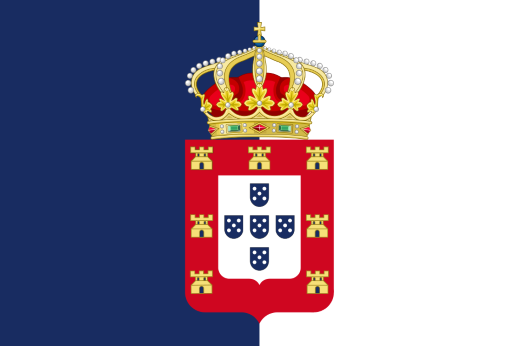
Flag of Portugal (1830–1910)
The flag of the constitutional monarchy consisted of blue and white vertical stripes with the national coat of arms in the center.
History of Portugal’s flag
Monarchical flag
For centuries, Portuguese flags incorporated white, blue, and royal heraldic symbols associated with the monarchy.
Republican Revolution
The Republican Revolution of 5 October 1910 led to the overthrow of the monarchy and the establishment of the Portuguese Republic.
One of the provisional government’s first actions was to appoint a commission to design a new national flag.
Creation of the current flag
The commission completed its work in October 1910, and the provisional government approved the green-and-red design on 29 November 1910.
The new flag replaced the blue-and-white colors of the monarchy with the green and red colors associated with the republican movement.
Adoption and acceptance
The new flag generated considerable controversy, with supporters of the monarchy defending the old blue-and-white colors and republicans promoting the new design.
Despite calls for a public referendum, the Constituent Assembly formally approved the flag on 19 June 1911.
Over time, particularly during World War I, the green-and-red flag became widely accepted as the national symbol of Portugal.

Caitriona Maria is an education writer and owner of The Facts Institute. With seven years of teaching experience and a background in educational content, she specialises in creating clear reference resources about countries, geography and global topics.