A brief overview of the meaning, history, and key facts about the national flag of Tajikistan.
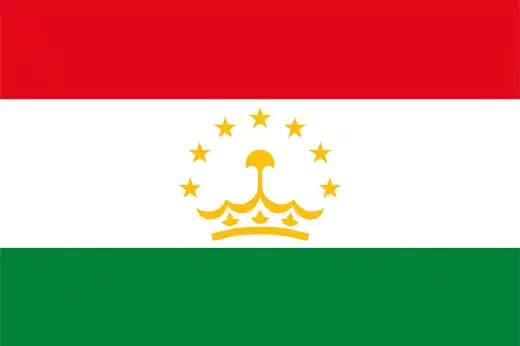
Flag of Tajikistan
Adopted in 1992, the national flag of Tajikistan consists of three horizontal stripes of red, white and green. In the center of the white stripe is a gold crown topped by a semicircle of seven five-pointed stars. Green represents the valleys of Tajikistan, which make up only a small portion of the country’s mountainous territory. White symbolizes cotton, one of the country’s main agricultural products, as well as the snow and ice of the high mountains. Red represents unity within the republic and brotherhood with other nations.
Printable Tajikistan Flag (PNG Download)
Interesting facts about Tajikistan’s flag
1. The national flag of Tajikistan was officially adopted on 25 November 1992, more than a year after the country gained independence in September 1991.
2. The white stripe is wider than the others, measuring one and a half times the width of the red and green stripes.
3. Some observers have noted that the red, white, and green colors of the Tajikistan flag resemble those of the Iranian flag, which may reflect the shared Persian cultural and linguistic heritage of the Tajik people.
4. The number seven holds special cultural significance in Tajik tradition and mythology, where it is associated with perfection and happiness.
5. The national flag of Tajikistan is officially described as a symbol of state sovereignty, unity among workers, peasants and intellectuals, and friendship and brotherhood among the peoples living in the republic.
6. Tajikistan celebrates National Flag Day on 24 November, marking the adoption of the flag through parades, exhibitions, ceremonies, and other sporting and cultural events.
Explore more about Tajikistan:
Evolution of Tajikistan’s flag
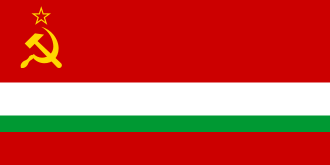
Flag of the Tajik Soviet Socialist Republic (1953–1992)
Under Soviet rule, Tajikistan used a flag derived from the flag of the Soviet Union. The design included red, white, and green stripes along with communist symbols such as the hammer and sickle.
History of Tajikistan’s flag
Soviet period
Before independence, Tajikistan was a republic within the Soviet Union known as the Tajik Soviet Socialist Republic. During this time the country used a flag based on the Soviet model, featuring communist symbolism alongside the red-white-green stripe pattern.
The white stripe represented cotton production, an important part of the region’s agriculture, while green symbolized other agricultural activities. The red stripe represented the workers’ revolution.
Adoption of the modern flag
Following the collapse of the Soviet Union, Tajikistan adopted a new national flag on 25 November 1992.
The new design retained the traditional tricolor layout while introducing a gold crown and seven stars, representing the country’s sovereignty and national identity.

Caitriona Maria is an education writer and owner of The Facts Institute. With seven years of teaching experience and a background in educational content, she specialises in creating clear reference resources about countries, geography and global topics.