A brief overview of the meaning, history, and key facts about the national flag of Iran.

Flag of Iran
The national flag of Iran consists of three horizontal stripes of green, white, and red. In the center of the white stripe appears a red emblem composed of four crescents and a sword topped by a shaddah. Along the borders of the stripes is a repeated decorative inscription of the phrase “Allahu Akbar” (“God is Greater”). The colors of the flag are traditionally interpreted as representing Islam (green), peace (white), and courage (red).
Printable Iran Flag (PNG Download)
Interesting facts about Iran’s flag
1. The national flag of Iran was adopted after the 1979 Iranian Revolution, replacing earlier versions of the flag that featured the lion and sun emblem.
2. The red emblem is composed of stylized elements representing the word “Allah.”
3. The five elements are also often interpreted as symbolizing the five pillars of Islam.
4. The phrase “Allahu Akbar” (“God is Greater”) appears 22 times along the borders of the white stripe on the Iranian flag written in stylized Kufic script.
5. The shape of the emblem is also designed to resemble a tulip, referencing an Iranian tradition that a red tulip grows on the grave of someone who dies for their country.
6. For several centuries, Iran’s national flag featured the lion and sun emblem, a symbol that became widely associated with the country during the Safavid, Zand and Qajar periods. The design is still used today by some Iranian opposition groups and diaspora communities.
Explore more about Iran:
Evolution of Iran’s flag
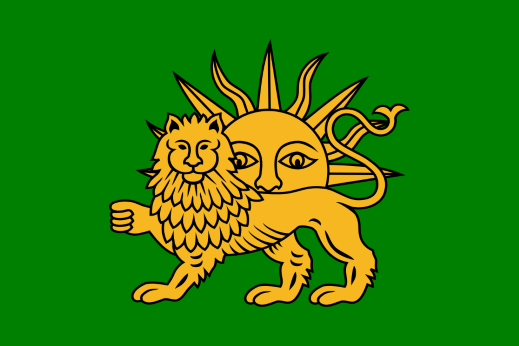
Safavid Empire (16th–18th centuries)
The lion and sun emblem became widely associated with Iran and appeared on banners, coins, and royal standards. The symbol combined older Persian traditions with political symbolism used by the Safavid rulers.
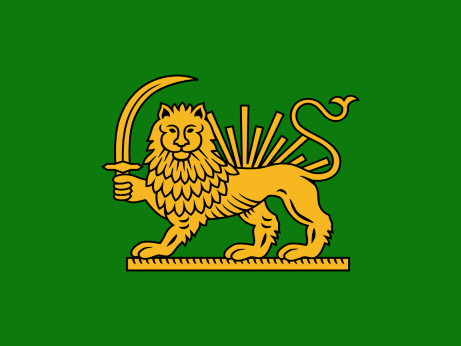
Qajar Dynasty (1794–1925)
Many flags during this period displayed a lion holding a sword in front of a rising sun, although the background colors and designs varied.
Orange Tuesday, CC BY-SA 3.0, via Wikimedia Commons
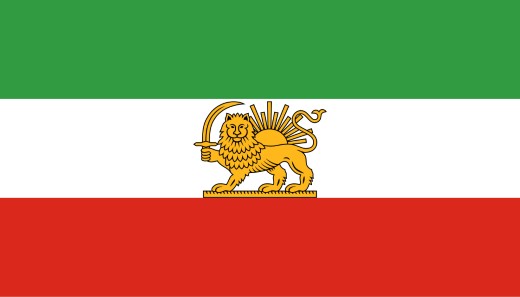
Tricolor with Lion and Sun (1907–1979)
Iran adopted a tricolor flag of green, white, and red with the lion and sun emblem in the center. This design remained the national flag during the Pahlavi monarchy.
History of Iran’s flag
Early symbolism and traditional colors
The colors green, white, and red have long been associated with Iran and its national identity.
These colors later appeared together in Iranian flags during the 19th century and eventually formed the basis of the modern national flag.
Adoption of the modern tricolor
The modern Iranian tricolor emerged during the Constitutional Revolution in the early 20th century, when Iran introduced constitutional reforms and modern state symbols.
In 1907, the Supplementary Fundamental Laws described the national flag as a tricolor of green, white, and red with the lion and sun emblem in the center.
In 1910, a decree standardized the design of the emblem, specifying details such as the shape of the lion’s tail and the position and size of the lion, sword, and sun.
Changes after the Islamic Revolution
Following the 1979 Islamic Revolution, the monarchy was abolished and the lion and sun emblem was removed.
On 29 July 1980, the current design was adopted, featuring a stylized Islamic emblem and decorative inscriptions of “Allahu Akbar.”
Browse all Middle Eastern flags, or explore more resources about Asia below.

Caitriona Maria is an education writer and owner of The Facts Institute. With seven years of teaching experience and a background in educational content, she specialises in creating clear reference resources about countries, geography and global topics.