A brief overview of the meaning, history, and key facts about the national flag of Indonesia.

Flag of Indonesia
The national flag of Indonesia consists of two horizontal stripes of red and white, with red on the top and white on the bottom. Red is commonly interpreted as representing human blood or the physical aspects of life, while white represents the spiritual dimension.
Printable Indonesia Flag (PNG Download)
Interesting facts about Indonesia’s flag
1. The national flag of Indonesia was officially adopted on 17 August 1945, the day Indonesia declared independence.
2. In Indonesian, the national flag is known as “Sang Merah Putih,” meaning “The Red and White.”
3. Red and white are traditionally associated with courage and purity.
4. In Javanese tradition, the colors are also sometimes linked to palm sugar (red) and rice (white), two staple foods that symbolize life and sustenance.
5. Indonesia shares an almost identical flag design with Monaco, although Indonesia’s flag has slightly different proportions and historical origins.
Explore more about Indonesia:
Evolution of Indonesia’s flag

Majapahit Empire (13th–16th centuries)
The Majapahit Empire is believed to have used alternating red and white stripes on its flags.
BP47Dhorifah, svg: Puck04, CC BY-SA 3.0, via Wikimedia Commons

Dutch East Indies (1800–1942)
During Dutch colonial rule, the territory used colonial flags associated with the Netherlands and the Dutch East Indies administration.
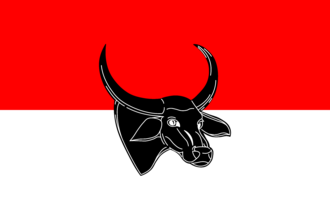
Indonesian nationalist movement (1922–1945)
An early flag associated with the Indonesian nationalist movement was a red-over-white banner featuring the head of a banteng (bull) in the center.
History of Indonesia’s flag
Early origins of the red and white colors
The red and white colors of Indonesia’s national flag have deep historical roots. These colors were used in the banner of the Majapahit Empire, a powerful Javanese state that ruled parts of the Indonesian archipelago beginning in the late 13th century.
Historical records also suggest that red and white banners were used even earlier by regional kingdoms in the Indonesian archipelago.
Rise of the nationalist flag
In the early 20th century, Indonesian nationalist groups revived the red and white colors as symbols of independence from Dutch colonial rule.
In 1922, Indonesian students in Leiden, the Netherlands, adopted a red-over-white flag with the head of a banteng (bull) for their association. The red and white flag was later raised by the Partai Nasional Indonesia in Bandung in 1928.
In 1929, a plain red-over-white flag was hoisted during a student congress in Batavia (now Jakarta).
Adoption of the national flag
Indonesia proclaimed independence on 17 August 1945, and the red-and-white flag was raised during the ceremony in Jakarta.
The first national flag, known as the Bendera Pusaka, was sewn by Fatmawati, the wife of Indonesia’s first president, Sukarno.
The design consisted of two horizontal stripes of red above white and has remained unchanged since its adoption.
The historic independence flag
The original independence flag became an important national symbol. It was raised during annual independence day ceremonies until 1968, after which it was preserved due to its fragile condition and replaced with a replica.

Caitriona Maria is an education writer and owner of The Facts Institute. With seven years of teaching experience and a background in educational content, she specialises in creating clear reference resources about countries, geography and global topics.