A brief overview of the meaning, history, and key facts about the national flag of Kiribati.

Flag of Kiribati
Adopted in 1979, the national flag of Kiribati features a red upper half with a golden frigatebird flying above a rising sun. The lower half of the flag displays three horizontal white wavy stripes on a blue background representing the Pacific Ocean and the three island groups that make up the country: the Gilbert Islands, Phoenix Islands, and Line Islands. The frigatebird symbolizes power, freedom, and traditional Kiribati cultural dance patterns, while the rising sun reflects the country’s position near the Equator.
Printable Kiribati Flag (PNG Download)
Interesting facts about Kiribati’s flag
1. Kiribati officially adopted its national flag on 12 July 1979, the same day the country gained independence from Britain.
2. The 17 rays of the sun represent the sixteen islands of the Gilbert group plus Banaba, formerly known as Ocean Island.
3. The frigatebird depicted on the flag is a common bird on the islands.
4. The design of the flag is derived from the coat of arms granted to the Gilbert and Ellice Islands colony in 1937.
Explore more about Kiribati:
Evolution of Kiribati’s flag
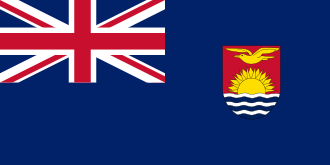
Flag of the Gilbert and Ellice Islands (1937–1976)
During British colonial rule, the Gilbert and Ellice Islands used a British Blue Ensign with a colonial badge. The badge featured a frigatebird flying above a rising sun over the ocean.
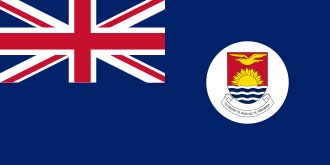
Flag of the Gilbert Islands (1976–1979)
After the Ellice Islands separated to become Tuvalu in 1976, the remaining territory became known as the Gilbert Islands (later Kiribati). The badge also featured the colony’s motto, “Health, Peace, and Prosperity.”
History of Kiribati’s flag
Colonial origins of the design
The design of the modern Kiribati flag originates from the colonial coat of arms of the Gilbert and Ellice Islands, created in 1931 and officially granted in 1937.
The emblem featured a golden frigatebird flying above a rising sun with waves below. The waves represented the surrounding Pacific Ocean, while the sun reflected the islands’ position near the 180-degree meridian.
Design of the national flag
In the years leading up to independence, a competition was held to design a national flag. A design based on the colonial coat of arms was submitted and initially modified by the College of Arms in London, which enlarged the bird and sun and reduced the size of the waves.
However, the people of the islands preferred the original design, where the bird and sun were smaller and the upper and lower halves of the flag were equal.
Adoption at independence
The final design was adopted when Kiribati became independent from Britain on 12 July 1979. The flag was first raised during the independence celebrations in the capital, Tarawa.
The modern flag retains imagery from the former colonial coat of arms while reflecting the country’s geography, culture, and national identity.
Explore more: Oceania flags or test your knowledge with our Oceania Flag Quiz.

Caitriona Maria is an education writer and owner of The Facts Institute. With seven years of teaching experience and a background in educational content, she specialises in creating clear reference resources about countries, geography and global topics.