A brief overview of the meaning, history, and key facts about the national flag of Burundi.

Flag of Burundi
Adopted in 1967, the national flag of Burundi is divided by a white diagonal cross into four sections. The upper and lower sections are red, while the left and right sections are green. At the center of the flag is a white disk containing three red six-pointed stars outlined in green, arranged in a triangular pattern with one star above two. Red represents the struggle for independence, green symbolizes hope for the future, and white stands for peace. The three stars represent the national motto of Burundi: Unity, Work, Progress.
Printable Burundi Flag (PNG Download)
Interesting facts about Burundi’s flag
1. Burundi first adopted a national flag when it gained independence from Belgium on 1 July 1962.
2. The current version of the flag was introduced in 1967 after the monarchy was abolished and the republic was established.
3. The three stars on the flag are said to symbolize the three main ethnic groups of Burundi: the Hutu, Tutsi and Twa.
4. The proportions of the flag were changed from 2:3 to 3:5 on 27 September 1982.
Explore more about Burundi:
Evolution of Burundi’s flag
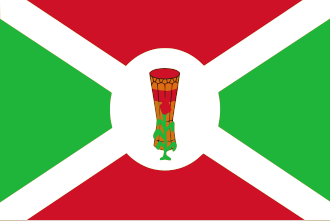
Flag of Burundi (1962–1966)
After independence, Burundi adopted a flag featuring red and green sections divided by a white cross. At the center was a white disk displaying a karyenda, a royal drum believed to possess divine power.
Eeilios, CC BY-SA 4.0, via Wikimedia Commons.
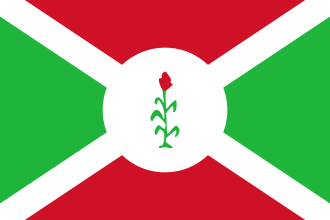
Flag of Burundi (1967–1982)
After the monarchy was abolished, the royal drum was removed from the flag and replaced with a sorghum plant, an important agricultural crop in Burundi.
History of Burundi’s flag
Independence and early flag
Burundi gained independence from Belgium on 1 July 1962. The first national flag adopted after independence included a royal drum known as the karyenda, which symbolized the authority of the monarchy.
Transition to a republic
In November 1966, the monarchy was abolished and Burundi became a republic. As part of these changes, the royal drum was removed from the flag.
A transitional design briefly appeared before a new version featuring a sorghum plant was introduced.
Adoption of the modern design
In 1967, the sorghum plant was replaced by three stars arranged in a triangular formation.
These stars symbolize the national motto of Burundi: Ubumwe, Ibikorwa, Amajambere, which means “Unity, Work, Progress.”
The design has remained unchanged since then, except for an official change in proportions in 1982.

Caitriona Maria is an education writer and owner of The Facts Institute. With seven years of teaching experience and a background in educational content, she specialises in creating clear reference resources about countries, geography and global topics.