A brief overview of the meaning, history, and key facts about the national flag of Equatorial Guinea.
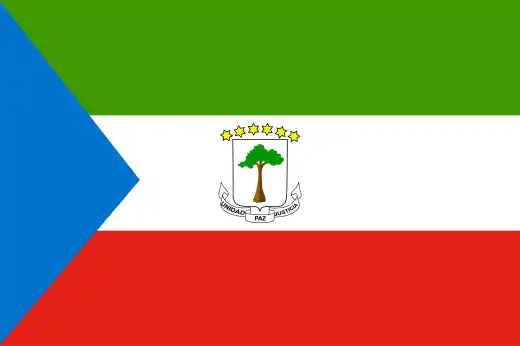
Flag of Equatorial Guinea
The national flag of Equatorial Guinea features three horizontal stripes of green, white, and red, with a blue triangle at the hoist. The green stripe represents the country’s rich forests, the white stripe symbolizes peace, and the red stripe commemorates the blood shed by those who fought for independence. The blue triangle represents the sea that connects the mainland with the country’s islands. At the center of the flag is the national coat of arms of Equatorial Guinea. The coat of arms displayed on the flag features a silk-cotton tree, also known as a ceiba tree, on a silver shield.
Printable Equatorial Guinea Flag (PNG Download)
Interesting facts about Equatorial Guinea’s flag
1. The national flag of Equatorial Guinea was adopted on 12 October 1968, the same day the country gained independence.
2. The coat of arms featured on the flag includes six six-pointed stars, which represent the six territories of the Republic of Equatorial Guinea and its surrounding islands.
3. A scroll below the shield displays the national motto: “Unidad, Paz, Justicia” (“Unity, Peace, Justice”).
Explore more about Equatorial Guinea:
Evolution of Equatorial Guinea’s flag

Flag of Spain (colonial period – 1968)
Before independence, Equatorial Guinea was a Spanish colony and used the national flag of Spain as the official flag of the territory.
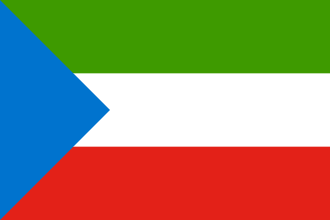
First national flag (1968–1973)
The first national flag of Equatorial Guinea featured three horizontal stripes of green, white, and red with a blue triangle at the hoist. Some early versions of the flag did not include the coat of arms.
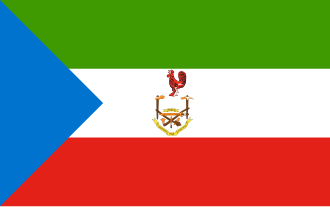
Flag during the rule of Francisco Nguema (1973–1979)
The coat of arms used during this period included different symbols and featured a cockerel along with tools and weapons.
Fornax, CC BY-SA 3.0, via Wikimedia Commons
History of Equatorial Guinea’s flag
Independence and first national flag
Equatorial Guinea gained independence from Spain on 12 October 1968. The new national flag was first flown on that day and included the national coat of arms in the center.
The design features a horizontal tricolor of green, white, and red with a blue triangle at the hoist.
Changes during the Nguema dictatorship
In 1973, during the rule of President Francisco Nguema, the emblem used on the flag was replaced with a different coat of arms.
The altered design included additional symbols such as tools, a sword, and a cockerel, along with a modified national motto.
Restoration of the original design
After Nguema was overthrown in 1979, the original national emblem adopted at independence was restored. The flag has remained unchanged since that time.

Caitriona Maria is an education writer and owner of The Facts Institute. With seven years of teaching experience and a background in educational content, she specialises in creating clear reference resources about countries, geography and global topics.