A brief overview of the meaning, history, and key facts about the national flag of Eritrea.

Flag of Eritrea
The national flag of Eritrea features a red triangle extending from the hoist toward the fly, with green above and blue below. At the center of the red triangle is a yellow wreath made of olive branches. Green represents Eritrea’s agricultural and livestock economy, blue symbolizes the country’s marine wealth, red commemorates the blood shed during the struggle for independence, and yellow represents the country’s mineral wealth.
Printable Eritrea Flag (PNG Download)
Interesting facts about Eritrea’s flag
1. The current national flag of Eritrea has been used since 1993, the year the country gained independence.
2. The design combines elements from two earlier flags: the flag of the Eritrean People’s Liberation Front (EPLF) and a flag used in Eritrea during the 1950s.
3. The yellow wreath in the red triangle is sometimes said to symbolize the United Nations and is generally interpreted as a symbol of peace.
Explore more about Eritrea:
Evolution of Eritrea’s flag
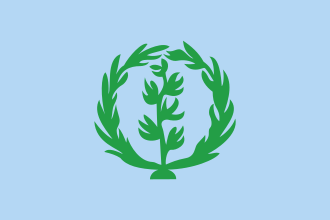
Flag of Eritrea (1952–1962)
In 1952, Eritrea adopted a blue flag featuring three olive branches as its national symbol.
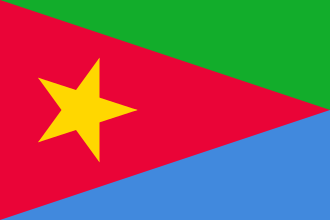
Flag of the Eritrean People’s Liberation Front (1970s–1993)
During the struggle for independence, the flag featured a red triangle with green and blue sections, but instead of the wreath symbol it displayed a yellow star.
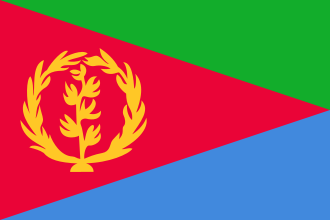
Flag of Eritrea (1993–1995)
When Eritrea became independent, the national flag adopted the overall design used by the EPLF but replaced the star with a yellow wreath.
History of Eritrea’s flag
Early national symbol
After the Second World War, Eritrea came under British administration before being federated with Ethiopia.
In 1952, Eritrea adopted a blue flag with olive branches as its national symbol during this autonomous period.
Suppression of the Eritrean flag
The Eritrean flag was later banned as Ethiopia progressively dismantled Eritrea’s autonomy.
In the early 1960s, Ethiopia dissolved the federal arrangement and annexed Eritrea.
Independence movement
During the long struggle for independence, Eritrean nationalist movements used their own flags, most notably the flag of the Eritrean People’s Liberation Front (EPLF). This design later influenced the modern national flag.
Adoption of the modern flag
After Eritrea achieved independence in 1993, the new national flag incorporated elements from both the EPLF flag and the earlier Eritrean flag from the 1950s. The emblem of an olive wreath was added in place of the star used by the EPLF.
In 1995, the design was standardized, including the number of leaves in the wreath and the official proportions of the flag.

Caitriona Maria is an education writer and owner of The Facts Institute. With seven years of teaching experience and a background in educational content, she specialises in creating clear reference resources about countries, geography and global topics.