The most interesting facts about Tunisia, from the northernmost point of Africa to the protests that started a wave of revolutions across the Arab world.

Fast facts
Official name: Republic of Tunisia
Capital city: Tunis
Population: 12.3 million
Area: 163,610 sq km
Major languages: Arabic, French, Berber
Major religion: Islam
Time zone: UTC +1 (Central European Time)
Interesting facts about Tunisia
1. Tunisia is located in North Africa on the Mediterranean Sea. Due to its location and proximity to essential shipping routes, it was once an influential regional power.
2. Tunisia has been inhabited for around 200,000 years, dating back to the Stone Age.
3. Tunisia is partly home to the largest hot desert in the world. The Sahara Desert, with a total area of some 8,600,000 sq km (3,320,000 sq mi), covers much of North Africa including Southern Tunisia.
4. Several scenes from the Star Wars movies were filmed in Tunisia. The Saharan landscape of southern Tunisia is home to several sets including the village of Tataouine, which was Luke Skywalker’s home planet, Tatooine, in the original 1977 movie.

5. Southern Tunisia was once covered with forest and savannah as opposed to sand. At the end of the last Ice Age, around 8000 years ago, the Sahara desert spread throughout the region.
6. Tunisia is home to the northernmost point of Africa, Cape Angela (Ras Angela).
7. In 1881, France invaded Tunisia taking control of its economic and foreign affairs. In 1883, Tunisia became a French protectorate.
8. Following independence in 1956, Tunisia was led for three decades (1956 to 1987) by former president Habib Bourguiba, who advanced secular ideas, particularly the emancipation of women.
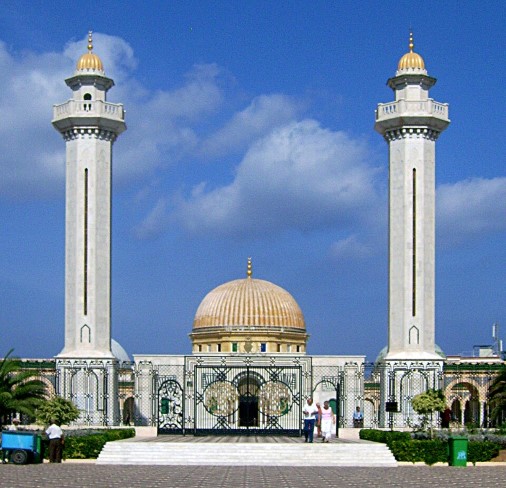
9. In 2010, Tunisian street vendor Mohamed Bouazizi took his own life by setting himself on fire. His actions sparked anti-government demonstrations that led to the Jasmine Revolution, forcing President Ben Ali into exile after 23 years in power.
10. The event in Tunisia sparked a wave of protests throughout the Arab world that later became known as the Arab Spring, which also toppled the governments of Egypt, Libya, and Yemen.

11. In total, Tunisia has eight UNESCO World Heritage Sites. In Africa, only South Africa (10), Ethiopia and Morocco (9) have more.
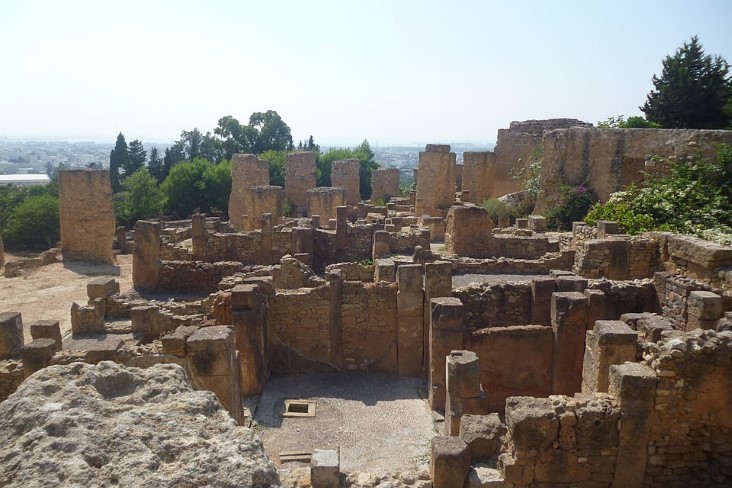
12. Tunisia is home to the ancient city of Carthage, founded in the 9th century BC on the Gulf of Tunis. The UNESCO-listed Archaeological Site of Carthage was once the center of a great trading empire covering much of the Mediterranean.
13. Tunisia’s name derives from the capital city of Tunis, which has three possible origins: from the Berber root word “ens,” which means “to lie down” or “to pass the night,” implying Tunis was once a camp or rest stop; after the Punic goddess Tanit; or after the city of Tynes mentioned in the writings of ancient authors.
14. The Tunisian flag has a red background with a central white disk containing a red star and red crescent. The star and crescent are widely associated with Islam and are common symbols on the flags of several Muslim-majority countries.

See how Tunisia’s flag compares to other African flags.
15. Tunisia stands out in Africa for its low hunger levels, nearly matching countries like Brazil and Argentina on the 2025 Global Hunger Index.
16. Tunisia’s holiest city is the UNESCO-listed city of Kairouan which is often referred to as the fourth holiest city of Islam after Mecca, Medina and Jerusalem. Some traditions claim one pilgrimage to Mecca can be equalled by seven pilgrimages to Kairouan.
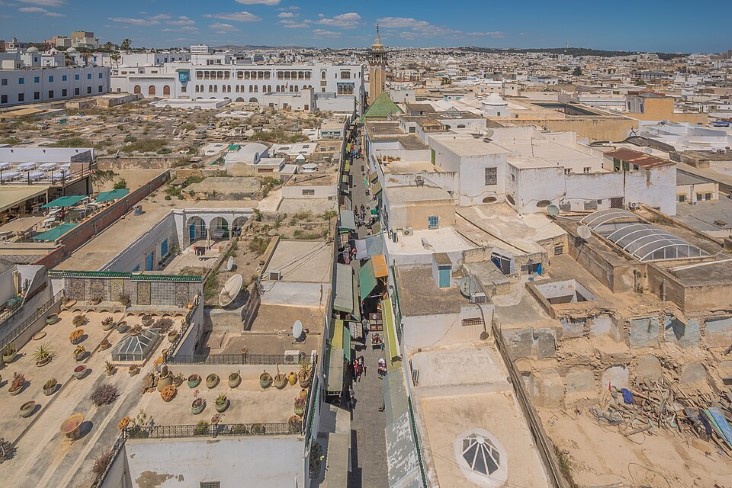
17. The capital city, Tunis, was once considered one of the greatest and wealthiest cities in the Islamic world. Today, the city centre, Medina of Tunis, is a UNESCO World Heritage Site and home to around 700 monuments including palaces, mosques, mausoleums, madrasas and fountains.
18. In 2020, Tunisia deployed a police robot or ‘robocop’ to patrol the streets of the capital and enforce the coronavirus lockdown rules.
19. The ancient remains of the Roman site of Dougga is considered the best-preserved example of an Africo-Roman town in North Africa and has also been called “the most magnificent Roman site in Africa”.
20. The largest colosseum in North Africa is in Tunisia. The UNESCO-listed Amphitheatre of El Jem was built by the Romans around 238 AD and could hold up to 35,000 spectators.

21. In 2017, a British DJ was sentenced to a year in a Tunisian jail for remixing the Muslim call to prayer. The London-born Dax J was charged with public indecency and offending public morality.
22. In 2015, the Nobel Peace Prize was unexpectedly awarded to the Tunisian National Dialogue Quartet, a coalition of civil society groups that came together in the summer of 2013 to develop democracy after the protests of 2011.
23. Tunisia’s UNESCO-listed Ichkeul National Park is famous for its wildlife, particularly its birdlife which includes more than 300,000 ducks, geese and coots. The park also has more than 200 animal species and more than 500 plant species.
24. About 6.35% of Tunisia’s population is estimated to be living with depression, one of the highest rates in the world.
Explore more: Test your knowledge with our Africa map quiz.
We strive to verify all facts using authoritative and primary sources where possible. However, if you find an error or have any questions, please contact us.

Caitriona Maria is an education writer and owner of The Facts Institute. With seven years of teaching experience and a background in educational content, she specialises in creating clear reference resources about countries, geography and global topics.