The Central African Republic, located in Middle Africa, has a tropical climate, with hot temperatures throughout the year and pronounced wet and dry seasons. Rainfall is generally highest in the south and southwest and decreases toward the drier north.
Central African Republic’s climate at a glance
Warmest average month
March
27.8°C
(82.0°F)
Coolest average month

August
24.3°C
(75.7°F)
Wettest month nationally

August
238.3 mm
(9.38 in)
Driest
month nationally

December
5.9 mm
(0.23 in)
Main rainy period

May–October
Temperature and precipitation figures are from CRU-CY v4.10, Climatic Research Unit, University of East Anglia. National averages for 1991–2020.
What is the climate of the Central African Republic?
The Central African Republic becomes progressively drier from south to north.
The southern forest zone has the wettest climate, with annual rainfall commonly around 1,500–1,800 mm (59–71 in). Across the central savanna, rainfall is generally around 1,100–1,500 mm (43–59 in), while northern areas receive considerably less, in some places around 800–1,000 mm (31–39 in) annually.
This difference is also reflected in the length of the rainy season. In the south, rainy conditions can persist for much of the year, while the rainy season becomes considerably shorter toward the north.
Northern areas are also more strongly affected by the harmattan during the dry season, bringing hot, dry and dusty air from the Sahara.
Climate types in the Central African Republic
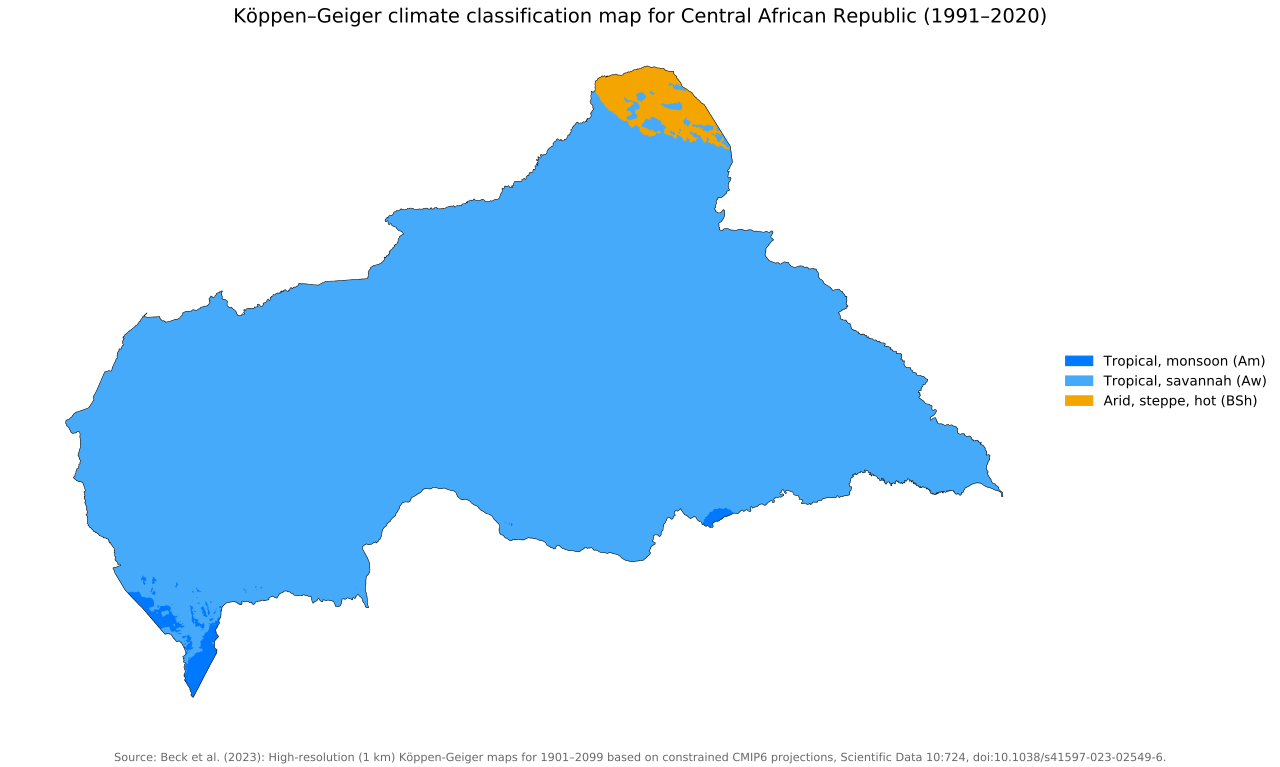
Most of the Central African Republic has a tropical savanna climate, covering almost the entire interior.
The main changes appear around the country’s outer edges. A hot semi-arid climate occurs in the far north, while small areas of tropical monsoon climate appear along the far southwest and parts of the southern border. Compared with these border areas, the climate across most of the interior is remarkably uniform.
Temperatures in the Central African Republic
Temperatures remain high throughout the year, although the hottest conditions occur shortly before the main rains become established.
Data for 1991–2020 show national average temperatures ranging from 24.3°C (75.7°F) in August to 27.8°C (82.0°F) in March. Average daytime maximum temperatures reach 35.3°C (95.5°F) in March, before falling below 30°C (86°F) during July, August and September.
| Month | Avg. minimum | Avg. temperature | Avg. maximum |
|---|---|---|---|
| January | 16.0 °C (60.8 °F) | 24.6 °C (76.3 °F) | 33.3 °C (91.9 °F) |
| February | 18.5 °C (65.3 °F) | 26.7 °C (80.1 °F) | 35.1 °C (95.2 °F) |
| March | 20.4 °C (68.7 °F) | 27.8 °C (82.0 °F) | 35.3 °C (95.5 °F) |
| April | 21.7 °C (71.1 °F) | 27.6 °C (81.7 °F) | 33.6 °C (92.5 °F) |
| May | 21.1 °C (70.0 °F) | 26.6 °C (79.9 °F) | 32.2 °C (90.0 °F) |
| June | 20.4 °C (68.7 °F) | 25.3 °C (77.5 °F) | 30.3 °C (86.5 °F) |
| July | 20.0 °C (68.0 °F) | 24.5 °C (76.1 °F) | 29.1 °C (84.4 °F) |
| August | 19.6 °C (67.3 °F) | 24.3 °C (75.7 °F) | 29.0 °C (84.2 °F) |
| September | 19.5 °C (67.1 °F) | 24.5 °C (76.1 °F) | 29.5 °C (85.1 °F) |
| October | 19.4 °C (66.9 °F) | 24.9 °C (76.8 °F) | 30.5 °C (86.9 °F) |
| November | 17.4 °C (63.3 °F) | 25.0 °C (77.0 °F) | 32.6 °C (90.7 °F) |
| December | 16.1 °C (61.0 °F) | 24.4 °C (75.9 °F) | 32.7 °C (90.9 °F) |
Nights are coolest around the beginning and end of the year. Average minimum temperatures fall to 16.0°C (60.8°F) in January, compared with 21.7°C (71.1°F) in April.
Regional temperatures also differ, with generally hotter conditions toward the drier northeast and somewhat milder conditions in some western highland areas.
Rainfall in the Central African Republic
Rainfall in the Central African Republic is strongly seasonal.
National data for 1991–2020 show precipitation rising rapidly from March onward. Rainfall exceeds 140 mm per month from May through October, with August the wettest month nationally at 238.3 mm (9.38 in).
| Month | Precipitation |
|---|---|
| January | 6.0 mm (0.24 in) |
| February | 13.2 mm (0.52 in) |
| March | 51.3 mm (2.02 in) |
| April | 95.4 mm (3.76 in) |
| May | 144.6 mm (5.69 in) |
| June | 165.7 mm (6.52 in) |
| July | 204.5 mm (8.05 in) |
| August | 238.3 mm (9.38 in) |
| September | 218.4 mm (8.60 in) |
| October | 178.0 mm (7.01 in) |
| November | 33.5 mm (1.32 in) |
| December | 5.9 mm (0.23 in) |
Rainfall then drops sharply toward the end of the year. December is the driest month, averaging only 5.9 mm (0.23 in), followed closely by January at 6.0 mm (0.24 in).
The monthly figures add up to roughly 1,355 mm (53.3 in) annually across the country, although totals are much higher in the wetter south and southwest and considerably lower toward the north.
Rainy and dry seasons in the Central African Republic
The timing and length of the rainy season differ between northern and southern parts of the country.
In southern areas, the main rainy season generally extends from around May to October. Farther north, it is shorter and is concentrated more heavily between June and September. Rainstorms are common during the wet season, and early-morning fog can also occur.
The dry season therefore becomes progressively longer toward northern parts of the country. During this period, northern areas can be affected by the harmattan, which carries hot, dry and dusty air southward from the Sahara.
How is the Central African Republic’s climate changing?
The Central African Republic is expected to become considerably warmer over the coming decades. Climate projections indicate that average temperatures could rise by around 1.4–2.7°C (2.5–4.9°F) by the middle of the century, depending on future emissions.
Rainfall projections are less certain. Climate models show relatively small changes in total annual rainfall compared with the much clearer warming trend, with some projecting increases and others decreases.
Extreme heat is expected to become more common, with more hot days and longer heatwaves, particularly in northern and central parts of the country.
Reference
Harris I, Osborn TJ, Jones P and Lister D (2020) Version 4 of the CRU TS Monthly High-Resolution Gridded Multivariate Climate Dataset. Sci Data 7, 109. https://doi.org/10.1038/s41597-020-0453-3.

Caitriona Maria is an education writer and owner of The Facts Institute. With seven years of teaching experience and a background in educational content, she specialises in creating clear reference resources about countries, geography and global topics.