The most interesting facts about Haiti, from the world’s first black-led republic to the birth of a unique religion and the origin of zombies.

Fast facts
Official name: Republic of Haiti
Capital city: Port-au-Prince
Population: 11,753,943
Area: 27,750 sq km
Major languages: French, Creole
Time zone: UTC-5 (Eastern Time Zone)
Interesting facts about Haiti
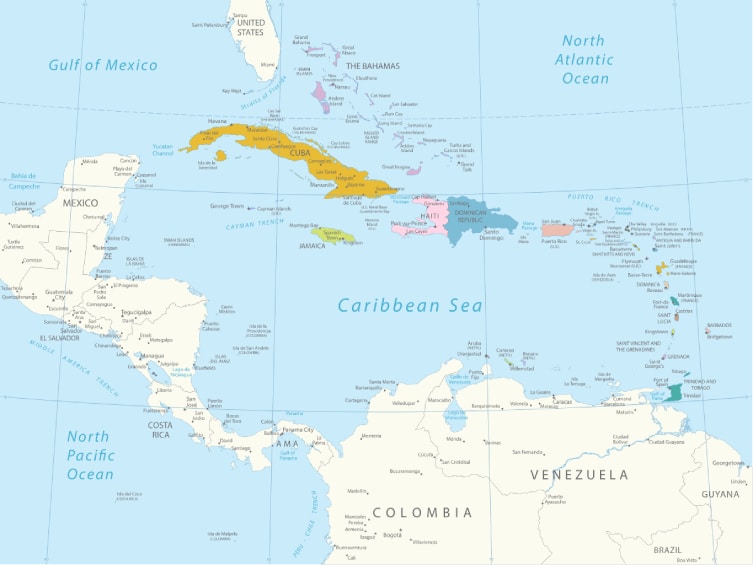
1. Haiti was first inhabited around 5000BC with farming villages established around 300BC. The Arawak people developed large communities with the Taino eventually becoming the dominant Arawak group.
2. Haiti was the world’s first black-led republic after it threw off French colonial control and slavery in the early 19th century.
3. In doing so it simultaneously became the first independent Caribbean state and the first independent nation in Latin America.
4. In 1801, the former black slave cum guerrilla leader Toussaint Louverture conquered Haiti and abolished slavery.

5. Christopher Columbus was the first European to explore Haiti in 1492. He landed and named the island La Isla Española (The Spanish Island), which later became Anglicized as Hispaniola.
6. Spain colonised the island shortly afterwards but would cede the western part of Hispaniola to France in 1697. Renamed Saint-Domingue, this would eventually become Haiti.
7. The Saint-Domingue colony would become France’s most prosperous New World territory. Thousands of slaves were transported there from Africa to work on the sugar, coffee, cacao, indigo and cotton plantations.
8. In 2010, more than 220,000 people were killed in Haiti when a magnitude 7.0 earthquake struck the capital Port-au-Prince.

9. Haiti is the poorest country in the western world when measured by GDP per capita based on purchasing power parity (PPP). It is also the poorest country in Latin America and the Carribean. Haiti had a GDP per capita of $1694.1 in 2023.
10. Haiti is also among the five hungriest countries in the world and is classified as suffering from alarming levels of hunger.
11. Voodooism – or Haitian Vodou – was developed in Haiti during the 17th and 18th centuries. The official religion is based on ancestral spirits and patron saints. There is a common adage that says Haitians are “70% Catholic, 30% Protestant, and 100% Vodou”.
12. Zombie is a Haitian word. Haitian slaves used the word in reference to their belief that dying would release them back to Guinea, or Africa in general, a form of an afterlife where they would be free.
13. Suicide was common among slaves, but it was believed that those who took their own lives would be condemned to walk the plantations for eternity as an undead slave – or soulless zombie.
14. One of the most popular sports in Haiti is cockfighting – a sport that is banned in most countries. Roosters are revered animals in Haiti and figure prominently in voodoo ceremonies.
15. The name Haiti means “mountainous country” in the language of the indigenous Taíno Indians.

16. Haiti is the second oldest independent nation in the Western Hemisphere, after the USA.
17. Following a period of instability in Haiti, culminating in the assassination of President Jean Vilbrun Guillaume Sam, the USA invaded and occupied Haiti from 1915 to 1934.
18. The most common phrase in Haitian creole is “pa gen pwoblem,” which it translates to “no have problem.” Haitians use it in a range of contexts which include replying to a thank-you, affirming well-being or even to fill an awkward silence.
19. The flag of Haiti is horizontally striped blue and red. Initially, the Haitian flag was inspired by the French Tricolor flag. However, the white stripe was quickly removed with the new blue and red representing the union of blacks and mulattoes (people of mixed white and black heritage).

See how Haiti’s flag compares to other Caribbean flags.
20. Haiti has suffered from mass deforestation. The country was once covered in verdant forests but land clearance for colonial plantations was followed by tree felling for charcoal. This has made the country dangerously exposed to other environmental threats such as floods and mudslides.
21. Haiti shares the world’s fifth-highest murder rate with Saint Vincent and the Grenadines, at 41.2 intentional homicides per 100,000 people.
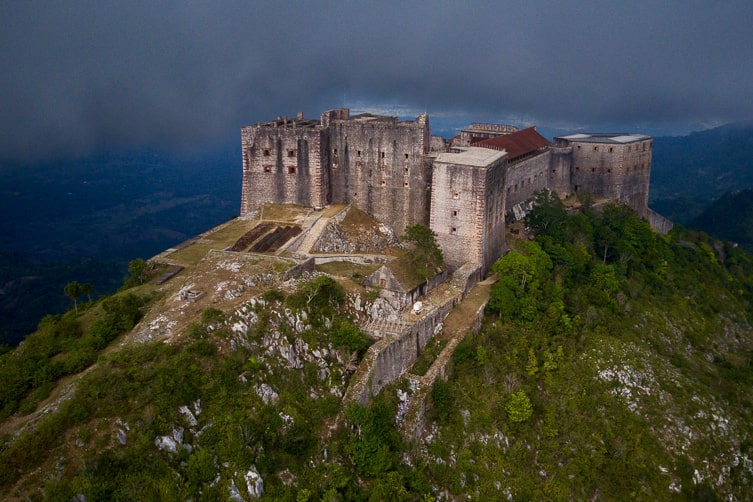
22. Haiti has one UNESCO World Heritage site, the National History Park-Citadel Sans Souci Ramiers. The monuments date from the beginning of the 19th century when Haiti declared its independence.
23. The Citadelle is the largest fortress in the Western Hemisphere.
24. During the 17th century, the rocky island of Tortuga in Haiti was a pirate stronghold for those who preyed on Spanish treasure ships in the Caribbean.
Explore more from North America
We strive to verify all facts using authoritative and primary sources where possible. However, if you find an error or have any questions, please contact us.

Caitriona Maria is an education writer and owner of The Facts Institute. With seven years of teaching experience and a background in educational content, she specialises in creating clear reference resources about countries, geography and global topics.