The last sherpas of Europe, a ‘Clapping Tower’ and the ‘Cage of Shame’ are some of the most interesting facts about Slovakia.
Fast facts
Official name: Slovak Republic
Population: 5.4 million
Area: 49,035 sq km
Capital city: Bratislava
Major languages: Slovak, Hungarian, Roma
Major religions: Christianity
Time zone: UTC+1 (Central European Time)
Interesting facts about Slovakia
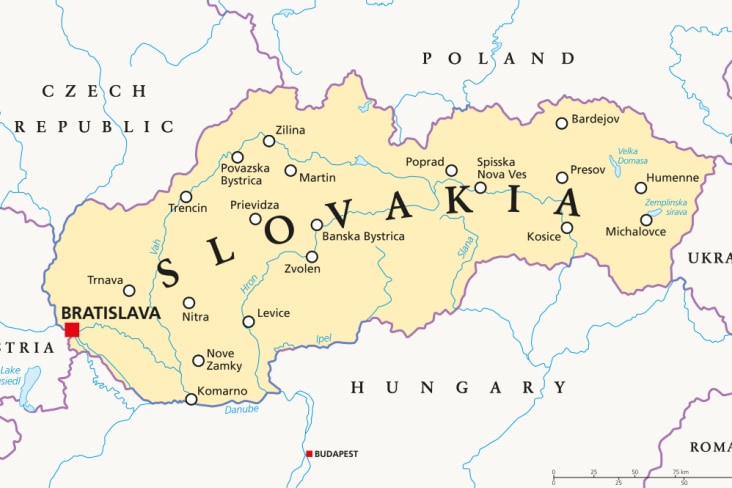
1. Slovakia is a landlocked country located in Central Europe bordering Austria, Czech Republic, Hungary, Poland and Ukraine.
2. From 1918 to 1992, Slovakia, along with the Czech Republic, was part of the former country of Czechoslovakia.
3. The relatively amicable break up of Czechoslovakia was known as the “Velvet Divorce” in reference to the bloodless Velvet Revolution that overthrew communist power in 1989.
4. The name Slovakia likely comes from the Latin word “Slavus” meaning Slav. It had the local form “Sloven” which was used since the 13th century to refer to the territory of Slovakia.
5. Slovakia is known for its exceptional concentration of caves. There are over 1,000 within its borders.
6. Slovakia’s flag is a traditional Slavic white, blue and red tricolor, similar to the flags of Russia and Slovenia, but features the country’s coat of arms of a red shield with a white cross rising from three hills – the Tatra, Fatra and Mátra ranges.

See how Slovakia’s flag compares to other European flags.
7. Brown bears, European wolves and Eurasian lynx (three of Europe’s Big Five animals) can all be found in Slovakia, particularly in its famous High Tatras National Park.
8. The highest peak in the Carpathian Mountains – the enormous range running through Austria, Czech Republic, Poland, Romania, Serbia, Slovakia and Ukraine – is in Slovakia. Gerlachovský štít in High Tatras National Park is 2,655m (8,709ft) high.
9. Adjoining Austria and Hungary, Bratislava is the only national capital to border two sovereign states.

10. Bratislava, the capital, got its name in 1919 after Czechoslovakia gained independence. It likely derives transliterations of the 9th-century military commander, Braslav, or the 11th-century Bohemian Duke Bretislav I. Finally, it may also come from the Slovak words brat (brother) and slava (glory).
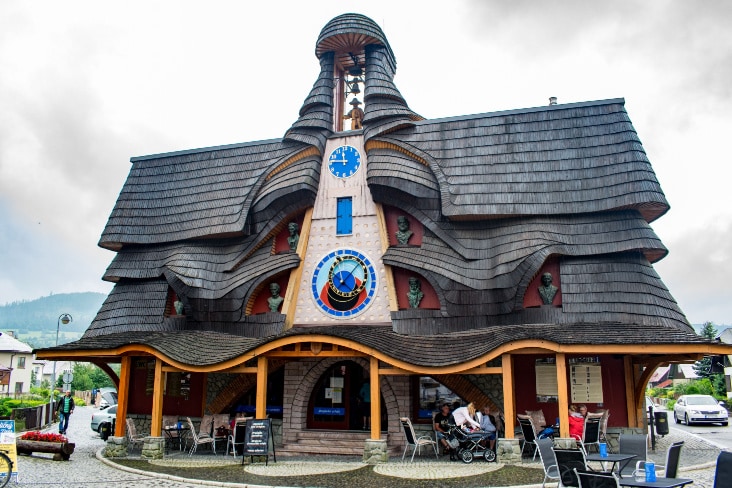
11. Slovakia has the world’s newest and most accurate astronomical clock. Built in 2009, the Stará Bystrica Astronomical Clock uses satellite-controlled software to display true solar time. As such, it’s believed to be the world’s most accurate astronomical clock.
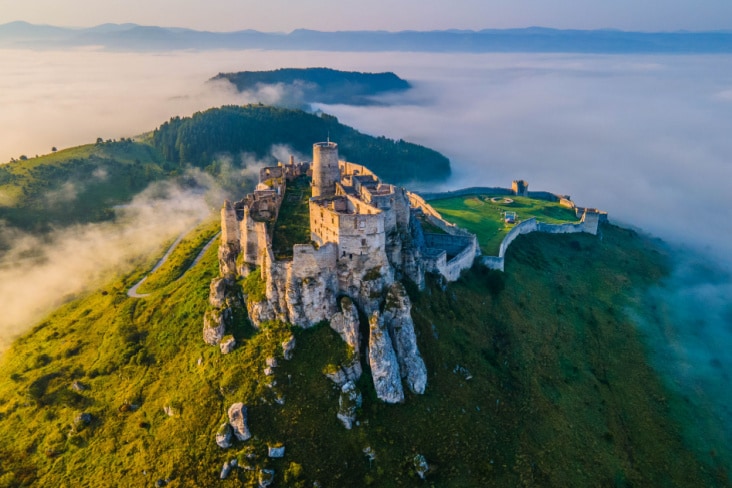
12. Spiš Castle is one of Central Europe’s largest castle complexes. Initially built in the 12th century, the castle features a 22m-high tower.
13. In Levoča there is the Cage of Shame. Here, during the 16th century, women caught on the streets after dark were imprisoned overnight in their undergarments and had their heads shaved as an example to other females.
14. Pop artist Andy Warhol’s parents came from Slovakia. Their village, Mikova, is considered a place of pilgrimage for his fans, still has some of his family living there and has converted a post office into the Andy Warhol Museum of Modern Art.

15. Other celebrities with Slovakian roots include Angelina Jolie, Alexandra Daddario, Jason Mraz, Paul Newman and Jon Bon Jovi.
16. In total, Slovakia has eight properties inscribed on the UNESCO World Heritage List.
17. Slovakia’s minimum wage is $8 per hour, or $15,944 per year, when adjusted for purchasing power parity (PPP). PPP compares wages based on real buying power rather than currency value.
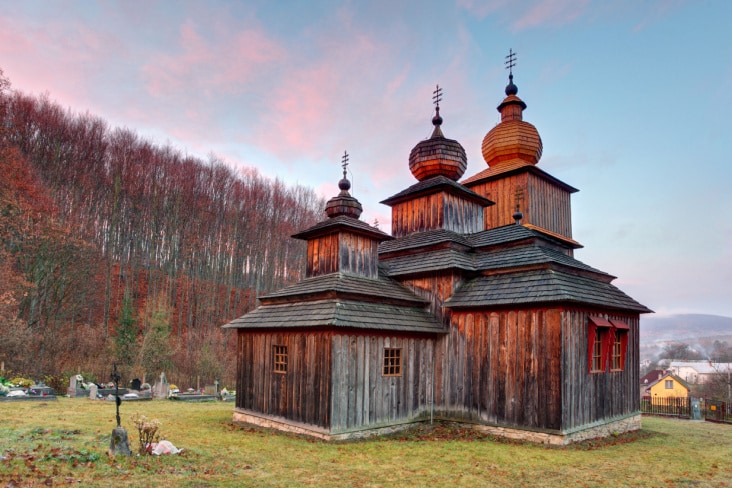
18. Slovakia is famous for its wooden churches located in the Carpathian Mountains. The eight structures include Roman Catholic, Protestant and Greek Orthodox churches built between the 16th and 18th centuries, mostly in isolated villages.
19. In the town of Banská Štiavnica, there is a Clapping Tower (Klopačka) where a giant clapping contraption was built for waking up miners. Today it still claps but only for the amusement of tourists.
20. Kofola is a popular fizzy drink in Slovakia. It was created as an alternative to Coca-Cola and Pepsi when Western goods were prohibitively expensive in the region.
21. The Basilica of St. James in Levoča has the world’s tallest wooden altar at 18.6m (61ft).

22. Slovakia’s High Tatra Mountains are home to the ‘last sherpas of Europe’. Here, it’s not unusual for porters to still carry enormous loads of up to 100kg up and down the mountain trails using skis, crampons and chains.
23. The Fujara is an extremely long flute played in Slovakia. Measuring between 160cm and 200cm, the Fujara is played with three finger holes traditionally by Slovak shepherds.
24. The village of Terchová in northwest Slovakia is known for its collective vocal and instrumental folk music, traditionally played by shepherds.
Explore more from Europe
We strive to verify all facts using authoritative and primary sources where possible. However, if you find an error or have any questions, please contact us.

Caitriona Maria is an education writer and owner of The Facts Institute. With seven years of teaching experience and a background in educational content, she specialises in creating clear reference resources about countries, geography and global topics.