A brief overview of the meaning, history, and key facts about the national flag of Mali.

Flag of Mali
The flag consists of three vertical stripes: green, yellow and red. The green stripe represents nature and agriculture, the yellow stripe symbolizes wealth, particularly the country’s gold resources, and the red stripe commemorates the sacrifice made by Mali’s forefathers in the struggle for independence.
Printable Mali Flag (PNG Download)
Interesting facts about Mali’s flag
1. The colors of the Mali flag are commonly associated with the pan-African movement and are used by several African nations.
2. The Malian flag closely resembles the flag of the former Mali Federation, a short-lived union between present-day Mali and Senegal. The federation’s flag also used green, yellow, and red vertical stripes but had a symbol in the center.
3. The flag of Mali should not be confused with the flag of Guinea, which uses the same colors in the reverse order (red, yellow, green), or the flag of Bolivia, which uses the same colors arranged horizontally.
Explore more about Mali:
Evolution of Mali’s flag
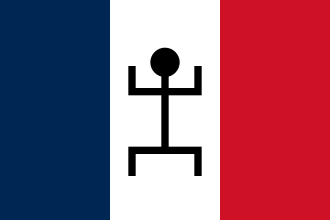
Flag of the Sudanese Republic (1958–1959)
When French Sudan became an autonomous republic within the French Community, a new flag was introduced based on the French tricolor, with a black Kanaga symbol placed in the center of the white stripe.
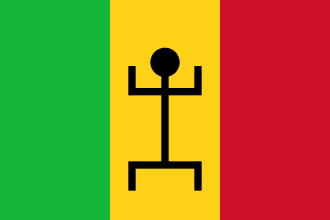
Flag of the Mali Federation (1959–1960)
The federation adopted a new flag consisting of vertical green, yellow, and red stripes with a black Kanaga symbol in the center of the yellow stripe.
History of Mali’s flag
Colonial period
During the colonial era the territory that is now Mali was known as French Sudan and formed part of the French colonial empire. The French tricolor served as the official flag of the territory for most of this period.
In 1958 French Sudan became an autonomous republic within the French Community.
Creation of the first national flag
On 4 April 1959 French Sudan and Senegal united to form the Mali Federation. A new flag was adopted consisting of three vertical stripes of green, yellow, and red with a black Kanaga symbol placed in the center.
The Kanaga symbol represented a stylized human figure with raised arms.
Independence and removal of the Kanaga
The Mali Federation gained independence from France on 20 June 1960 but soon dissolved when Senegal withdrew from the union later that year.
Mali continued using the federation flag but removed the Kanaga symbol in March 1961. The symbol was dropped largely because of opposition from Muslim groups who objected to human-like imagery on the national flag.

Caitriona Maria is an education writer and owner of The Facts Institute. With seven years of teaching experience and a background in educational content, she specialises in creating clear reference resources about countries, geography and global topics.