A brief overview of the meaning, history, and key facts about the national flag of Rwanda.
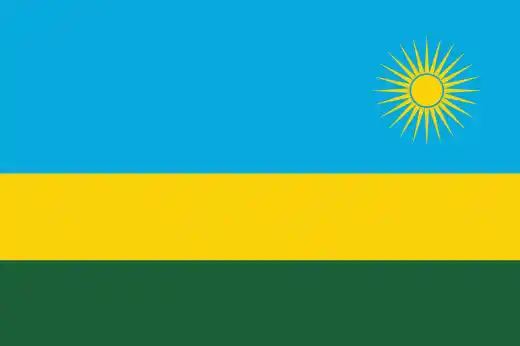
Flag of Rwanda
The national flag of Rwanda consists of three horizontal stripes of blue, yellow, and green, with a golden sun and 24 rays in the upper fly corner. The blue stripe occupies the upper half of the flag, while the yellow and green stripes each take up a quarter of the flag. Blue symbolizes peace and happiness, yellow represents economic development and green represents hope for prosperity. The golden sun represents enlightenment, unity, transparency and the fight against ignorance.
Printable Rwanda Flag (PNG Download)
Interesting facts about Rwanda’s flag
1. Rwanda adopted its current national flag on 31 December 2001, replacing an earlier red, yellow, and green flag that had been used since independence.
2. The blue stripe covers half of the flag’s height, while the yellow and green stripes each occupy one quarter.
3. The flag was designed by Rwandan artist and engineer Alphonse Kirimobenecyo.
4. The colors of the flag represent peace and happiness (blue), economic development (yellow), and hope for prosperity (green).
5. The previous Rwandan flag included a black letter “R” in the center to distinguish it from the flag of Guinea, which used the same colors.
Explore more about Rwanda:
Evolution of Rwanda’s flag
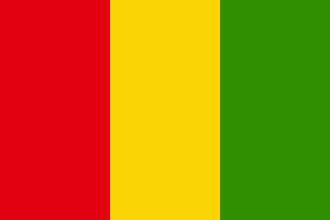
Flag of Rwanda (January–September 1961)
After the abolition of the monarchy during the Gitarama coup in 1961, Rwanda adopted a vertical tricolor of red, yellow, and green.
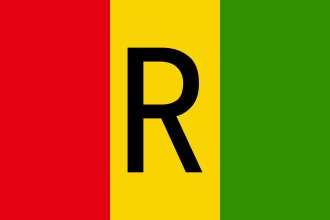
Flag of Rwanda (1961–2001)
Later in 1961 a black letter “R” was added to the center of the flag. Red represented the bloodshed for liberation, yellow peace, green hope and optimism, and black gloom and mourning. The “R” stood for Rwanda, revolution and referendum.
History of Rwanda’s flag
Colonial period
Before independence Rwanda was ruled first by Germany and later by Belgium.
After World War I the territory became part of the Belgian mandate of Ruanda-Urundi, and the Belgian national flag was used in the territory until independence.
First national flag
In January 1961 the monarchy in Rwanda was abolished during the Gitarama coup, and a republic was proclaimed.
A new national flag was introduced consisting of vertical stripes of red, yellow, and green.
Later a black letter “R” was added to the center to distinguish it from the flag of Guinea.
This flag remained in use after Rwanda gained independence from Belgium on 1 July 1962.
Adoption of the current flag
After the 1994 genocide and the rise of a new government, discussions began about replacing the national symbols associated with the previous regime.
In 1999 the government announced plans to adopt a new flag.
A nationwide design competition was held, and the winning design was created by Alphonse Kirimobenecyo, a Rwandan artist and engineer.
The new national flag was officially adopted on 31 December 2001, along with a new national anthem.
The design introduced the blue, yellow, and green stripes and the golden sun symbolizing unity, transparency and enlightenment.

Caitriona Maria is an education writer and owner of The Facts Institute. With seven years of teaching experience and a background in educational content, she specialises in creating clear reference resources about countries, geography and global topics.