A brief overview of the meaning, history, and key facts about the national flag of Thailand.

Flag of Thailand
The national flag of Thailand consists of five horizontal stripes in the order red, white, blue, white, and red. The blue stripe in the center is twice as wide as the other stripes. The red stripes represent the Thai nation and its people, the white stripes symbolize religion, and the blue stripe represents the monarchy.
Printable Thailand Flag (PNG Download)
Interesting facts about Thailand’s flag
1. The current design of Thailand’s flag was officially adopted in 1917 during the reign of King Vajiravudh (Rama VI).
2. According to a popular story, King Vajiravudh decided to redesign the flag after seeing the previous elephant flag accidentally flown upside down, which led to the creation of a symmetrical design.
3. In 1917, King Mongkut Klao Chao Yu Hua (King Rama VI) officially named Thailand’s national flag “Thong Trai Rong,” meaning “the tricolor flag.” The name refers to the flag’s three main colors: red, white, and blue.
4. The blue stripe in the center is twice as wide as the other stripes, giving the monarchy special prominence in the design.
5. December 5, the birthday of the late King Bhumibol Adulyadej (Rama IX), is celebrated as Thailand’s National Day and Father’s Day. The date honors the long-reigning monarch, who ruled the country for more than 70 years. On this day, the national flag is widely displayed across the country.
Explore more about Thailand:
Evolution of Thailand’s flag

Plain red flag (c. 1680–1782)
One of the earliest known flags used by Siam was a simple red flag.
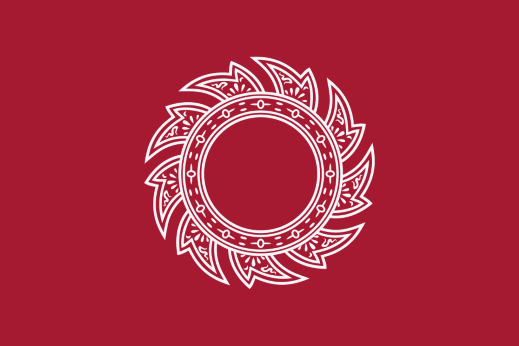
Red flag with a white chakra (1782–1817)
After the founding of the Chakri dynasty, a white chakra, associated with Hindu mythology, was added to the red flag.
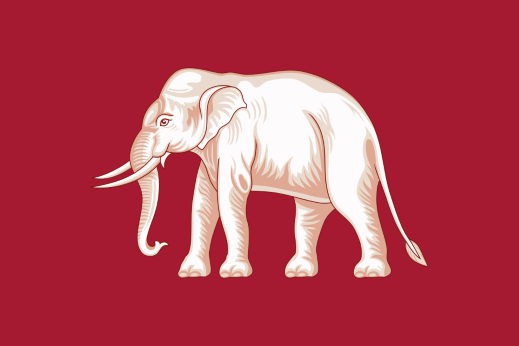
Red flag with a white elephant (1817–1916)
The chakra symbol was later replaced with a white elephant, a royal and religious symbol.

Red and white striped flag (1916–1917)
In 1916 King Vajiravudh introduced a new flag consisting of five horizontal red and white stripes.
History of Thailand’s flag
Early flags of Siam
The earliest known national flag of Siam, as Thailand was officially called at the time, was a plain red banner, used from the 17th century during the Ayutthaya period. As Siam expanded its international trade and diplomatic relations, more distinctive flags were introduced.
During the reign of King Rama I in the late 18th century, a white Sudarshana Chakra (a sacred symbol associated with the Hindu god Vishnu) was added to the red field. This emblem represented the Chakri dynasty, which still rules Thailand today. It was used to distinguish royal ships from ordinary vessels.
In the early 19th century the design was modified again to feature a white elephant, an important royal and religious symbol in Thai culture. The elephant flag remained the national flag of Siam for many decades.
Creation of the tricolor design
In 1916 King Vajiravudh (Rama VI) replaced the elephant flag with a symmetrical design of red and white stripes. According to a popular story, the king ordered the change after seeing the elephant flag mistakenly flown upside down.
The following year, on 28 September 1917, the central stripe was changed to blue, forming the modern tricolor design seen today.

Caitriona Maria is an education writer and owner of The Facts Institute. With seven years of teaching experience and a background in educational content, she specialises in creating clear reference resources about countries, geography and global topics.