Continents are large, continuous landmasses that form the Earth’s land surface. They are commonly defined as distinct regions separated by oceans or major geographic features.
Together, the continents cover approximately 148 million square kilometers (57 million square miles) of land, accounting for about 29% of the Earth’s surface. While continents vary widely in size, climate, and population, they serve as the primary geographic divisions of the planet.
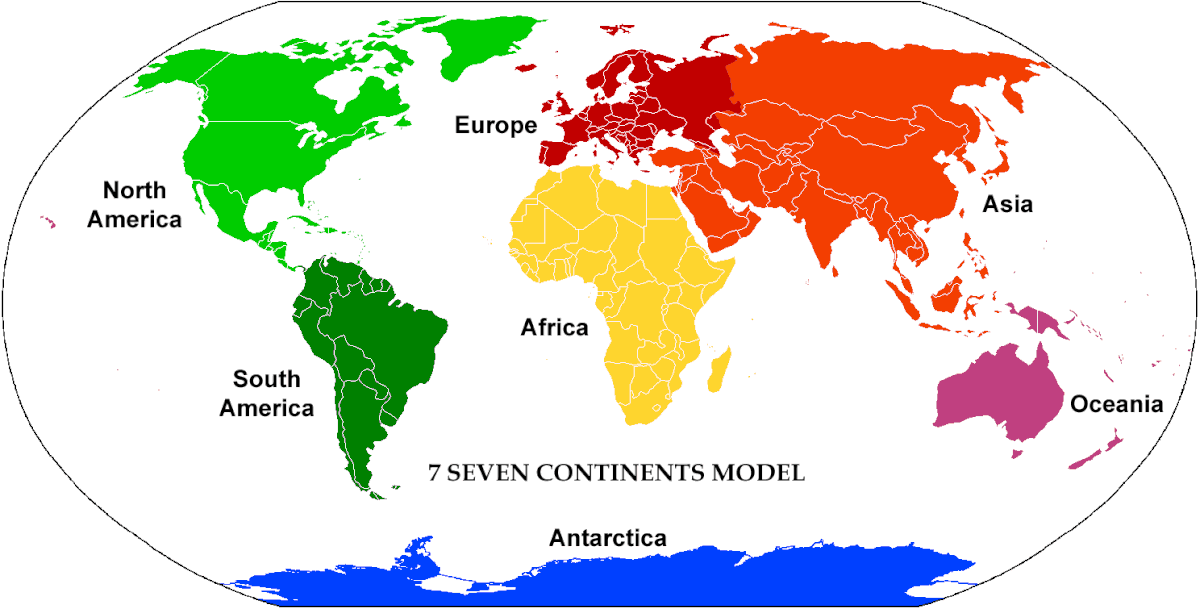
The seven continents
The seven continents are:
- Africa
- Antarctica
- Asia
- Australia (Oceania)
- Europe
- North America
- South America
This seven-continent model is the standard used in modern education, atlases, and most reference works.
Alternative continent models
While the seven-continent model is the most commonly used today, other continent classifications exist in academic and regional contexts.
Some models combine Europe and Asia into a single continent known as Eurasia, resulting in a six-continent model. Other models merge North and South America into a single continent, producing a five-continent model.
These alternative models are less widely used in contemporary education and reference materials. For consistency and clarity, this article follows the seven-continent model.
Population distribution by continent
The world’s population is estimated at approximately 8.06 billion people (2024), according to the Central Intelligence Agency (CIA) World Factbook.
Population is unevenly distributed across continents, with Asia and Africa accounting for the majority of the global population.
| Continent | Total Land Area (Km²) | Population (most recent estimate) |
|---|---|---|
| Africa | 30,365,000 | 1,480,771,000 |
| Antarctica | 14,200,000 | 0 |
| Asia | 44,614,000 | 4,772,123,000 |
| Australia (Oceania) | 9,000,000 | 52,600,000 |
| Europe | 10,000,000 | 751,000,000 |
| North America | 24,230,000 | 592,000,000 |
| South America | 17,814,000 | 434,000,000 |
For a detailed comparison of continents by land area and population share, see our ranking of the largest continents in the world.
Africa
Africa is the second-largest continent by both land area and population. It contains 54 internationally recognized sovereign states, with some institutions also recognizing the Sahrawi Arab Democratic Republic as a disputed additional state.
Africa has the youngest population profile of any continent and is experiencing the fastest population growth globally.
Asia
Asia is the largest and most populous continent, accounting for more than half of the world’s population.
There are 49 countries in Asia, some of which extend to the continents of Africa and Europe. The status of some territories, such as Taiwan, is subject to international dispute.
Asia’s scale means that demographic changes within the continent strongly influence global population trends.
Australia
Australia, often grouped with surrounding Pacific island nations as Oceania, is the smallest continent by land area.
The region includes 17 countries, with Australia accounting for the vast majority of the continent’s landmass and population.
Antarctica
Antarctica has no permanent residents and is governed through international agreements rather than national sovereignty.
Human activity on the continent is limited almost entirely to scientific research and seasonal operations. Several countries (Argentina, Australia, Chile, France, New Zealand, Norway, and the United Kingdom) maintain territorial claims, though these are not widely recognized.
Europe
Europe, though the second smallest continent by land area, has a moderate population density and a long history of urban settlement.
There are 49 countries in Europe, with 27 members of the European Union (EU).
North America
North America includes 23 countries, extending from Arctic island chains in the north to the Isthmus of Panama in the south.
North America is the third-largest continent after Asia and Africa.
South America
South America is the closest continent to Antarctica, located mostly in the Southern Hemisphere.
It is divided into 12 countries, the largest of which is Brazil.
Related: How many countries are there?
A worthy mention: Eurasia
Eurasia exists as a concept because Europe and Asia are technically part of the same continuous landmass. Geographically, there’s no clear natural boundary that fully separates the two regions.
Despite this geographic continuity, Europe and Asia are traditionally regarded as separate continents for historical, cultural, and political reasons.
Europe developed different civilizations, cultures, and political systems from those in Asia, leading to their classification as distinct continents even though they are physically connected.
Continents and their oceans
While continents account for about 29% of the Earth’s surface, the remaining 71% is covered by water.
The Pacific, Atlantic, Indian, Arctic, and Southern (Antarctic) Ocean separate and surround the continents.
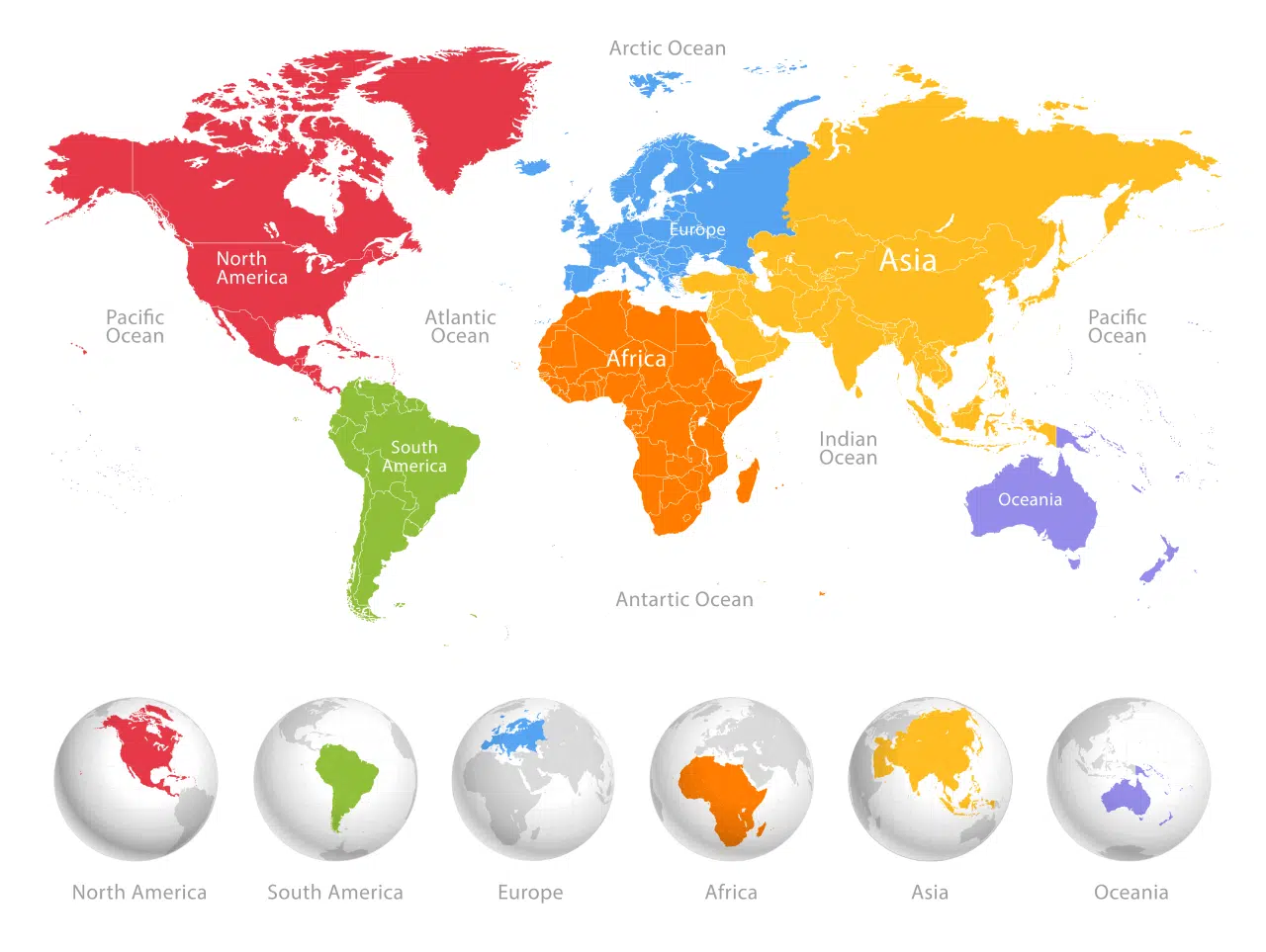
Countries listed by continent
A list of all the countries in the world and the continents to which they belong:

Caitriona Maria is an education writer and owner of The Facts Institute. With seven years of teaching experience and a background in educational content, she specialises in creating clear reference resources about countries, geography and global topics.