Australia is the smallest continent but the sixth-largest country globally. With a diverse population of almost 27 million people, it makes up over 50% of Oceania’s total population.
While Australia is considered a continent, it does not include all of the surrounding islands, which is why the broader region is referred to as Oceania.
Oceania, or the “marine continent”, is a region that is made up of thousands of islands. It includes four main regions: Australasia (Australia and New Zealand), Melanesia, Micronesia, and Polynesia. It also includes the US state of Hawaii.

Papua New Guinea, Indonesia’s Western New Guinea, and New Zealand comprise 40% of the population of Oceania, with the rest of the population spread out among the much smaller island countries and dependencies.
Most of Oceania is scattered throughout the Pacific Ocean, the largest and deepest Ocean basin on the planet, and forms a central part of the broader Asia-Pacific region. It was the last great region of the world to be settled by humans.
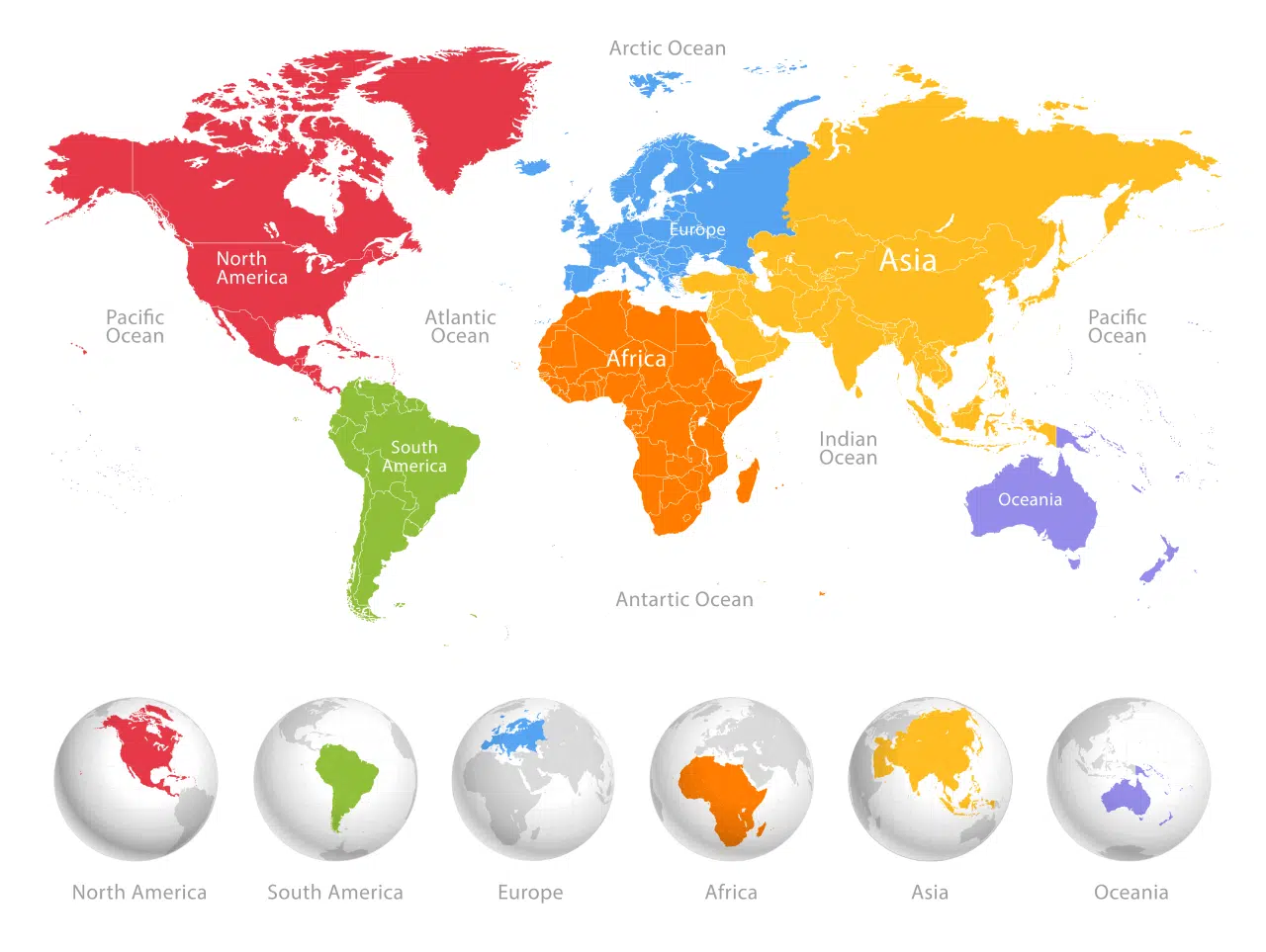
Australia and Oceania countries in alphabetical order
Here is the alphabetical list of the countries in Oceania, along with their capitals. We have also included the countries’ regions and the international standard for country codes (ISO 3166).
Looking for a map of all the Oceanian countries with their names and borders? You’ll find it further down the page, or you can jump straight to the map here.
Download: List of the Oceanian countries.
Do you know the countries of Oceania?
Loading activity…
Australia and Oceanian map
Our printable Oceanian maps show the exact locations of each country.

How many countries are in Oceania?
There are 16 widely recognized countries in the Australia and Oceania region: Australia, Cook Islands, Fiji, Kiribati, Marshall Islands, Micronesia, Nauru, New Zealand, Niue, Palau, Papua New Guinea, Samoa, Solomon Islands, Tonga, Tuvalu and Vanuatu.
Some geographic classifications also include Indonesia, since its eastern provinces (Papua and West Papua, along with nearby islands) lie on the Australian continental shelf.
Geologically, this places part of Indonesia within the Australian continent, even though politically and culturally the country is grouped with Asia.
Related: How many countries are there in the world?
United Nations members in Australia and Oceania
The United Nations (UN) recognizes 14 of these as member states:
- Australia
- Fiji
- Kiribati
- Marshall Islands
- Micronesia
- Nauru
- New Zealand
- Palau
- Papua New Guinea
- Samoa
- Solomon Islands, The
- Tonga
- Tuvalu
- Vanuatu
View their country flags here.
The Cook Islands and Niue are not yet recognized as United Nations members despite operating as independent, self-governing countries.
The Cook Islands (consisting of 15 islands) and Niue (a single island) are in “Free Association” with New Zealand. New Zealand retains limited responsibility and support in the areas of defense and foreign affairs.
The United States, part of the North American continent, recognized the Cook Islands and Niue as sovereign and independent states in September 2023.
Next: Country names of the world.

Caitriona Maria is an education writer and owner of The Facts Institute. With seven years of teaching experience and a background in educational content, she specialises in creating clear reference resources about countries, geography and global topics.

Naa-Atswei Mawufemor Lomo is a content writer who contributes educational articles to The Facts Institute. With a background in communication and digital publishing, she specialises in presenting complex information in an accessible and reader-friendly way.