The Asia-Pacific (APAC) is a broad geographic, economic, and geopolitical term used to describe a large region spanning parts of East Asia and Southeast Asia alongside Oceania, centered around the western and central Pacific Ocean.
Unlike formal continental divisions, the Asia-Pacific is not a fixed geographic region and is not defined as an official subregion under the United Nations (UN) geoscheme. Its boundaries vary depending on political, economic, institutional, and strategic context.
As a result, the term is descriptive rather than strictly geographic, and its definition changes depending on whether it is being used in academic, economic, diplomatic, or geopolitical frameworks.
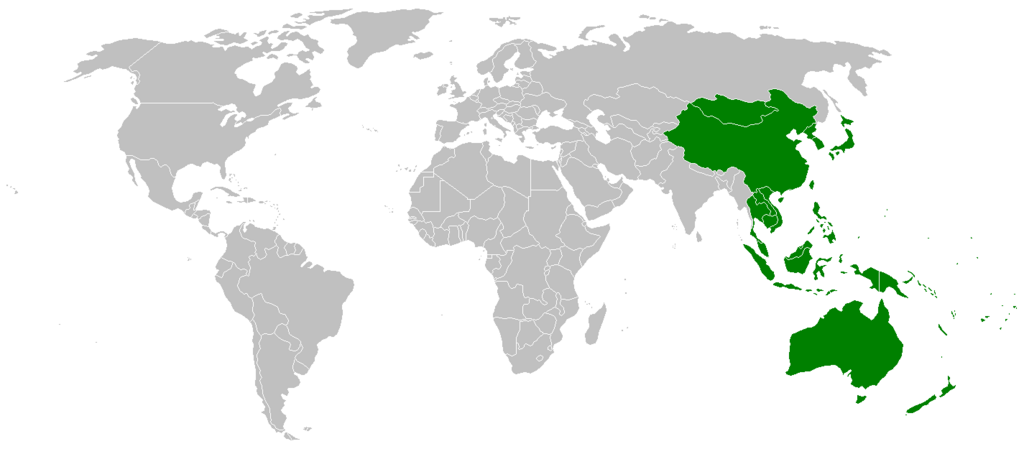
Some definitions of the Asia-Pacific follow frameworks used by the United Nations Economic and Social Commission for Asia and the Pacific (ESCAP), which groups countries into multiple subregions across Asia and the Pacific.
In geopolitical usage, the Asia-Pacific is often defined as the part of the Old World outside Europe, the Middle East and Africa (EMEA) region, focused around the western Pacific basin.
For clarity, this page presents the countries most commonly included in definitions of the Asia-Pacific region, while acknowledging areas of overlap and variation.
Countries commonly considered part of the Asia-Pacific
The following countries are most consistently included in standard definitions of the Asia-Pacific:
East Asia
- China
- Japan
- Mongolia
- North Korea
- South Korea
- Taiwan
Southeast Asia
- Brunei
- Cambodia
- Indonesia
- Laos
- Malaysia
- Myanmar
- Philippines
- Singapore
- Thailand
- Timor-Leste
- Vietnam
Oceania / Pacific region
- Australia
- Fiji
- Kiribati
- Marshall Islands
- Micronesia
- Nauru
- New Zealand
- Palau
- Papua New Guinea
- Samoa
- Solomon Islands
- Tonga
- Tuvalu
- Vanuatu
These countries form the core Asia-Pacific region in most academic, economic, and policy-based definitions.
Sometimes included in broader definitions
Some broader or alternative definitions of the Asia-Pacific may also include:
South Asia
- Afghanistan
- Bangladesh
- Bhutan
- India
- Iran
- Maldives
- Nepal
- Pakistan
- Sri Lanka
South Asian countries are often included in economic and geopolitical uses of the term, particularly in regional development frameworks and international trade groupings.
Central Asia
- Kazakhstan
- Kyrgyzstan
- Tajikistan
- Turkmenistan
- Uzbekistan
In wider geopolitical or strategic contexts, Central Asian states may also be grouped into Asia-Pacific frameworks.
Caucasus region
- Armenia
- Azerbaijan
- Georgia
- Turkey
- Russia
Pacific-adjacent countries in the Americas
- United States
- Canada
- Mexico
- Chile
- Peru
Some institutional definitions, such as those used by Asia-Pacific Economic Cooperation (APEC), include Pacific-adjacent countries in the Americas as part of trans-Pacific regional frameworks.
Because of these variations, no single, universal country list exists for the Asia-Pacific region.
Asia-Pacific countries table
The countries listed above are commonly grouped together in regional studies, economic reports, geopolitical analysis, and international policy frameworks.
| Country | Region |
|---|---|
| Australia | Oceania / Pacific region |
| Brunei | Southeast Asia |
| Cambodia | Southeast Asia |
| China | East Asia |
| Fiji | Oceania / Pacific region |
| Indonesia | Southeast Asia |
| Japan | East Asia |
| Kiribati | Oceania / Pacific region |
| Laos | Southeast Asia |
| Malaysia | Southeast Asia |
| Marshall Islands | Oceania / Pacific region |
| Micronesia | Oceania / Pacific region |
| Mongolia | East Asia |
| Myanmar | Southeast Asia |
| Nauru | Oceania / Pacific region |
| New Zealand | Oceania / Pacific region |
| North Korea | East Asia |
| Palau | Oceania / Pacific region |
| Papua New Guinea | Oceania / Pacific region |
| Philippines | Southeast Asia |
| Samoa | Oceania / Pacific region |
| Singapore | Southeast Asia |
| Solomon Islands | Oceania / Pacific region |
| South Korea | East Asia |
| Taiwan | East Asia |
| Thailand | Southeast Asia |
| Timor-Leste | Southeast Asia |
| Tonga | Oceania / Pacific region |
| Tuvalu | Oceania / Pacific region |
| Vanuatu | Oceania / Pacific region |
| Vietnam | Southeast Asia |
For broader context, you can also explore how these nations compare in size and population across continents.
How the Asia-Pacific is defined
The concept of the Asia-Pacific developed primarily in the late 20th century as global trade, finance, and political cooperation increasingly focused on the Pacific Basin.
The term became widely used to describe a region shaped by:
- shared Pacific trade routes
- economic integration and supply chains
- maritime connectivity
- geopolitical cooperation
- regional development frameworks
- trans-Pacific diplomacy
Over time, the Asia-Pacific evolved into a practical regional concept used in international trade policy, economic forecasting, security cooperation, academic research, geopolitical strategy, and institutional governance.
In economic contexts, the term “Asia-Pacific excluding Japan (APEJ)” is sometimes used to describe emerging markets within the region, reflecting how financial and investment frameworks segment regional economies.
Although its boundaries remain flexible, the term persists because it reflects real economic, political, and strategic relationships that transcend continental boundaries.
Related regional terms
Asia-Pacific is often discussed alongside related regional concepts, including:
- Indo-Pacific
- Pacific Rim
- Oceania
- Europe, the Middle East and Africa (EMEA)
- The Middle East and North Africa (MENA)
Each of these terms describes different types of regional grouping based on geography, politics, economics, or strategy.

Caitriona Maria is an education writer and owner of The Facts Institute. With seven years of teaching experience and a background in educational content, she specialises in creating clear reference resources about countries, geography and global topics.