From an annual p***s festival to the world’s highest density of vending machines, these are the most interesting facts about Japan.

Fast facts
Official name: Japan
Population: 123.7 million
Area: 377,915 sq km
Capital city: Tokyo
Major languages: Japanese
Major religions: Shintoism, Buddhism
Time zone: UTC+9 (Japan Standard Time)
Interesting facts about Japan
1. Japan is an island nation located in Eastern Asia in the North Pacific Ocean and is a key country within the Asia-Pacific region.
2. Japan is made up of four main islands: Hokkaido, Honshu, Shikoku and Kyushu as well as a further 6,848 smaller islands and islets.
3. Japan is located on the Ring of Fire, an arc of active volcanoes and earthquake epicenters bordering the Pacific Ocean. A tremor occurs in Japan around every five minutes, and each year, there are up to 2,000 earthquakes that can be felt by people – the densest seismic network in the world.
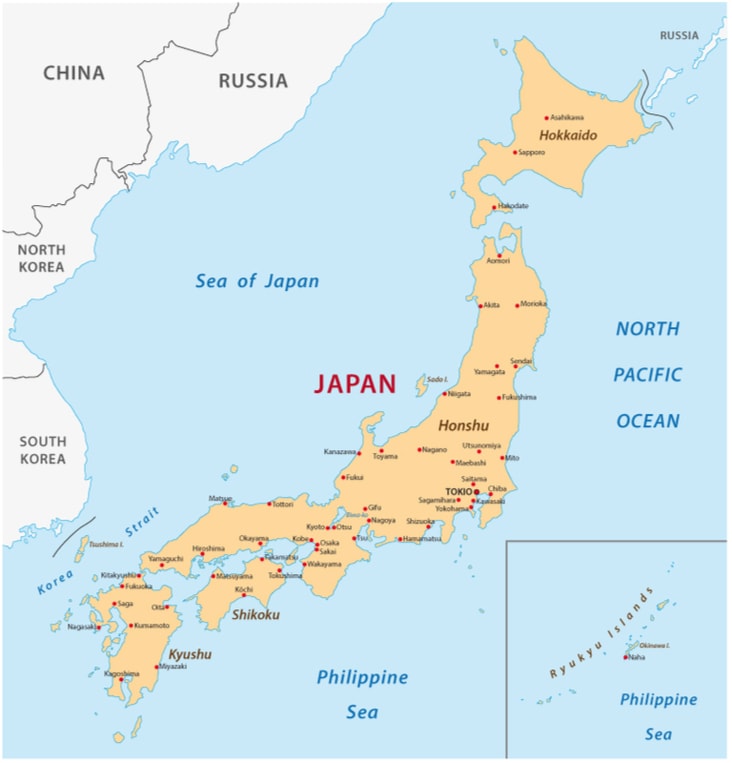
4. Japan has been inhabited for around 30,000 years. Originally, its main islands were connected to Siberia and Korea by bridges of dry land which allowed people to migrate across on foot.
5. Japan followed a policy of national seclusion known as sakoku (literally “closed country”) for over 200 years from the 1630s to 1867. During this time, foreign nationals were barred from entering Japan, Christianity and international travel were forbidden and relations and trade between Japan and other countries were severely restricted.
6. Adopted in 1999, Japan’s flag features a red disc on a white background. The red disc – called Hinomaru – denotes the sun, a traditional symbol of Japan. The white represents purity and honesty.

See how Japan’s flag compares to other Asian flags.
7. Japan’s name means “where the sun originates” or “Land of the Rising Sun”. In Japanese, the name is Nippon or Nihon. The English word for Japan comes from the Chinese name for the country, “Cipangu”.
8. Japan is the seventh-most populous country in Asia and the twelfth-most populous in the world.
9. Japan went through a remarkable giant-statue boom between 1980s and 1990s. In just those few years, the country completed the 73 m Kaga Kannon, 88 m Kita no Miyako Kannon, 92 m Sendai Dai Kannon and 100 m Ushiku Daibutsu, all of which remain among the world’s tallest statues today.

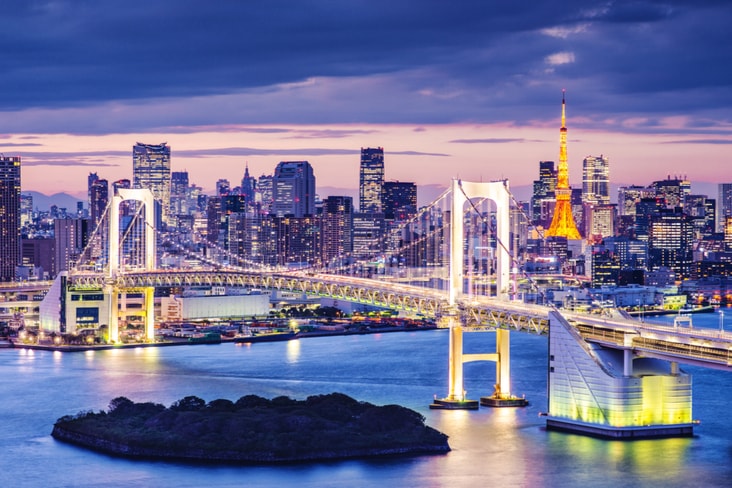
10. The capital, Tokyo, was originally known as Edo, meaning “estuary” in Japanese. In 1868, its name was changed to Tokyo meaning “eastern capital”.
11. Tokyo is considered the world’s largest city, with 37 million residents in the metropolitan area and 14 million in the city proper.
12. Despite its size, Tokyo remains one of the safest cities in the world, ranking 5th globally with a score of 80 in the Safe Cities Index and taking first place worldwide for health security.
13. Tokyo is also one of the world’s most significant global cities, overtaking New York to become the 2nd most powerful city in the 2025 Global Power City Index (GPCI).
14. At 84 years, Japan has one of the highest life expectancies in the world.
15. At just 1.23 births per woman, Japan has one of the lowest fertility rates in the world, with the number of births consistently declining since 1973. Experts have suggested that by 2070, the country’s population could decline to around 87 million.
16. Around half the world’s zippers are made in Japan. Founded in 1934, the Yoshida Kōgyō Kabushikigaisha – YKK – company produces around 7 billion zippers a year.
17. With over 5 million, Japan has the highest density of vending machines in the world – one for every 23 people.
18. Busy trains in Japan (particularly in Tokyo) employ “pushers” known as oshiya. Attendants were employed to physically push people onto packed trains at busy stations. Since 2000, the practice has become less widespread due to improved congestion.

19. As such, Japan is considered a “super-aged” nation, meaning more than 20% of its population is older than 65. It’s the world’s fastest-aging country.
20. Japan saw a positive net migration of about 153,400 in 2024, reflecting its gradual policy shift toward accepting more foreign workers. Despite a declining population, Japan is easing immigration rules to address labor shortages.
21. Japan has an annual p***s festival. Dating from the 17th century, the Kanamara Matsuri (Festival of the Steel Phallus) sees a 2.5m (8.2ft) tall pink p***s paraded through streets, vegetables carved into suggestive shapes as well as p***s-themed paraphernalia such as lollipops and lucky charms sold.

22. In 2012, a “cuddle cafe” called Soineya (sleep together shop) opened in Tokyo. Patrons pay around 3,000 Yen ($23) for a twenty-minute cuddle.
23. Japan records an average of 6.3 liters of pure alcohol consumed per person each year, surprisingly moderate given its reputation for sake and after-work drinking. Consumption has been falling for years as younger generations drink far less than their parents. Ironically, the government has launched a “Sake Viva!” campaign to encourage young adults to drink more, hoping to revive the alcohol industry and boost tax revenue.
24. Japan is home to many of the world’s oldest companies. Kongo Gumi, a construction company founded back in 578, is believed to have been the world’s oldest business surviving over 1,400 years before it went into liquidation in 2006.
25. Japan’s national sport is sumo wrestling. The sport, up to 2,000 years old, sees near-naked wrestlers weighing on average 136kg (300lb) – but sometimes up to 272kg (613lb) – try to knock opponents down or out of the ring – known as a dohyō.

26. Japanese melons can cost over $100 USD. Known as “high-end fruit”, a single melon can sell for upwards of 15,000 Yen ($120), a bunch of grapes for 8,000 Yen ($63) and premium white strawberries for 3,000 Yen ($23) each.
27. Japan has 25 properties inscribed on the UNESCO World Heritage List.
28. The most famous of which is Japan’s most sacred mountain, Mount Fuji. At 3,776m (12,388ft), it is the country’s highest peak. Around 300,000 people climb Mount Fuji every year.

29. Japanese scientists created a completely organic way to make ice cream retain its shape and not melt for up to three hours.
30. In 1904, Japan became the first Asian country in modern times to defeat a European power when it overcame Russia in Manchuria.
31. There is a highway in Japan that passes through a building. The Hanshin Expressway has an offramp that passes through the 16-story Gate Tower Building in Osaka.

32. Japan has the world’s fourth-largest economy behind the USA, China and Germany. Its GDP is 4.2 trillion, while Germany is at 4.4 trillion USD.
33. Japan spends about $5,387 per person each year on healthcare (PPP), and it maintains some of the strongest overall health outcomes globally across multiple measures.
34. Japan is the only modern nation to refer to its head of state as emperor. Since 2019, Emperor Naruhito is the current and 126th emperor in a line that extends back to the country’s founding in 600 BC by Emperor Jimmu. As such, it is the world’s oldest hereditary monarchy.
35. In 1945, Japan became the first and only country to ever have a nuclear weapon deployed outside testing on its territory. The cities of Hiroshima and Nagasaki were both bombed, killing around 224,000 people in total and bringing about an abrupt end to the Second World War in Asia.

36. The world’s deepest underwater postbox is in Japan, located 10m (32ft 9in) beneath the surface of Susami Bay.
37. Japan is among the top-ranking countries when it comes to powerful passports. The Japanese passport can easily access 194 destinations.
38. Japan has one of the world’s lowest murder rates. The latest figures show it records just 0.23 intentional homicides per 100,000 people.
39. Japan is one of the least obese nations. Most notably, it ranks ninth-least obese country in the world by female population.
Explore more from Asia
We strive to verify all facts using authoritative and primary sources where possible. However, if you find an error or have any questions, please contact us.

Caitriona Maria is an education writer and owner of The Facts Institute. With seven years of teaching experience and a background in educational content, she specialises in creating clear reference resources about countries, geography and global topics.