A brief overview of the meaning, history, and key facts about the national flag of the United States, also known as the American flag.
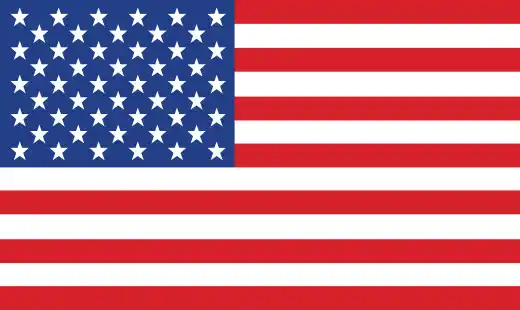
Flag of the United States
The current 50-star version of the US flag was officially adopted in 1960. It features 13 horizontal stripes representing the 13 original colonies that became the first states. Fifty stars form a constellation pattern in a blue rectangle in the upper left corner, symbolizing the union of the 50 states.
Printable United States Flag (PNG Download)
Interesting facts about the American flag
1. The United States flag has had 27 official versions since 1777, with a new star added each time a state joined the Union.
2. For a short period between 1795 and 1818, the flag featured 15 stars and 15 stripes to represent Vermont and Kentucky before Congress decided to permanently return to 13 stripes.
3. The 50-star design has been in use since 1960, making it the longest-used version of the US flag.
4. The current 50-star design was created by 17-year-old Robert G. Heft as a school project in 1958. His design was later chosen as the official national flag.
5. Although no official meaning was assigned to the flag’s colors in 1777, the red, white, and blue are traditionally associated with the meanings later given to the Great Seal of the United States: red for valor, white for purity, and blue for vigilance and justice.
6. Six US flags were planted on the Moon during the Apollo missions.
7. While flag burning is controversial, it is protected as free speech under US Supreme Court rulings. At the same time, the US Flag Code recommends burning as a dignified method for retiring a worn or damaged flag.
Evolution of the US flag
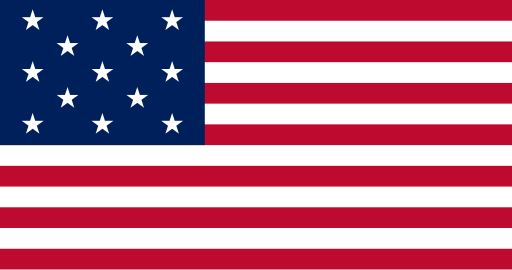
First official US flag
The 13-star 13-stripe flag became the first official flag of the United States in 1777.
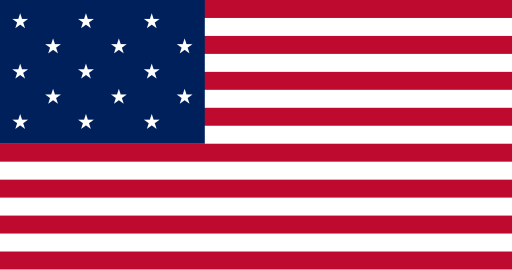
15-star flag
The 15-star, 15-stripe flag was adopted in 1795 to recognize Vermont and Kentucky as new states.
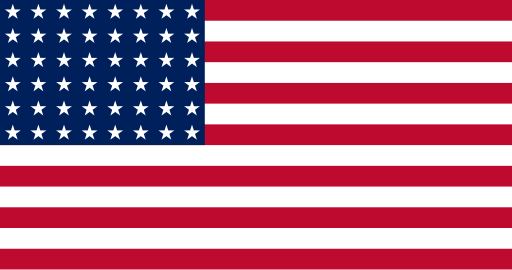
48-star flag
The 48-star version appeared in 1912 after New Mexico and Arizona joined the Union.
History of the American flag
The first official flag of the United States was adopted on June 14, 1777, during the American Revolutionary War. The Continental Congress passed a resolution stating that the flag should have thirteen stripes, alternating red and white, and thirteen white stars on a blue field representing a new constellation. The stripes symbolized the thirteen original colonies that had declared independence from Britain.
Before this resolution, several unofficial flags were used, including the Continental Union Flag (also known as the Grand Union Flag), which featured thirteen stripes and the British Union flag in the canton. This design reflected the colonies’ complicated relationship with Britain in the early stages of the Revolution.
As new states joined the Union, stars were added to the flag. In 1795, both stars and stripes were increased to fifteen to represent Vermont and Kentucky. However, Congress later decided to permanently return the stripe count to thirteen in 1818 to honor the original colonies, while continuing to add a star for each new state.
The flag has been updated 27 times in total. The current 50-star version was adopted on July 4, 1960, following Hawaii’s admission as the 50th state. While the overall structure of thirteen stripes and a blue canton has remained consistent, the arrangement of stars has changed over time to reflect the growth of the United States.
Today, the American flag is defined by federal law, and its design and proportions were standardized in 1912. It remains one of the most recognizable national flags in the world.

Caitriona Maria is an education writer and owner of The Facts Institute. With seven years of teaching experience and a background in educational content, she specialises in creating clear reference resources about countries, geography and global topics.