A brief overview of the meaning, history, and key facts about the national flag of Nicaragua.
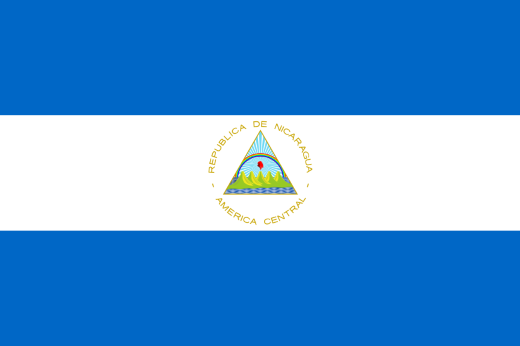
Flag of Nicaragua
Adopted in 1908, Nicaragua’s flag consists of three horizontal stripes of blue, white and blue, with the national coat of arms in the center. The blue stripes represent justice and loyalty, while the white stripe symbolizes purity and integrity. The coat of arms features an equilateral triangle with five volcanoes between two oceans, representing the five original nations of Central America.
Printable Nicaragua Flag (PNG Download)
Interesting facts about Nicaragua’s flag
1. Nicaragua’s flag reflects the country’s historical connection to the former Central American federation and its aspiration for renewed regional unity.
2. The 1908 decree establishing the flag did not officially define the meaning of its colors; most interpretations of the symbolism developed later.
3. Nicaragua’s coat of arms includes a rainbow containing the color purple, making the flag one of the few national flags in the world to feature purple.
4. The current flag design was first adopted in 1908 and later standardized by law in 1971.
5. The country briefly used a yellow–white–red tricolor in 1854.
6. Nicaragua recognizes both the traditional blue-and-white flag and the red-and-black Sandinista banner as official national symbols.
7. In 2025, Nicaragua moved its official Flag Day from July 14 to May 4. The new date commemorates the anti-imperialist struggle of Augusto C. Sandino and is now celebrated annually as both National Dignity Day and National Flag Day.
Explore more about Nicaragua:
Evolution of the Nicaragua flag
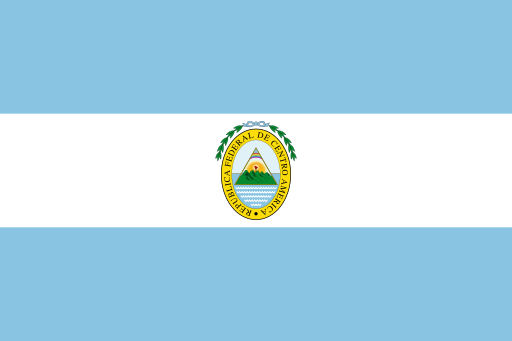
Federal Republic of Central America (1823–1838)
This flag, used by the Federal Republic of Central America, featured a blue–white–blue horizontal triband with the federal coat of arms in the center.

Nicaragua yellow–white–red tricolor (1854)
This national flag consisted of yellow, white, and red horizontal stripes. The state version included a coat of arms in the center.
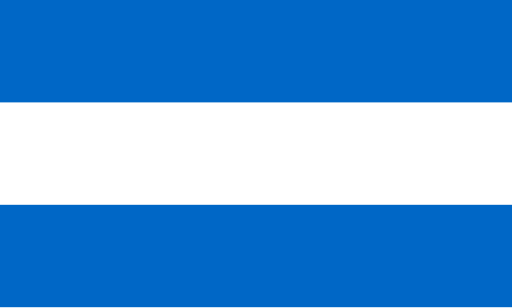
Nicaragua blue–white–blue flag (1858–1889)
This version restored the traditional blue–white–blue colors associated with the former Central American federation and the idea of regional unity.
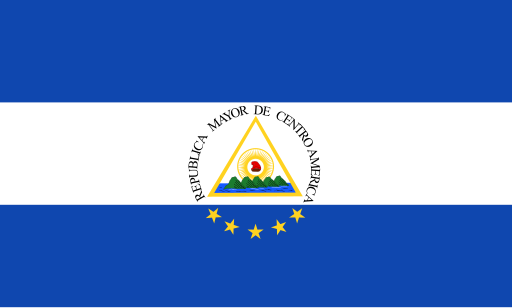
Greater Republic of Central America (1896–1898)
The union used a blue–white–blue flag similar to the earlier federation banner, featuring a modified coat of arms.
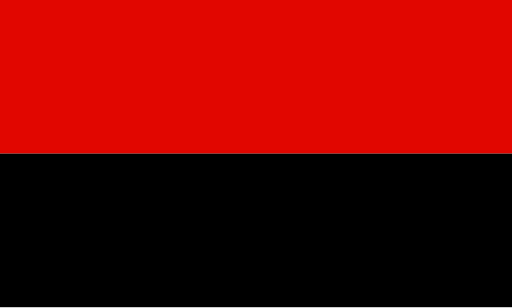
Sandinista red–black flag
The red-and-black banner is officially recognized alongside the blue-and-white flag as a national symbol of Nicaragua.
History of the Nicaraguan flag
Origins in the Central American Federation (1823–1838)
After gaining independence from Spain in 1821, Nicaragua became part of the United Provinces of Central America, later known as the Federal Republic of Central America.
The federation adopted a blue–white–blue horizontal triband with a coat of arms in the center. Many elements of this emblem, including the triangle, volcanoes, Phrygian cap, and rainbow, later influenced Nicaragua’s modern coat of arms.
The 1854 tricolor flag
After the collapse of the Central American Federation, Nicaragua continued using the blue–white–blue flag for several years.
In 1854, however, the country adopted a new national flag consisting of yellow, white, and scarlet horizontal stripes.
Although legally adopted in 1854, the tricolor quickly fell out of use as the traditional blue–white–blue colors associated with Central American unity reappeared.
Greater Republic of Central America (1896–1898)
Between 1896 and 1898, Nicaragua joined the Greater Republic of Central America, a short-lived political union with Honduras and El Salvador.
During this period, a flag similar to the former Central American federation banner was used again.
Restoration of the federation design (1908)
In 1908, Nicaragua restored the blue–white–blue flag. The design included a modified version of the historic coat of arms placed in the center of the white stripe.
The modern Nicaraguan flag and coat of arms were formally established by executive decree on September 5, 1908, under President José Santos Zelaya. The design intentionally mirrored the former Central American federation flag, reflecting Nicaragua’s aspiration for renewed regional unity.
Standardization of the modern flag
Although the basic design had been used since 1908, the modern version of the Nicaraguan flag was formally standardized by law on August 27, 1971.
The legislation defined the coat of arms and other specifications used on the flag today.
In 2025, legislation recognized both the traditional blue-and-white national flag and the red-and-black Sandinista flag as official national symbols.

Caitriona Maria is an education writer and owner of The Facts Institute. With seven years of teaching experience and a background in educational content, she specialises in creating clear reference resources about countries, geography and global topics.