A brief overview of the meaning, history, and key facts about the national flag of Honduras.
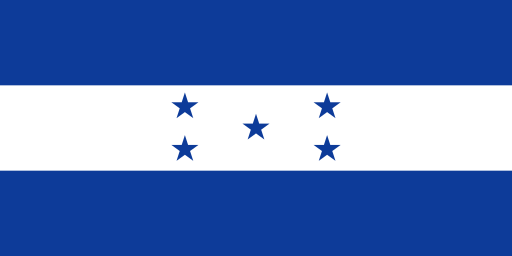
Flag of Honduras
Adopted in 1839, the flag of Honduras consists of three equal horizontal stripes of blue, white, and blue, with five blue stars arranged in an X pattern at the center. The blue stripes represent the surrounding oceans, the sky, and brotherhood, while the white symbolizes peace and prosperity, and the land between the ocean and the sea. The five stars reflect the historic unity of Central America.
Printable Honduras Flag (PNG Download)
Interesting facts about the Honduras flag
1. The five blue stars represent the five former members of the Federal Republic of Central America: Costa Rica, El Salvador, Guatemala, Honduras, and Nicaragua.
2. The five stars form a quincunx, which is a pattern of four stars surrounding a central star.
3. A 1949 decree officially specified turquoise blue, but the flag was widely produced in navy blue for decades.
4. The government began officially using turquoise blue in 2022, but the change was reversed in 2026.
5. The naval ensign includes the national coat of arms above an inverted arc of five stars.
Explore more about Honduras:
Evolution of the Honduras flag
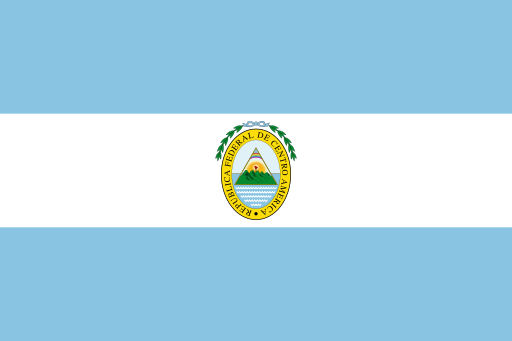
Flag of the Federal Republic of Central America (1823–1839)
Honduras used this blue–white–blue horizontal triband while it was part of the Federal Republic of Central America.
Bharata-indstar, CC BY-SA 4.0, via Wikimedia Commons
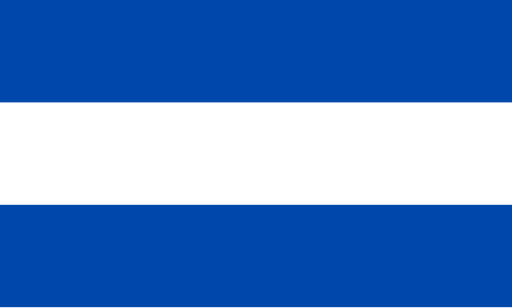
Plain triband of Honduras (1839–1866)
After the dissolution of the Central American federation, Honduras retained the blue–white–blue triband without stars.
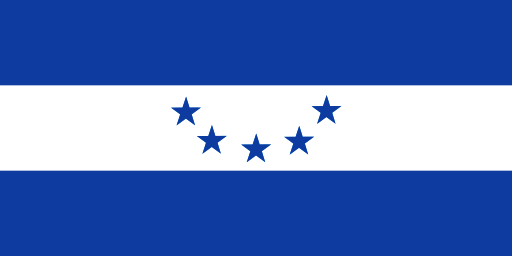
Five-star flag of Honduras (1866–1898, alternative arrangement)
After the addition of five stars in 1866, several layouts were used before the modern quincunx pattern became standardized.
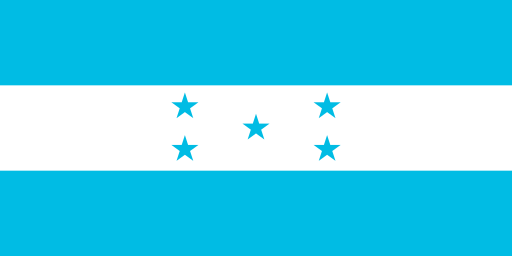
Turquoise version of the flag (2022–2026)
Between 2022 and 2026, the government officially used a lighter turquoise shade of blue.
History of the Honduras flag
Origins in the Central American Federation (1823–1839)
Honduras was part of the United Provinces of Central America, later called the Federal Republic of Central America, which used a blue–white–blue horizontal triband inspired by Argentina’s flag.
After the federation dissolved in 1838, Honduras continued using the plain triband without an emblem.
Addition of the five stars (1866)
On 16 February 1866, President José María Medina modified the national flag by adding five blue stars to the center white stripe.
The stars represented the five original member states of the former Central American federation and the hope of future Central American unity.
Different star arrangements were used during the late 19th century before the modern quincunx layout became standardized.
Greater Republic of Central America (1896–1898)
Between 1896 and 1898, Honduras joined the Greater Republic of Central America, a short-lived political union.
Although Honduras retained its national flag, some unofficial versions during this period displayed gold stars, though this was never officially adopted.
Standardization and the 1949 decree
On 26 January 1949, President Juan Manuel Gálvez officially confirmed the position of the five stars and specified turquoise blue as the official shade.
Despite this decree, navy blue continued to be widely used in practice for many decades.
The blue color debate (2022–2026)
In 2022, following recommendations from the National Autonomous University of Honduras, the government began officially using turquoise blue on the national flag in accordance with the 1949 decree.
However, in 2026, the National Congress reverted to the darker navy blue version.

Caitriona Maria is an education writer and owner of The Facts Institute. With seven years of teaching experience and a background in educational content, she specialises in creating clear reference resources about countries, geography and global topics.