A brief overview of the meaning, history, and key facts about the national flag of Argentina.
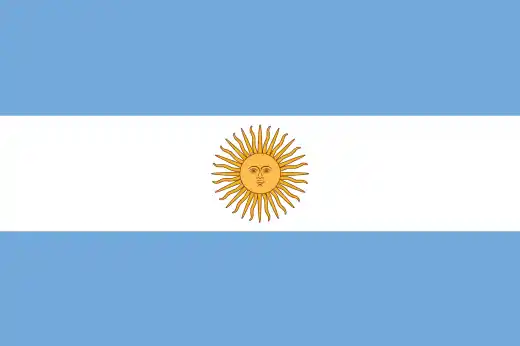
Flag of Argentina
Adopted in 1816, the flag of Argentina features a horizontal triband of pale blue, white, and pale blue, with the Sun of May in the center. The Sun of May has thirty-two rays, alternating between straight and wavy. The colors are commonly said to represent the sky and clouds, while the Sun of May signifies the May Revolution of 1810.
Printable Argentina Flag (PNG Download)
Interesting facts about the Argentine flag
1. There has been much debate about the original shade of blue used in the first Argentine flag. One of the oldest surviving Argentine flags (from 1814) wasn’t originally the pale sky blue seen today. Scientific testing found the blue stripes were made from lapis lazuli, which was a rare, expensive stone used in Renaissance art, meaning the early flag was likely a deep, rich royal blue.
2. The flag was first raised at the city of Rosario in 1812 on the banks of the Paraná River, during the War of Independence, though it wasn’t dedicated as the national flag until 1816.
3. According to tradition, the Sun of May was added to the flag to commemorate the May Revolution of 1810, when the sun is said to have broken through the clouds as independence supporters gathered in Buenos Aires.
4. The design of the Sun of May is also linked to earlier Indigenous symbolism and is commonly associated with Inti, the Inca sun god.
5. It wasn’t until 1985 that citizens were granted the right to fly the Argentine flag with the Sun of May. Up until then, only the government and military could fly this flag.
6. The Argentine flag influenced the design of several Central American flags— Costa Rica, El Salvador, Guatemala, Honduras and Nicaragua.
7. Uruguay took heavy inspiration from the Argentine flag, with its flag also featuring horizontal blue and white stripes with the iconic Sun of May.
8. Argentina celebrates Flag Day every year on June 20 to honor General Manuel Belgrano, the creator of the flag.
Explore more about Argentina:
Official (state) vs civil version

Civil flag of Argentina
The civil flag consists of three equal horizontal stripes of light blue, white, and light blue, without the Sun of May in the center.
Historically, the Civil Flag of Argentina was reserved for civilian use, while the flag featuring the Sun of May was used by the government and military. Since 1985, Argentine citizens have been permitted to use either version.
History of the Argentine flag
The Argentine flag was created during the War of Independence against Spanish rule. In 1812, General Manuel Belgrano designed a new banner using blue and white — the same colors as the recently adopted national cockade.
He first raised the flag on February 27, 1812, on the banks of the Paraná River in Rosario. At the time, the revolutionary government had not yet formally broken ties with Spain and was still claiming loyalty to the captive King Ferdinand VII, so the flag was not immediately approved.
Despite initial resistance from the First Triumvirate, the blue-and-white flag continued to be used by patriot forces.
Official adoption (1816–1818)
After the Declaration of Independence on July 9, 1816, the Congress of Tucumán officially recognized Belgrano’s design as the national flag of the United Provinces of the Río de la Plata.
In 1818, a golden “Sun of May” was added to the center, based on the design of Argentina’s first national coin.
Political changes and color debates (19th century)
During the 19th century, the flag’s appearance underwent several modifications during periods of political conflict between Federalists and Unitarians. Variations in the shade of blue, the inclusion of red elements, and different versions of the Sun were used at various times.
By the early 20th century, light blue and white were firmly established as Argentina’s official national colors, although precise technical specifications were defined later.
Modern regulations (20th–21st century)
For many decades, only government institutions and the military were permitted to fly the version featuring the Sun of May. Civilians were required to use a plain blue-and-white version without the emblem.
In 1985, a new law granted all citizens the right to display the official flag with the Sun. Today, both versions are recognized as national flags, though the sun-bearing design remains the official state and ceremonial flag.

Caitriona Maria is an education writer and owner of The Facts Institute. With seven years of teaching experience and a background in educational content, she specialises in creating clear reference resources about countries, geography and global topics.