A brief overview of the meaning, history, and key facts about the national flag of Uruguay.
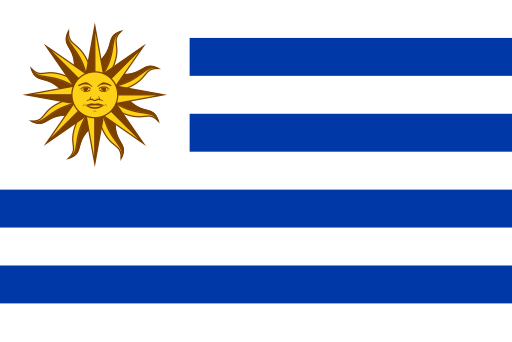
Flag of Uruguay
Adopted in 1830, Uruguay’s flag consists of nine alternating horizontal stripes of white and blue, with a white canton in the upper hoist corner that contains the Sun of May. The nine stripes represent the original departments of Uruguay. The Sun of May is a national symbol associated with independence and appears on several South American flags.
Printable Uruguay Flag (PNG Download)
Interesting facts about Uruguay’s flag
1. Uruguay’s flag was first adopted in 1828, the same year Uruguay was established as an independent state.
2. The original flag had nineteen alternating stripes, but the design was modified to include nine alternating white and blue stripes representing the nine original departments of Uruguay.
3. The sun in the canton is known as the Sun of May, a symbol associated with the May Revolution of 1810 in Buenos Aires.
4. The Sun of May features a human face with sixteen alternating straight and wavy rays.
5. Uruguay’s flag design was inspired by the flag of the United States, which also uses stripes and a canton.
6. During the 19th century the design of the sun varied because early laws did not specify its exact appearance.
7. In addition to the national flag, Uruguay officially recognizes two other historical flags: the Artigas flag and the flag of the Treinta y Tres, both declared national symbols in 1952.
Explore more about Uruguay:
Evolution of Uruguay’s flag
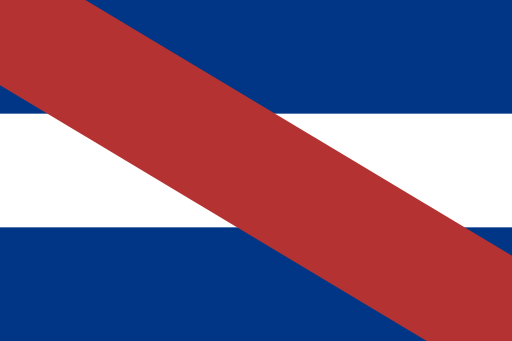
Artigas flag (1815)
The Artigas flag consists of a blue–white–blue triband with a red diagonal stripe and remains one of Uruguay’s national symbols today.
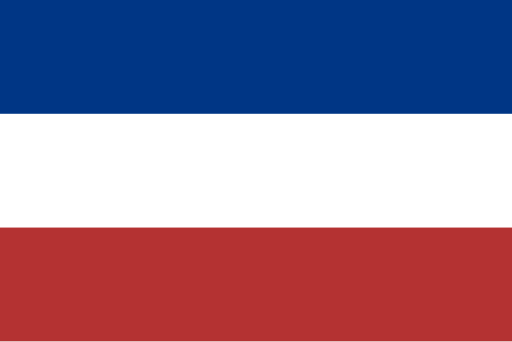
Eastern Province flag (1825)
During the independence movement against Brazil, the Eastern Province used a flag consisting of three horizontal stripes of blue, white, and red.
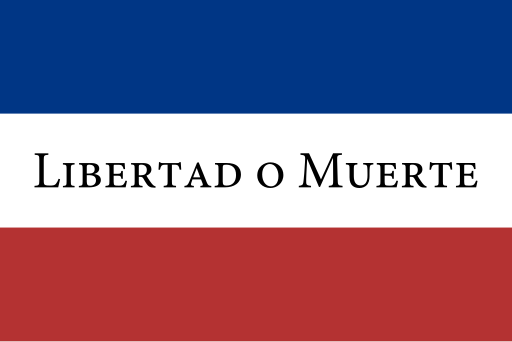
Bandera de los Treinta y Tres Orientales (1825)
This revolutionary flag known as the Thirty-Three Orientals, consists of three horizontal stripes of blue, white, and red with the inscription “Libertad o Muerte” (“Liberty or Death”) in the center.
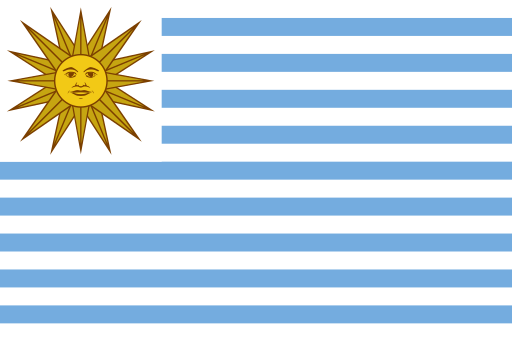
First national flag of Uruguay (1828–1830)
The first national flag featured nine horizontal light-blue stripes on a white background, with a white canton containing a sun.
Goldsztern, CC BY-SA 2.5, via Wikimedia Commons
History of Uruguay’s flag
Creation of the national flag (1828–1830)
Uruguay’s national flag was first established on December 16, 1828, by the Constituent Assembly of the newly created Eastern State of Uruguay. The original design consisted of a white field with nine light-blue stripes on white, resulting in 19 alternating stripes, and a white canton containing a sun.
Shortly before the swearing-in of the country’s first Constitution in 1830, the design was modified. The number of blue stripes was reduced so that the flag displayed nine alternating white and blue stripes in total, representing the nine original departments of Uruguay.
Early influences
Before the creation of the national flag, several banners were used during the independence period. One of the most important was the Artigas flag, associated with the revolutionary leader José Gervasio Artigas and the Federal League.
Another flag used during the struggle for independence was adopted in 1825 and consisted of three horizontal stripes: blue, white, and crimson.
The flag of the Treinta y Tres Orientales, which featured three horizontal stripes of blue, white, and red with the inscription “Libertad o Muerte” (“Liberty or Death”), was used by the revolutionary group that launched the 1825 uprising against Brazilian rule.
When the Eastern Province joined the United Provinces of the Río de la Plata in 1826, the Argentine flag replaced it until Uruguay became independent.
Evolution of the flag design
During the first century of Uruguay’s independence, the appearance of the national flag showed some variation, mainly in the design of the Sun of May and in the number and color of the stripes.
The blue stripes were often rendered in a pale sky-blue tone, although the exact shade could vary. During the Uruguayan Civil War in the mid-19th century, rival governments used different shades of blue.
Forces loyal to the National Party under Manuel Oribe used a darker blue version, while forces loyal to the Colorado Party defending Montevideo under Fructuoso Rivera used a lighter blue version.
The design of the Sun of May also varied because early laws did not define its exact appearance. In many flags the sun was depicted with a human face and multiple rays, but the precise design differed.
Standardization of the modern flag
A regulatory decree issued on February 18, 1952 established more precise rules for the design of the flag. The decree specified that the Sun of May should appear as a radiant circle with a face, surrounded by sixteen rays.
The same decree also confirmed the official status of two additional national symbols: the Artigas flag and the flag of the Treinta y Tres.

Caitriona Maria is an education writer and owner of The Facts Institute. With seven years of teaching experience and a background in educational content, she specialises in creating clear reference resources about countries, geography and global topics.