A brief overview of the meaning, history, and key facts about the national flag of Sudan.

Flag of Sudan
Adopted in 1970, Sudan’s flag consists of red, white, and black horizontal stripes with a green triangle at the hoist. Black symbolizes the country’s strong ancestors, white represents peace and purity, red symbolizes the blood of martyrs, and green represents fertility and growth.
Printable Sudan Flag (PNG Download)
Interesting facts about Sudan’s flag
1. The red, white, black, and green colors are known as the pan-Arab colors, which appear on the flags of several Arab countries including Egypt, Iraq, Syria, and Yemen.
2. From 1956 to 1970, Sudan used a flag with horizontal blue, yellow, and green stripes, representing the Nile River, the Sahara desert, and agriculture.
3. The name “Sudan” comes from the Arabic phrase Bilād as-Sūdān, meaning “Land of the Black people.” The black stripe on the flag is sometimes associated with the country’s name.
4. The flag adopted in 1970 reflected Sudan’s growing alignment with Arab nationalism at the time.
Explore more about Sudan:
Evolution of Sudan’s flag

Mahdist banner (1881–1899)
The Black Banner, or the Black Standard, was a prominent flag used by Mahdist forces during the Mahdist uprising in Sudan.
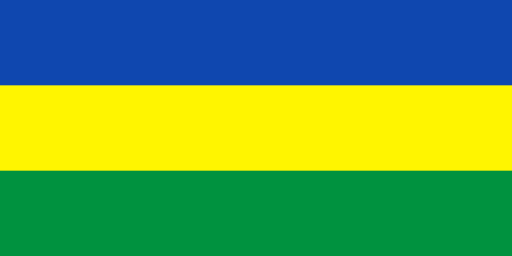
Flag of Sudan (1956–1970)
Sudan’s first national flag after independence featured horizontal stripes of blue, yellow, and green representing the Nile River, the desert, and agriculture.
History of Sudan’s flag
Mahdist flags (1881–1899)
During the Mahdist War, which began in 1881, the Sudanese religious leader Muhammad Ahmad al-Mahdi used various banners during his uprising against Egyptian and British rule.
Different Mahdist commanders carried flags of different colors, including a prominent black banner used by Abdallahi ibn Muhammad, one of the Mahdi’s leading commanders.
This black flag later influenced the symbolism of the black stripe on the modern Sudanese flag, which is sometimes associated with the Mahdist resistance.
Anglo-Egyptian Sudan (1899–1956)
After the fall of the Mahdist state in 1899, Sudan came under joint British and Egyptian administration, known as the Anglo-Egyptian Sudan.
During this period, Sudan did not have its own national flag. Instead, the flags of the United Kingdom and Egypt were flown together to represent the condominium government.
A special flag did exist for the British Governor-General of Sudan, which consisted of a Union Flag with a white disk containing the words “Governor General of the Sudan.”
In 1955, Sudan was represented at the Afro–Asian Conference by a temporary white flag bearing the word “SUDAN” in red letters.
Independence flag (1956–1970)
Sudan gained independence on 1 January 1956. Upon independence, the country adopted its first national flag: a horizontal tricolour of blue, yellow, and green.
The flag was designed by Macki Sufi, a Sudanese visual artist and poet, and remained in use for fourteen years.
Adoption of the current flag (1970–present)
Following a military coup in 1969, Sudan was renamed the Democratic Republic of Sudan. A competition was held to design a new national flag.
The winning design, created by artist Abdel Rahman Ahmed Al-Jali, was adopted in May 1970.
The new flag introduced the Pan-Arab colors: red, white, black, and green. It consists of three horizontal stripes of red, white, and black with a green triangle at the hoist.
The flag has remained in use since 1970.

Caitriona Maria is an education writer and owner of The Facts Institute. With seven years of teaching experience and a background in educational content, she specialises in creating clear reference resources about countries, geography and global topics.