A brief overview of the meaning, history, and key facts about the national flag of India.

Flag of India
Adopted in 1947, India’s flag consists of three horizontal stripes of saffron, white, and green with a 24-spoked blue chakra (wheel) in the center. The colors represent courage and strength (saffron), peace and truth (white), and fertility, growth and the prosperity of the land (dark green). The spoked wheel is the “Ashoka Chakra.”
Printable India Flag (PNG Download)
Interesting facts about the Indian flag
1. In India, the national flag is often referred to as Tiranga, which means “tricolor,” reflecting its three horizontal bands of saffron, white, and green.
2. The navy blue wheel in the center of India’s flag is called the Ashoka Chakra. It is based on an ancient stone carving during the reign of Emperor Ashoka in the 3rd century BC.
3. The Ashoka Chakra is derived from the Dharma Chakra, an ancient symbol associated with moral law and righteousness in Indian tradition. The chakra is often expressed through the idea that “there is life in movement and death in stagnation.”
4. India’s present flag was formally adopted on July 22, 1947, less than a month before independence from British rule on August 15, 1947.
5. Until 2021, Indian law required that the national flag be made exclusively from khadi, a hand-spun fabric promoted by Mahatma Gandhi.
6. For many years, private citizens were only allowed to display the flag on specific national holidays. This changed in 2002 after a Supreme Court ruling allowed broader public use.
Explore more about India:
Evolution of the Indian flag
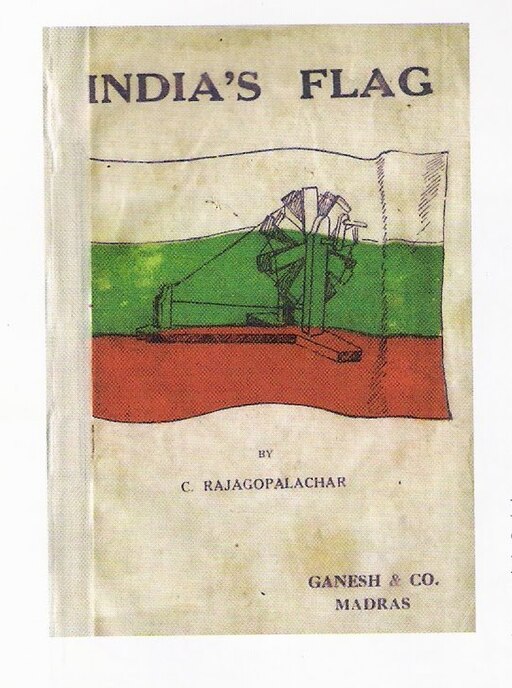
Swaraj flag (1921 proposal)
This early tricolor featured a spinning wheel (charkha) at its center. The charkha symbolized self-reliance and resistance to British economic control.
Bharata-indstar, CC BY-SA 4.0, via Wikimedia Commons
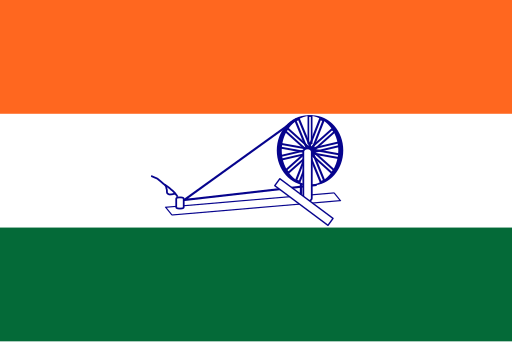
Indian National Congress flag (1931)
This version standardized the saffron, white, and green tricolor with the spinning wheel at the center. It became the principal symbol of the Indian independence movement before 1947.
History of the Indian flag
Origins in the independence movement (early 1900s–1931)
A wide range of proposed flags appeared during the independence movement, but many struggled to represent India’s full diversity.
A major breakthrough came when Mahatma Gandhi promoted a simple flag design centered on the charkha (spinning wheel).
This evolved into the Congress “Swaraj” flag, which became widely recognized as a national symbol before independence.
The shift toward a national flag (1947)
As independence approached, India’s Constituent Assembly moved to adopt a flag that would be acceptable to all communities and free of “communal” meaning.
On July 22, 1947, the Assembly adopted the current tricolor in saffron, white, and green.
The charkha was replaced with the Ashoka Chakra to represent dharma (moral law) and to create a balanced, symmetrical design.
From Dominion to Republic (1947–1950)
The tricolor became the official flag on August 15, 1947, when India became independent.
It continued unchanged when India became a republic on January 26, 1950.
Rules, materials, and modern use (post-1950)
India’s Flag Code sets rules for respectful display and use. For many years, only khadi flags were permitted by law.
Over time, court decisions and government amendments gradually expanded the public’s right to fly the flag, including updated rules in the 21st century.

Caitriona Maria is an education writer and owner of The Facts Institute. With seven years of teaching experience and a background in educational content, she specialises in creating clear reference resources about countries, geography and global topics.