A brief overview of the meaning, history, and key facts about the national flag of Chile.

Flag of Chile
Adopted in 1817, the national flag of Chile consists of two horizontal bands of white and red, with a blue square in the upper left corner bearing a white five-pointed star. The most common interpretation links blue to the sky and the Pacific Ocean, white to the snow-covered Andes Mountains, and red to the sacrifices made during the struggle for independence. The single white star represents the three branches of government—Executive, Legislative, and Judicial—which uphold the nation’s unity and stability.
Printable Chile Flag (PNG Download)
Interesting facts about the Chilean flag
1. The flag is known as the Flag of the Lone Star, or La Estrella Solitaria.
2. The white star on Chile’s flag was originally placed using proportions based on the “golden ratio,” a mathematical principle often associated with visual harmony and balance. This meant the star’s position and size were carefully calculated rather than placed arbitrarily.
3. Some interpretations suggest that the lone star reflects Chile’s unitary form of government, in contrast to federal states such as the United States, whose flag features multiple stars.
4. According to historical accounts, the single white star was also intended to reflect the legacy of the Mapuche people, on the instruction of Bernardo O’Higgins.
5. Some historians trace the flag’s colors back to the Mapuche resistance during the Arauco War against Spanish rule. References in the 16th-century epic poem La Araucana describe Mapuche leaders using blue, white, and red banners, while the single star is sometimes linked to the “Star of Arauco,” a symbol associated with Mapuche identity.
6. The current Chilean flag was introduced by legal decree in 1817, and was first officially used during the Declaration of Independence in early 1818.
7. Chile celebrates National Flag Day on July 9, commemorating the Battle of La Concepción (1882), where 77 Chilean soldiers chose to fight to the death rather than lower the national flag during the War of the Pacific.
8. Every year on July 9 or 10, members of the Chilean Armed Forces formally swear allegiance to the national flag in a public ceremony.
Explore more about Chile:
Evolution of the Chilean flag
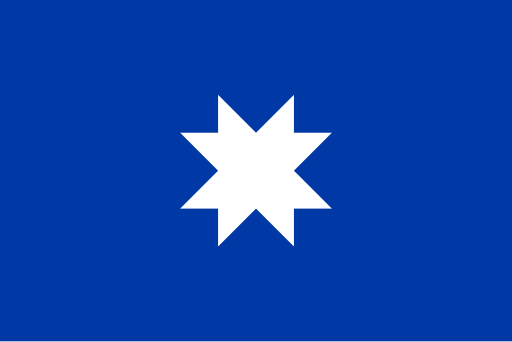
Mapuche Banner (Arauco War Era)
Historical accounts describe Mapuche leaders using blue and white emblems featuring a star symbol during resistance against Spanish rule. The star, known as the guñelve or “Star of Arauco,” is associated with the planet Venus.
Al2, CC BY 3.0, via Wikimedia Commons
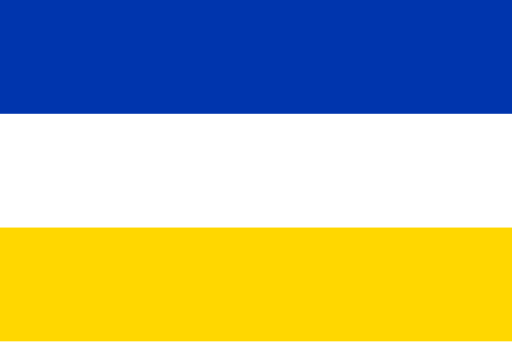
Flag of the Patria Vieja (1812–1814)
This flag featured three horizontal stripes of blue, white, and yellow. It is widely regarded as Chile’s first national flag and was flown during the Patria Vieja era before Spanish rule was re-established in 1814.
B1mbo, CC BY-SA 4.0, via Wikimedia Commons
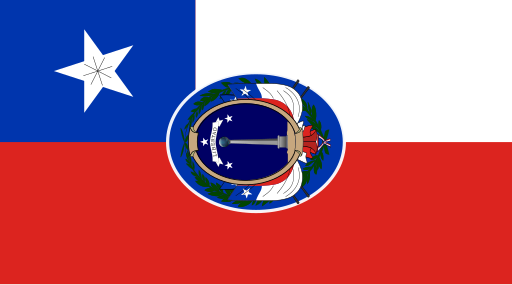
Early National Flag with Coat of Arms (1817)
The original 1817 design of Chile’s current flag included a white star in the blue canton and the national coat of arms displayed prominently across the center.
B1mbo, CC BY-SA 3.0, via Wikimedia Commons
History of the Chilean flag
Indigenous origins and early symbols (pre-1810)
Long before Chile’s independence, blue, white, and red banners were associated with Mapuche resistance during the Arauco War against Spanish rule. In the 16th-century epic poem La Araucana, Mapuche leaders are described carrying emblems in these colors.
One prominent symbol was the guñelve, also known as the “Star of Arauco”, associated with the morning star, Venus. Some historical interpretations link this indigenous symbol to the design of Chile’s modern flag.
During the colonial period, Spanish forces used various imperial banners, including the Cross of Burgundy and later the red-and-yellow naval flag of Spain introduced in the late 18th century.
The flag of the Patria Vieja (1812–1814)
Chile’s first national flag emerged during the early independence movement known as the Patria Vieja (“Old Fatherland”). Adopted in 1812 under the leadership of José Miguel Carrera, it featured three horizontal stripes of blue, white, and yellow.
After Spanish forces regained control in 1814, this flag was abolished and Spanish symbols were restored.
The flag of the transition (1817)
Following patriot victories in 1817, a new tricolor flag of blue, white, and red was adopted. Known as the Flag of the Transition, it replaced the earlier yellow stripe with red, symbolizing the blood shed during the struggle for independence.
However, this version closely resembled other European tricolors, including that of the Netherlands and revolutionary France, and it was short-lived.
Adoption of the current flag (1817–1818)
Chile’s present flag was officially adopted by decree on October 18, 1817. It was first used publicly during the Declaration of Independence ceremony on February 12, 1818.
The original 1817 design incorporated proportions based on the golden ratio. Early versions also included the national coat of arms in the center.
Due to construction difficulties, these intricate details were gradually simplified. The star was later standardized in an upright position without additional interior markings.
Standardization and modern regulation (19th–20th centuries)
In 1854, the flag’s proportions were formally defined, establishing the 2:3 height-to-length ratio. In 1912, the diameter of the star and additional design specifications were officially standardized.
Further regulations were consolidated in 1967 through Supreme Decree No. 1534, which formally defined Chile’s national emblems.
National Flag Day
Chile celebrates National Flag Day on July 9. The date commemorates the Battle of La Concepción (1882), during which 77 Chilean soldiers chose to fight to the death rather than lower the national flag.
On this day, members of the Chilean Armed Forces swear allegiance to the flag in formal ceremonies across the country.

Caitriona Maria is an education writer and owner of The Facts Institute. With seven years of teaching experience and a background in educational content, she specialises in creating clear reference resources about countries, geography and global topics.