A brief overview of the meaning, history, and key facts about the national flag of the Netherlands.
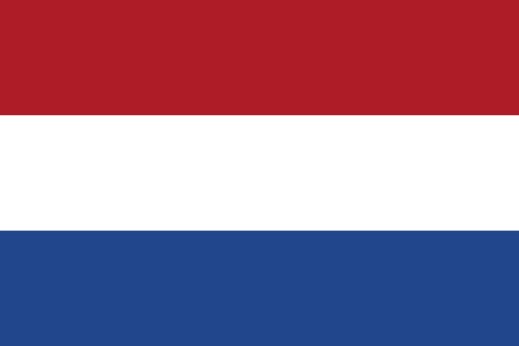
Netherlands flag
The national flag of the Netherlands consists of three equal horizontal stripes of red, white, and blue.
Printable Netherlands Flag (PNG Download)
Interesting facts about the Netherlands’ flag
1. The design evolved from the earlier “Prince’s Flag”, which featured orange, white, and blue colors.
2. During the seventeenth century, the orange stripe was gradually replaced by red, creating the design used today.
3. On King’s Day and certain royal birthdays, the Dutch flag is flown together with an orange pennant in honor of the Dutch royal family and the House of Orange.
4. The modern colors of the Dutch flag were formally defined by royal decree in 1937. In 1958, the shades were specified more precisely as bright vermilion red and cobalt blue.
5. Its red, white, and blue horizontal tricolor is similar in layout to the flag of Luxembourg, though the two flags use different shades.
6. In the Netherlands, it is traditional for families to fly the national flag with a school bag attached to the flagpole to celebrate a student’s graduation.
Evolution of the Netherlands’ flag

Prince’s Flag (c. 1572–17th century)
The earliest version of the Dutch national flag was the Prince’s Flag (Prinsenvlag), consisting of horizontal orange, white, and blue stripes.
History of the Netherlands’ flag
Origins during the Dutch Revolt
The origins of the Dutch flag date to the second half of the sixteenth century, when the Dutch provinces revolted against Spanish rule.
The rebels were led by William of Orange, and the flag used by his supporters became known as the Prince’s Flag. It featured horizontal stripes of orange, white, and blue.
Transition to the modern tricolor
During the seventeenth century, the orange stripe was gradually replaced by red. Although the exact reason remains debated, the red-white-blue design eventually became the standard flag of the Dutch Republic.
The Dutch Republic gained formal recognition of its independence from Spain in 1648 following the end of the Eighty Years’ War.
French occupation and restoration
During most of the French period (1795–1813), the Dutch continued to use the red-white-blue tricolor.
Only during the period when the Netherlands was directly incorporated into the French Empire (1810–1813) did the French tricolor become the dominant official flag.
After French rule ended in 1813, the Dutch tricolor was restored.
Official adoption
Although the red-white-blue flag had been used for centuries, its colors were not formally defined until 19 February 1937, when Queen Wilhelmina issued a royal decree confirming the national flag as red, white and blue.
The flag has remained the national flag of the Netherlands ever since.

Caitriona Maria is an education writer and owner of The Facts Institute. With seven years of teaching experience and a background in educational content, she specialises in creating clear reference resources about countries, geography and global topics.